SUBSCRIBE TO OUR FREE NEWSLETTER
Daily news & progressive opinion—funded by the people, not the corporations—delivered straight to your inbox.
5
#000000
#FFFFFF
To donate by check, phone, or other method, see our More Ways to Give page.
Daily news & progressive opinion—funded by the people, not the corporations—delivered straight to your inbox.
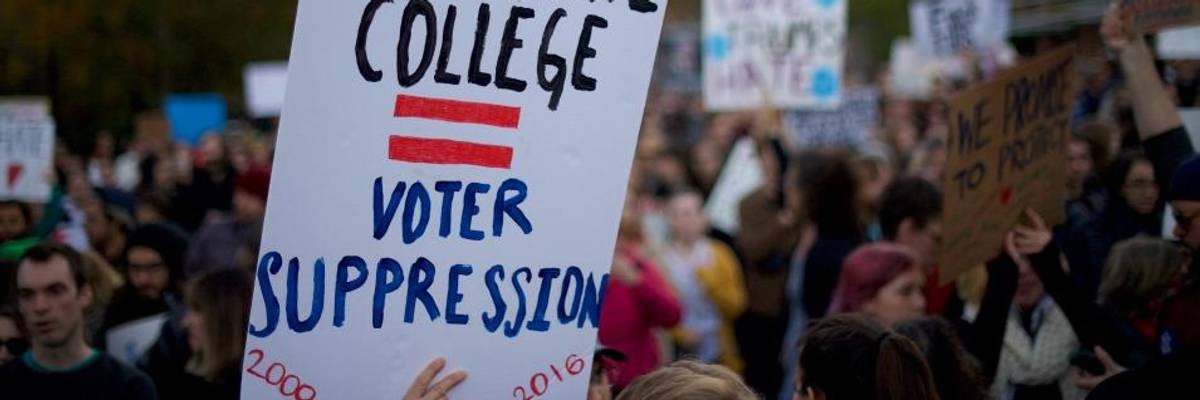
Protestors demonstrate against President-elect Donald Trump outside Independence Hall November 13, 2016 in Philadelphia, Pennsylvania. The Republican candidate lost the popular vote but won the electoral college. (Photo: Mark Makela/Getty Images)
In hopes of reforming the Electoral College to bring the U.S. closer to a "one person, one vote" system, a pro-democracy group celebrated a federal court decision on Thursday, as outside critics of the current voting process said the case reveals why the antiquated system should be abolished once and for all.
The decision could eventually bolster the case for the National Popular Vote Interstate Compact, in which states' electoral votes would go to the winner of the nationwide popular vote, instead of the winner of each states' popular vote in what Electoral College opponents call an unconstitutional system.
As the non-profit National Popular Vote Inc. says, "Existing winner-take-all laws are state laws--they are not part of the U.S. Constitution."
The judges handed down the decision in the case of Baca vs. Hickenlooper, brought by Micheal Baca, an elector in Colorado who in 2016 refused to cast his ballot for Hillary Clinton, the winner of the state's popular vote--acting as a so-called "faithless elector." The court ruled that the nation's 538 electors can vote for whomever they choose, rather than automatically giving their votes to the winner of their state's popular vote.
Equal Citizens, the group founded by Harvard law professor Lawrence Lessig, is working with Denver-based attorney Jason Wesoky to represent Baca.
"This is an incredibly thoughtful decision that could advance substantially our campaign to reform the Electoral College," Lessig told Fox 31, an affiliate station in Denver.
In 2016, Baca crossed out Clinton's name and wrote in Republican Gov. John Kasich of Ohio, after coordinating with a number of other electors in Colorado. If enough electors cast ballots for Republicans besides Trump, Baca reasoned, Trump would lose the electoral vote.
But the state invalidated his ballot and gave his vote to a different elector who agreed to vote for Clinton. In doing so, the appeals court ruled, the state violated the U.S. Constitution.
The court's decision contrasted with another ruling by Washington state's Supreme Court in another case brought by Equal Citizens. The court said in May that electors can be fined for failing to vote for the candidate chosen by the majority of voters in their state.
In other words, the whole legal battle over the Electoral College is complicated. And that's largely the point.
Critics of the Electoral College said both decisions only bolster the argument that the system must be replaced with one in which every voter's vote counts as a single vote, and candidates must win the approval of the majority of voters in order to become president.
Faithless electors? Let's get real; it's a faithless and outdated electoral college that must go away. Every American must feel their... https://t.co/YeX1Ys7uLR
-- Bob Witeck (@Bob_Witeck) August 22, 2019
While some saw the decision as one that could make way for electors to go against the majority of voters in their state, Equal Citizens Chief Counsel Jason Harrow viewed the ruling as a victory.
Harrow told Common Dreams that progressives' wariness over the 10th Circuit ruling is understandable, but that his organization is looking ahead to hopefully resolving how the Electoral College should operate--if at all--before the 2020 election.
"Win or lose, our clients wanted to highlight what the system really is," Harrow told Common Dreams. "If the system really says that they have the discretion as, the court said, the Constitution pretty much requires, that really could spur additional change and additional movement that would in some ways make a solution like the National Popular Vote stronger."
"In our view," he added, "the worst case scenario is status quo...Status quo means we don't know what role these electors play and it means we continue to be at risk of this crazy state of affairs where candidates campaign in all kinds of ways that are unfair."
Dear Common Dreams reader, It’s been nearly 30 years since I co-founded Common Dreams with my late wife, Lina Newhouser. We had the radical notion that journalism should serve the public good, not corporate profits. It was clear to us from the outset what it would take to build such a project. No paid advertisements. No corporate sponsors. No millionaire publisher telling us what to think or do. Many people said we wouldn't last a year, but we proved those doubters wrong. Together with a tremendous team of journalists and dedicated staff, we built an independent media outlet free from the constraints of profits and corporate control. Our mission has always been simple: To inform. To inspire. To ignite change for the common good. Building Common Dreams was not easy. Our survival was never guaranteed. When you take on the most powerful forces—Wall Street greed, fossil fuel industry destruction, Big Tech lobbyists, and uber-rich oligarchs who have spent billions upon billions rigging the economy and democracy in their favor—the only bulwark you have is supporters who believe in your work. But here’s the urgent message from me today. It's never been this bad out there. And it's never been this hard to keep us going. At the very moment Common Dreams is most needed, the threats we face are intensifying. We need your support now more than ever. We don't accept corporate advertising and never will. We don't have a paywall because we don't think people should be blocked from critical news based on their ability to pay. Everything we do is funded by the donations of readers like you. When everyone does the little they can afford, we are strong. But if that support retreats or dries up, so do we. Will you donate now to make sure Common Dreams not only survives but thrives? —Craig Brown, Co-founder |
In hopes of reforming the Electoral College to bring the U.S. closer to a "one person, one vote" system, a pro-democracy group celebrated a federal court decision on Thursday, as outside critics of the current voting process said the case reveals why the antiquated system should be abolished once and for all.
The decision could eventually bolster the case for the National Popular Vote Interstate Compact, in which states' electoral votes would go to the winner of the nationwide popular vote, instead of the winner of each states' popular vote in what Electoral College opponents call an unconstitutional system.
As the non-profit National Popular Vote Inc. says, "Existing winner-take-all laws are state laws--they are not part of the U.S. Constitution."
The judges handed down the decision in the case of Baca vs. Hickenlooper, brought by Micheal Baca, an elector in Colorado who in 2016 refused to cast his ballot for Hillary Clinton, the winner of the state's popular vote--acting as a so-called "faithless elector." The court ruled that the nation's 538 electors can vote for whomever they choose, rather than automatically giving their votes to the winner of their state's popular vote.
Equal Citizens, the group founded by Harvard law professor Lawrence Lessig, is working with Denver-based attorney Jason Wesoky to represent Baca.
"This is an incredibly thoughtful decision that could advance substantially our campaign to reform the Electoral College," Lessig told Fox 31, an affiliate station in Denver.
In 2016, Baca crossed out Clinton's name and wrote in Republican Gov. John Kasich of Ohio, after coordinating with a number of other electors in Colorado. If enough electors cast ballots for Republicans besides Trump, Baca reasoned, Trump would lose the electoral vote.
But the state invalidated his ballot and gave his vote to a different elector who agreed to vote for Clinton. In doing so, the appeals court ruled, the state violated the U.S. Constitution.
The court's decision contrasted with another ruling by Washington state's Supreme Court in another case brought by Equal Citizens. The court said in May that electors can be fined for failing to vote for the candidate chosen by the majority of voters in their state.
In other words, the whole legal battle over the Electoral College is complicated. And that's largely the point.
Critics of the Electoral College said both decisions only bolster the argument that the system must be replaced with one in which every voter's vote counts as a single vote, and candidates must win the approval of the majority of voters in order to become president.
Faithless electors? Let's get real; it's a faithless and outdated electoral college that must go away. Every American must feel their... https://t.co/YeX1Ys7uLR
-- Bob Witeck (@Bob_Witeck) August 22, 2019
While some saw the decision as one that could make way for electors to go against the majority of voters in their state, Equal Citizens Chief Counsel Jason Harrow viewed the ruling as a victory.
Harrow told Common Dreams that progressives' wariness over the 10th Circuit ruling is understandable, but that his organization is looking ahead to hopefully resolving how the Electoral College should operate--if at all--before the 2020 election.
"Win or lose, our clients wanted to highlight what the system really is," Harrow told Common Dreams. "If the system really says that they have the discretion as, the court said, the Constitution pretty much requires, that really could spur additional change and additional movement that would in some ways make a solution like the National Popular Vote stronger."
"In our view," he added, "the worst case scenario is status quo...Status quo means we don't know what role these electors play and it means we continue to be at risk of this crazy state of affairs where candidates campaign in all kinds of ways that are unfair."
In hopes of reforming the Electoral College to bring the U.S. closer to a "one person, one vote" system, a pro-democracy group celebrated a federal court decision on Thursday, as outside critics of the current voting process said the case reveals why the antiquated system should be abolished once and for all.
The decision could eventually bolster the case for the National Popular Vote Interstate Compact, in which states' electoral votes would go to the winner of the nationwide popular vote, instead of the winner of each states' popular vote in what Electoral College opponents call an unconstitutional system.
As the non-profit National Popular Vote Inc. says, "Existing winner-take-all laws are state laws--they are not part of the U.S. Constitution."
The judges handed down the decision in the case of Baca vs. Hickenlooper, brought by Micheal Baca, an elector in Colorado who in 2016 refused to cast his ballot for Hillary Clinton, the winner of the state's popular vote--acting as a so-called "faithless elector." The court ruled that the nation's 538 electors can vote for whomever they choose, rather than automatically giving their votes to the winner of their state's popular vote.
Equal Citizens, the group founded by Harvard law professor Lawrence Lessig, is working with Denver-based attorney Jason Wesoky to represent Baca.
"This is an incredibly thoughtful decision that could advance substantially our campaign to reform the Electoral College," Lessig told Fox 31, an affiliate station in Denver.
In 2016, Baca crossed out Clinton's name and wrote in Republican Gov. John Kasich of Ohio, after coordinating with a number of other electors in Colorado. If enough electors cast ballots for Republicans besides Trump, Baca reasoned, Trump would lose the electoral vote.
But the state invalidated his ballot and gave his vote to a different elector who agreed to vote for Clinton. In doing so, the appeals court ruled, the state violated the U.S. Constitution.
The court's decision contrasted with another ruling by Washington state's Supreme Court in another case brought by Equal Citizens. The court said in May that electors can be fined for failing to vote for the candidate chosen by the majority of voters in their state.
In other words, the whole legal battle over the Electoral College is complicated. And that's largely the point.
Critics of the Electoral College said both decisions only bolster the argument that the system must be replaced with one in which every voter's vote counts as a single vote, and candidates must win the approval of the majority of voters in order to become president.
Faithless electors? Let's get real; it's a faithless and outdated electoral college that must go away. Every American must feel their... https://t.co/YeX1Ys7uLR
-- Bob Witeck (@Bob_Witeck) August 22, 2019
While some saw the decision as one that could make way for electors to go against the majority of voters in their state, Equal Citizens Chief Counsel Jason Harrow viewed the ruling as a victory.
Harrow told Common Dreams that progressives' wariness over the 10th Circuit ruling is understandable, but that his organization is looking ahead to hopefully resolving how the Electoral College should operate--if at all--before the 2020 election.
"Win or lose, our clients wanted to highlight what the system really is," Harrow told Common Dreams. "If the system really says that they have the discretion as, the court said, the Constitution pretty much requires, that really could spur additional change and additional movement that would in some ways make a solution like the National Popular Vote stronger."
"In our view," he added, "the worst case scenario is status quo...Status quo means we don't know what role these electors play and it means we continue to be at risk of this crazy state of affairs where candidates campaign in all kinds of ways that are unfair."