SUBSCRIBE TO OUR FREE NEWSLETTER
Daily news & progressive opinion—funded by the people, not the corporations—delivered straight to your inbox.
5
#000000
#FFFFFF
To donate by check, phone, or other method, see our More Ways to Give page.
Daily news & progressive opinion—funded by the people, not the corporations—delivered straight to your inbox.
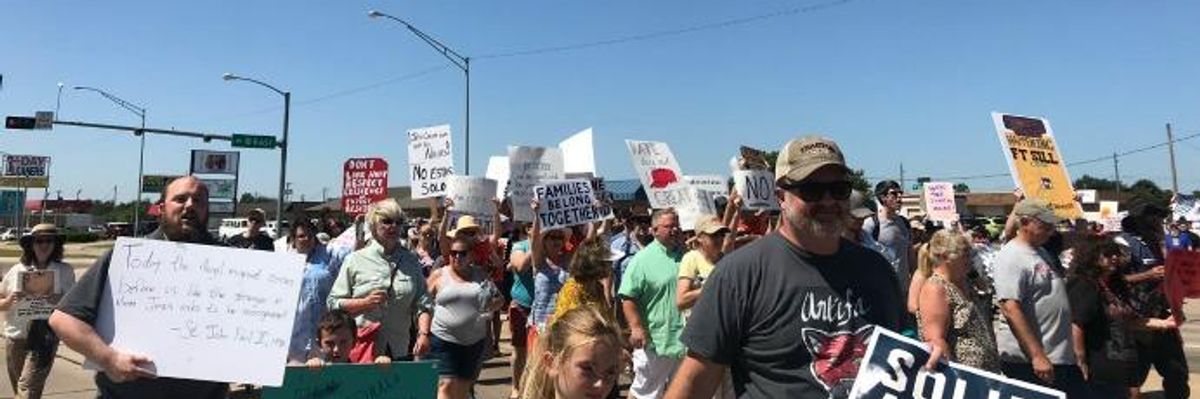
Immigrant rights advocates marched to Fort Sill in Lawton, Oklahoma on Saturday, July 20, 2019. (Photo: United We Dream via Twitter)
Hundreds of activists rallied in over 100deg heat in Lawton, Oklahoma on Saturday to demand the Trump administration stop the incarceration of asylum-seeking children.
"Close the camps!" the crowd of protesters shouted on their march to Fort Sill.
While the broad array of groups behind the action, including United We Dream, have voiced outrage over the detention camps broadly, the administration's plan to recycle Fort Sill as a detention site for roughly 1,400 migrant children currently at Customs and Border Patrol facilities in Texas--as soon as next month--has generated specific concerns given military post's history, spurring several protests already.
As the Close the Camps website says in call-to-action,
Fort Sill is the same place where 700 Japanese Americans were detained and tortured during World War II. This is the same location where indigenous people of the Apache nation were imprisoned, and separated from their families while generations of indigenous youth were forced to assimilate at the fort's boarding school.
Writer and law professor Mari Matsuda recently wrote of the site's dark past well, noting,
"This is not who we are" is belied by the history of the military base. Located on the plains to impose order in a time of settler ascendency, Fort Sill presided over the displacement of native people. The great Apache chief Geronimo and families from his tribe were imprisoned for years at Fort Sill--the first instance of child incarceration there.
"Fort Sill is not an anomaly, but it is a reminder of the ongoing violences of settler colonialism, racism, and xenophobia that have defined far too much of our nation's history," Densho, an organization that fosters education about the WWII internment camps, said last week.
"We must stop repeating history," said the ACLU of Oklahoma in a tweet promoting Saturday's action.
The protesters also focused on Oklahoma Gov. Kevin Stitt, a Republican. They are demanding he stop enabling Trump's anti-immigrant agenda and get ICE out of Oklahoma, according to a press statement from the Indigenous Environmental Network.
"Now we see our speaking up is not enough," Tom Ikeda, exuctive director of Densho, said recently. "We have to start going to the streets."
Dear Common Dreams reader, It’s been nearly 30 years since I co-founded Common Dreams with my late wife, Lina Newhouser. We had the radical notion that journalism should serve the public good, not corporate profits. It was clear to us from the outset what it would take to build such a project. No paid advertisements. No corporate sponsors. No millionaire publisher telling us what to think or do. Many people said we wouldn't last a year, but we proved those doubters wrong. Together with a tremendous team of journalists and dedicated staff, we built an independent media outlet free from the constraints of profits and corporate control. Our mission has always been simple: To inform. To inspire. To ignite change for the common good. Building Common Dreams was not easy. Our survival was never guaranteed. When you take on the most powerful forces—Wall Street greed, fossil fuel industry destruction, Big Tech lobbyists, and uber-rich oligarchs who have spent billions upon billions rigging the economy and democracy in their favor—the only bulwark you have is supporters who believe in your work. But here’s the urgent message from me today. It's never been this bad out there. And it's never been this hard to keep us going. At the very moment Common Dreams is most needed, the threats we face are intensifying. We need your support now more than ever. We don't accept corporate advertising and never will. We don't have a paywall because we don't think people should be blocked from critical news based on their ability to pay. Everything we do is funded by the donations of readers like you. When everyone does the little they can afford, we are strong. But if that support retreats or dries up, so do we. Will you donate now to make sure Common Dreams not only survives but thrives? —Craig Brown, Co-founder |
Hundreds of activists rallied in over 100deg heat in Lawton, Oklahoma on Saturday to demand the Trump administration stop the incarceration of asylum-seeking children.
"Close the camps!" the crowd of protesters shouted on their march to Fort Sill.
While the broad array of groups behind the action, including United We Dream, have voiced outrage over the detention camps broadly, the administration's plan to recycle Fort Sill as a detention site for roughly 1,400 migrant children currently at Customs and Border Patrol facilities in Texas--as soon as next month--has generated specific concerns given military post's history, spurring several protests already.
As the Close the Camps website says in call-to-action,
Fort Sill is the same place where 700 Japanese Americans were detained and tortured during World War II. This is the same location where indigenous people of the Apache nation were imprisoned, and separated from their families while generations of indigenous youth were forced to assimilate at the fort's boarding school.
Writer and law professor Mari Matsuda recently wrote of the site's dark past well, noting,
"This is not who we are" is belied by the history of the military base. Located on the plains to impose order in a time of settler ascendency, Fort Sill presided over the displacement of native people. The great Apache chief Geronimo and families from his tribe were imprisoned for years at Fort Sill--the first instance of child incarceration there.
"Fort Sill is not an anomaly, but it is a reminder of the ongoing violences of settler colonialism, racism, and xenophobia that have defined far too much of our nation's history," Densho, an organization that fosters education about the WWII internment camps, said last week.
"We must stop repeating history," said the ACLU of Oklahoma in a tweet promoting Saturday's action.
The protesters also focused on Oklahoma Gov. Kevin Stitt, a Republican. They are demanding he stop enabling Trump's anti-immigrant agenda and get ICE out of Oklahoma, according to a press statement from the Indigenous Environmental Network.
"Now we see our speaking up is not enough," Tom Ikeda, exuctive director of Densho, said recently. "We have to start going to the streets."
Hundreds of activists rallied in over 100deg heat in Lawton, Oklahoma on Saturday to demand the Trump administration stop the incarceration of asylum-seeking children.
"Close the camps!" the crowd of protesters shouted on their march to Fort Sill.
While the broad array of groups behind the action, including United We Dream, have voiced outrage over the detention camps broadly, the administration's plan to recycle Fort Sill as a detention site for roughly 1,400 migrant children currently at Customs and Border Patrol facilities in Texas--as soon as next month--has generated specific concerns given military post's history, spurring several protests already.
As the Close the Camps website says in call-to-action,
Fort Sill is the same place where 700 Japanese Americans were detained and tortured during World War II. This is the same location where indigenous people of the Apache nation were imprisoned, and separated from their families while generations of indigenous youth were forced to assimilate at the fort's boarding school.
Writer and law professor Mari Matsuda recently wrote of the site's dark past well, noting,
"This is not who we are" is belied by the history of the military base. Located on the plains to impose order in a time of settler ascendency, Fort Sill presided over the displacement of native people. The great Apache chief Geronimo and families from his tribe were imprisoned for years at Fort Sill--the first instance of child incarceration there.
"Fort Sill is not an anomaly, but it is a reminder of the ongoing violences of settler colonialism, racism, and xenophobia that have defined far too much of our nation's history," Densho, an organization that fosters education about the WWII internment camps, said last week.
"We must stop repeating history," said the ACLU of Oklahoma in a tweet promoting Saturday's action.
The protesters also focused on Oklahoma Gov. Kevin Stitt, a Republican. They are demanding he stop enabling Trump's anti-immigrant agenda and get ICE out of Oklahoma, according to a press statement from the Indigenous Environmental Network.
"Now we see our speaking up is not enough," Tom Ikeda, exuctive director of Densho, said recently. "We have to start going to the streets."