

SUBSCRIBE TO OUR FREE NEWSLETTER
Daily news & progressive opinion—funded by the people, not the corporations—delivered straight to your inbox.
5
#000000
#FFFFFF
To donate by check, phone, or other method, see our More Ways to Give page.
Daily news & progressive opinion—funded by the people, not the corporations—delivered straight to your inbox.
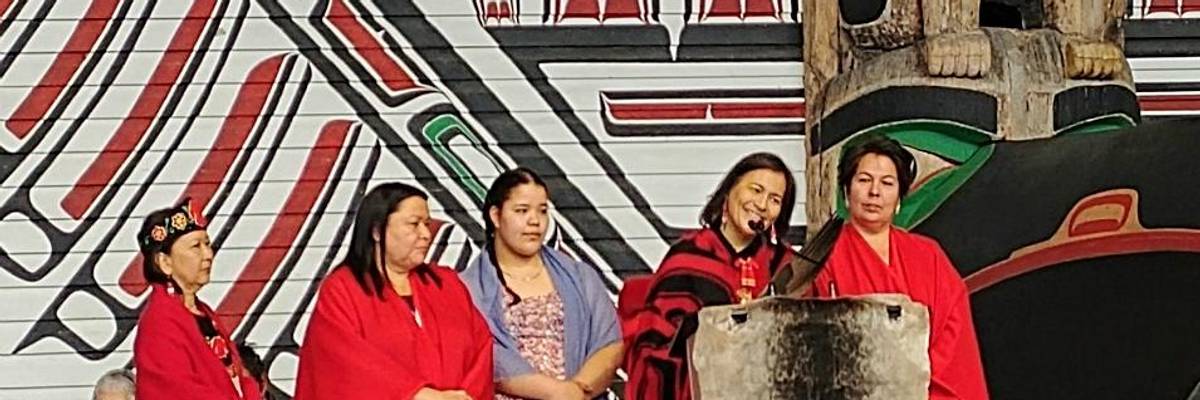
Michele Audette, a commissioner of the Canadian government's National Inquiry into Missing and Murdered Indigenous Women and Girls, spoke at a ceremony in Quebec on Monday. (Photo: @MMIWG/Twitter)
The Canadian government's National Inquiry into Missing and Murdered Indigenous Women and Girls concluded in a final report published Monday that "this violence amounts to a race-based genocide of Indigenous Peoples."
The Indigenous Peoples referred to in the report include First Nations, Inuit, and Metis--with a specific focus on women, girls, and 2SLGBTQQIA people, which stands for Two-Spirit, lesbian, gay, bisexual, transgender, queer, questioning, intersex, and asexual.
The report--entitled Reclaiming Power and Place--was unveiled at a Monday morning ceremony at the Canadian Museum of History in Gatineau, Quebec, but several news agencies published details from a leaked copy over the weekend. The inquiry also released a supplementary report (pdf) about the province of Quebec.
Based on testimonies from more than 2,380 people--including family members and survivors of violence as well as frontline workers, expert witnesses, officials, elders, and knowledge keepers--the report states:
Colonial violence, as well as racism, sexism, homophobia, and transphobia against Indigenous women, girls, and 2SLGBTQQIA people, has become embedded in everyday life--whether this is through interpersonal forms of violence, through institutions like the healthcare system and the justice system, or in the laws, policies, and structures of Canadian society. The result has been that many Indigenous people have grown up normalized to violence, while Canadian society shows an appalling apathy to addressing the issue. The National Inquiry into Missing and Murdered Indigenous Women and Girls finds that this amounts to genocide.
The report explains that "this genocide has been empowered by colonial structures, evidenced notably by the Indian Act, the Sixties Scoop, residential schools, and breaches of human and Inuit, Metis, and First Nations rights, leading directly to the current increased rates of violence, death, and suicide in the Indigenous populations."
The New York Times, which reported on the inquiry's findings Sunday, noted that based on government statistics, "Indigenous women and girls make up about 4 percent of Canada's females but 16 percent of the females killed." Government data also shows "some 1,181 Indigenous women were killed or disappeared across the country from 1980 to 2012," but the report points out that official counts represent only a portion of the victims of the "Canadian genocide."
Thousands of deaths and disappearances "have likely gone unrecorded over the decades," the report says. "Despite the national inquiry's best efforts to gather all of the truths relating to the missing and murdered, we conclude that no one knows an exact number of missing and murdered Indigenous women, girls, and 2SLGBTQQIA people in Canada... Without a doubt there are many more."
Part of the under-counting problem, according to the report, stems from "police apathy" in cases involving Indigenous Peoples, which "often takes the form of stereotyping and victim-blaming, such as when police describe missing loved ones as 'drunks,' 'runaways out partying,' or 'prostitutes unworthy of follow-up.'"
Additionally, First Nations police services often lack sufficient equipment and resources to conduct proper investigations--and "beyond the investigative process, families often found the court process inadequate, unjust, and retraumatizing."
The inquiry's chief commissioner, Marion Buller, said in a statement (pdf) Monday, "The hard truth is that we live in a country whose laws and institutions perpetuate violations of fundamental rights, amounting to a genocide against Indigenous women, girls, and 2SLGBTQQIA people."
Buller added that "despite their different circumstances and backgrounds, all of the missing and murdered are connected by economic, social, and political marginalization, racism, and misogyny woven into the fabric of Canadian society."
The 1,200-page report summarizes the findings from the two-and-a-half year inquiry and offers 231 "calls for justice" (pdf) directed at governments, institutions, social service providers, industries, and all Canadians to permanently end the genocide.
"To put an end to this tragedy, the rightful power and place of women, girls, and 2SLGBTQQIA people must be reinstated, which requires dismantling the structures of colonialism within Canadian society," said inquiry commissioner Michele Audette. "This is not just a job for governments and politicians. It is incumbent on all Canadians to hold our leaders to account."
Acknowledging some limitations of the inquiry, which began on Sept. 1, 2016, the report charges that "part of this national tragedy is governments' refusals to grant the national inquiry the full two-year extension requested. In doing so, governments chose to leave many truths unspoken and unknown."
Responding to the inquiry's findings and recommendations at the ceremony Monday, Canadian Prime Minister Justin Trudeau reportedly told the audience, "To the families and survivors... I want you to know that this report is not the end."
Promising that the report "will not be placed on a shelf to collect dust," Trudeau declared that Canada needs to "continue to decolonize."
As attendees shouted "genocide," the prime minister added: "This is an uncomfortable day for Canada... We have failed you. We will fail you no longer."
Dear Common Dreams reader, It’s been nearly 30 years since I co-founded Common Dreams with my late wife, Lina Newhouser. We had the radical notion that journalism should serve the public good, not corporate profits. It was clear to us from the outset what it would take to build such a project. No paid advertisements. No corporate sponsors. No millionaire publisher telling us what to think or do. Many people said we wouldn't last a year, but we proved those doubters wrong. Together with a tremendous team of journalists and dedicated staff, we built an independent media outlet free from the constraints of profits and corporate control. Our mission has always been simple: To inform. To inspire. To ignite change for the common good. Building Common Dreams was not easy. Our survival was never guaranteed. When you take on the most powerful forces—Wall Street greed, fossil fuel industry destruction, Big Tech lobbyists, and uber-rich oligarchs who have spent billions upon billions rigging the economy and democracy in their favor—the only bulwark you have is supporters who believe in your work. But here’s the urgent message from me today. It's never been this bad out there. And it's never been this hard to keep us going. At the very moment Common Dreams is most needed, the threats we face are intensifying. We need your support now more than ever. We don't accept corporate advertising and never will. We don't have a paywall because we don't think people should be blocked from critical news based on their ability to pay. Everything we do is funded by the donations of readers like you. When everyone does the little they can afford, we are strong. But if that support retreats or dries up, so do we. Will you donate now to make sure Common Dreams not only survives but thrives? —Craig Brown, Co-founder |
The Canadian government's National Inquiry into Missing and Murdered Indigenous Women and Girls concluded in a final report published Monday that "this violence amounts to a race-based genocide of Indigenous Peoples."
The Indigenous Peoples referred to in the report include First Nations, Inuit, and Metis--with a specific focus on women, girls, and 2SLGBTQQIA people, which stands for Two-Spirit, lesbian, gay, bisexual, transgender, queer, questioning, intersex, and asexual.
The report--entitled Reclaiming Power and Place--was unveiled at a Monday morning ceremony at the Canadian Museum of History in Gatineau, Quebec, but several news agencies published details from a leaked copy over the weekend. The inquiry also released a supplementary report (pdf) about the province of Quebec.
Based on testimonies from more than 2,380 people--including family members and survivors of violence as well as frontline workers, expert witnesses, officials, elders, and knowledge keepers--the report states:
Colonial violence, as well as racism, sexism, homophobia, and transphobia against Indigenous women, girls, and 2SLGBTQQIA people, has become embedded in everyday life--whether this is through interpersonal forms of violence, through institutions like the healthcare system and the justice system, or in the laws, policies, and structures of Canadian society. The result has been that many Indigenous people have grown up normalized to violence, while Canadian society shows an appalling apathy to addressing the issue. The National Inquiry into Missing and Murdered Indigenous Women and Girls finds that this amounts to genocide.
The report explains that "this genocide has been empowered by colonial structures, evidenced notably by the Indian Act, the Sixties Scoop, residential schools, and breaches of human and Inuit, Metis, and First Nations rights, leading directly to the current increased rates of violence, death, and suicide in the Indigenous populations."
The New York Times, which reported on the inquiry's findings Sunday, noted that based on government statistics, "Indigenous women and girls make up about 4 percent of Canada's females but 16 percent of the females killed." Government data also shows "some 1,181 Indigenous women were killed or disappeared across the country from 1980 to 2012," but the report points out that official counts represent only a portion of the victims of the "Canadian genocide."
Thousands of deaths and disappearances "have likely gone unrecorded over the decades," the report says. "Despite the national inquiry's best efforts to gather all of the truths relating to the missing and murdered, we conclude that no one knows an exact number of missing and murdered Indigenous women, girls, and 2SLGBTQQIA people in Canada... Without a doubt there are many more."
Part of the under-counting problem, according to the report, stems from "police apathy" in cases involving Indigenous Peoples, which "often takes the form of stereotyping and victim-blaming, such as when police describe missing loved ones as 'drunks,' 'runaways out partying,' or 'prostitutes unworthy of follow-up.'"
Additionally, First Nations police services often lack sufficient equipment and resources to conduct proper investigations--and "beyond the investigative process, families often found the court process inadequate, unjust, and retraumatizing."
The inquiry's chief commissioner, Marion Buller, said in a statement (pdf) Monday, "The hard truth is that we live in a country whose laws and institutions perpetuate violations of fundamental rights, amounting to a genocide against Indigenous women, girls, and 2SLGBTQQIA people."
Buller added that "despite their different circumstances and backgrounds, all of the missing and murdered are connected by economic, social, and political marginalization, racism, and misogyny woven into the fabric of Canadian society."
The 1,200-page report summarizes the findings from the two-and-a-half year inquiry and offers 231 "calls for justice" (pdf) directed at governments, institutions, social service providers, industries, and all Canadians to permanently end the genocide.
"To put an end to this tragedy, the rightful power and place of women, girls, and 2SLGBTQQIA people must be reinstated, which requires dismantling the structures of colonialism within Canadian society," said inquiry commissioner Michele Audette. "This is not just a job for governments and politicians. It is incumbent on all Canadians to hold our leaders to account."
Acknowledging some limitations of the inquiry, which began on Sept. 1, 2016, the report charges that "part of this national tragedy is governments' refusals to grant the national inquiry the full two-year extension requested. In doing so, governments chose to leave many truths unspoken and unknown."
Responding to the inquiry's findings and recommendations at the ceremony Monday, Canadian Prime Minister Justin Trudeau reportedly told the audience, "To the families and survivors... I want you to know that this report is not the end."
Promising that the report "will not be placed on a shelf to collect dust," Trudeau declared that Canada needs to "continue to decolonize."
As attendees shouted "genocide," the prime minister added: "This is an uncomfortable day for Canada... We have failed you. We will fail you no longer."
The Canadian government's National Inquiry into Missing and Murdered Indigenous Women and Girls concluded in a final report published Monday that "this violence amounts to a race-based genocide of Indigenous Peoples."
The Indigenous Peoples referred to in the report include First Nations, Inuit, and Metis--with a specific focus on women, girls, and 2SLGBTQQIA people, which stands for Two-Spirit, lesbian, gay, bisexual, transgender, queer, questioning, intersex, and asexual.
The report--entitled Reclaiming Power and Place--was unveiled at a Monday morning ceremony at the Canadian Museum of History in Gatineau, Quebec, but several news agencies published details from a leaked copy over the weekend. The inquiry also released a supplementary report (pdf) about the province of Quebec.
Based on testimonies from more than 2,380 people--including family members and survivors of violence as well as frontline workers, expert witnesses, officials, elders, and knowledge keepers--the report states:
Colonial violence, as well as racism, sexism, homophobia, and transphobia against Indigenous women, girls, and 2SLGBTQQIA people, has become embedded in everyday life--whether this is through interpersonal forms of violence, through institutions like the healthcare system and the justice system, or in the laws, policies, and structures of Canadian society. The result has been that many Indigenous people have grown up normalized to violence, while Canadian society shows an appalling apathy to addressing the issue. The National Inquiry into Missing and Murdered Indigenous Women and Girls finds that this amounts to genocide.
The report explains that "this genocide has been empowered by colonial structures, evidenced notably by the Indian Act, the Sixties Scoop, residential schools, and breaches of human and Inuit, Metis, and First Nations rights, leading directly to the current increased rates of violence, death, and suicide in the Indigenous populations."
The New York Times, which reported on the inquiry's findings Sunday, noted that based on government statistics, "Indigenous women and girls make up about 4 percent of Canada's females but 16 percent of the females killed." Government data also shows "some 1,181 Indigenous women were killed or disappeared across the country from 1980 to 2012," but the report points out that official counts represent only a portion of the victims of the "Canadian genocide."
Thousands of deaths and disappearances "have likely gone unrecorded over the decades," the report says. "Despite the national inquiry's best efforts to gather all of the truths relating to the missing and murdered, we conclude that no one knows an exact number of missing and murdered Indigenous women, girls, and 2SLGBTQQIA people in Canada... Without a doubt there are many more."
Part of the under-counting problem, according to the report, stems from "police apathy" in cases involving Indigenous Peoples, which "often takes the form of stereotyping and victim-blaming, such as when police describe missing loved ones as 'drunks,' 'runaways out partying,' or 'prostitutes unworthy of follow-up.'"
Additionally, First Nations police services often lack sufficient equipment and resources to conduct proper investigations--and "beyond the investigative process, families often found the court process inadequate, unjust, and retraumatizing."
The inquiry's chief commissioner, Marion Buller, said in a statement (pdf) Monday, "The hard truth is that we live in a country whose laws and institutions perpetuate violations of fundamental rights, amounting to a genocide against Indigenous women, girls, and 2SLGBTQQIA people."
Buller added that "despite their different circumstances and backgrounds, all of the missing and murdered are connected by economic, social, and political marginalization, racism, and misogyny woven into the fabric of Canadian society."
The 1,200-page report summarizes the findings from the two-and-a-half year inquiry and offers 231 "calls for justice" (pdf) directed at governments, institutions, social service providers, industries, and all Canadians to permanently end the genocide.
"To put an end to this tragedy, the rightful power and place of women, girls, and 2SLGBTQQIA people must be reinstated, which requires dismantling the structures of colonialism within Canadian society," said inquiry commissioner Michele Audette. "This is not just a job for governments and politicians. It is incumbent on all Canadians to hold our leaders to account."
Acknowledging some limitations of the inquiry, which began on Sept. 1, 2016, the report charges that "part of this national tragedy is governments' refusals to grant the national inquiry the full two-year extension requested. In doing so, governments chose to leave many truths unspoken and unknown."
Responding to the inquiry's findings and recommendations at the ceremony Monday, Canadian Prime Minister Justin Trudeau reportedly told the audience, "To the families and survivors... I want you to know that this report is not the end."
Promising that the report "will not be placed on a shelf to collect dust," Trudeau declared that Canada needs to "continue to decolonize."
As attendees shouted "genocide," the prime minister added: "This is an uncomfortable day for Canada... We have failed you. We will fail you no longer."

