SUBSCRIBE TO OUR FREE NEWSLETTER
Daily news & progressive opinion—funded by the people, not the corporations—delivered straight to your inbox.
5
#000000
#FFFFFF
To donate by check, phone, or other method, see our More Ways to Give page.

Just ahead of Memorial Day, a new report out Wednesday reveals that workers in the U.S. continue to lag far behind those in other wealthy countries when it comes to paid vacation and holidays.
The report--titled "No Vacation Nation, Revised" (pdf) and published by the Center for Economic and Policy Research (CEPR)--updates the center's two earlier studies on paid vacations, compiled in 2007 and 2013. Like the previous research, CEPR found that the U.S. is the only rich economy where a significant portion of the workforce receive no vacation pay.
Twenty-two percent of American workers don't receive any holiday pay, and the average employee can take 10 paid vacation days and six paid federal holidays per year--far less than paid time off that's offered to the majority of workers in Europe, where governments and employers have been forced to prioritize time for workers to recharge and relax.
"In the U.S., paid vacation and holiday benefits are based on luck in the boss lottery, not federal policy," said Eileen Appelbaum, co-director of CEPR. "Since we did this study in 2007, there's been no progress on the national front to catch up with other rich countries. We can't depend on the largesse of employers to do the right thing."
The study compared the U.S. to 20 other industrialized economies, including France, Germany, Finland, Japan, and Australia.
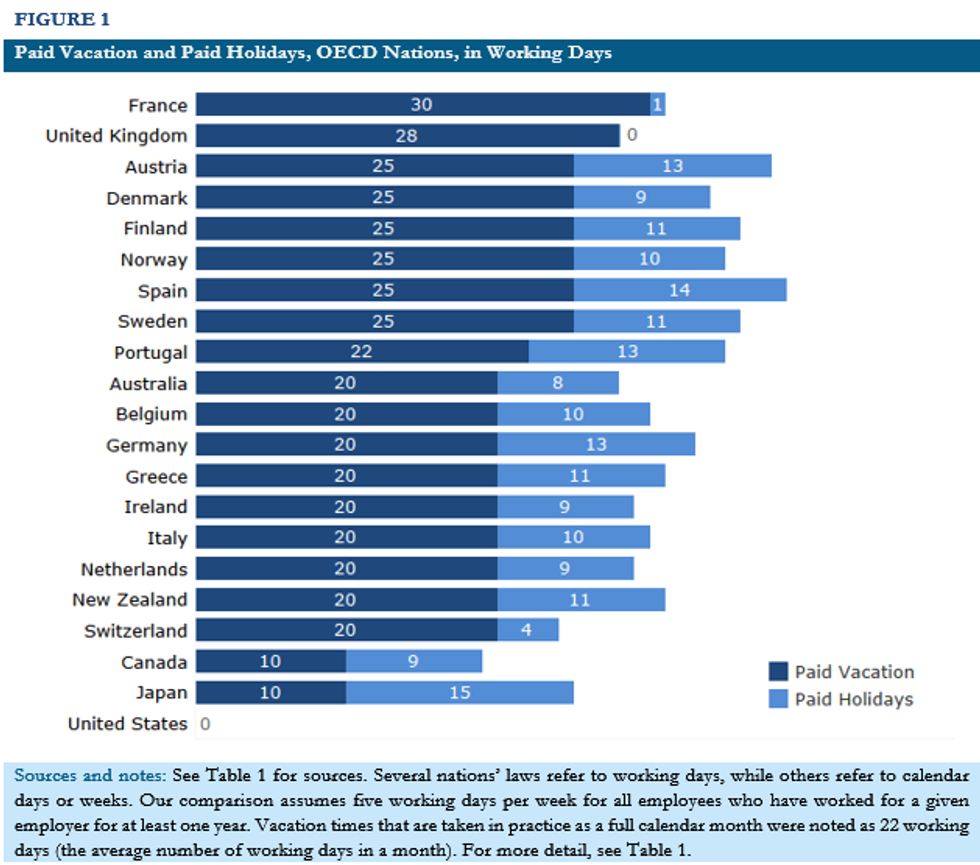
The European Union guarantees workers at least 20 paid vacation days per year, with some countries granting upwards of 30 days. Nine European countries also require companies to allow workers to take their vacations during peak vacation season in the summer.
Canada and Japan are closer to the U.S. in terms of offering paid vacation, with each country guaranteeing 10 days per year--but workers there are also given nine and 15 paid holidays per year, respectively.
In some ways, Americans' right to paid vacation days have been weakened since CEPR compiled a report on the topic.
High wage workers receive roughly the same amount of paid time off that they did in 2007, but only about 52 percent of low wage employees receive paid vacations--compared with 69 percent in 2007.
The study noted that earlier this year New York City Mayor Bill DeBlasio proposed a guaranteed paid leave policy for his city, which would grant all workers two weeks of paid vacation.
"While the measure would be a huge triumph for New York City workers if it passes," reads CEPR's report, "it also highlights the disparity between the United States and other countries when it comes to universal paid holiday and paid vacation policies for workers."
Just ahead of Memorial Day, a new report out Wednesday reveals that workers in the U.S. continue to lag far behind those in other wealthy countries when it comes to paid vacation and holidays.
The report--titled "No Vacation Nation, Revised" (pdf) and published by the Center for Economic and Policy Research (CEPR)--updates the center's two earlier studies on paid vacations, compiled in 2007 and 2013. Like the previous research, CEPR found that the U.S. is the only rich economy where a significant portion of the workforce receive no vacation pay.
Twenty-two percent of American workers don't receive any holiday pay, and the average employee can take 10 paid vacation days and six paid federal holidays per year--far less than paid time off that's offered to the majority of workers in Europe, where governments and employers have been forced to prioritize time for workers to recharge and relax.
"In the U.S., paid vacation and holiday benefits are based on luck in the boss lottery, not federal policy," said Eileen Appelbaum, co-director of CEPR. "Since we did this study in 2007, there's been no progress on the national front to catch up with other rich countries. We can't depend on the largesse of employers to do the right thing."
The study compared the U.S. to 20 other industrialized economies, including France, Germany, Finland, Japan, and Australia.
The European Union guarantees workers at least 20 paid vacation days per year, with some countries granting upwards of 30 days. Nine European countries also require companies to allow workers to take their vacations during peak vacation season in the summer.
Canada and Japan are closer to the U.S. in terms of offering paid vacation, with each country guaranteeing 10 days per year--but workers there are also given nine and 15 paid holidays per year, respectively.
In some ways, Americans' right to paid vacation days have been weakened since CEPR compiled a report on the topic.
High wage workers receive roughly the same amount of paid time off that they did in 2007, but only about 52 percent of low wage employees receive paid vacations--compared with 69 percent in 2007.
The study noted that earlier this year New York City Mayor Bill DeBlasio proposed a guaranteed paid leave policy for his city, which would grant all workers two weeks of paid vacation.
"While the measure would be a huge triumph for New York City workers if it passes," reads CEPR's report, "it also highlights the disparity between the United States and other countries when it comes to universal paid holiday and paid vacation policies for workers."
Just ahead of Memorial Day, a new report out Wednesday reveals that workers in the U.S. continue to lag far behind those in other wealthy countries when it comes to paid vacation and holidays.
The report--titled "No Vacation Nation, Revised" (pdf) and published by the Center for Economic and Policy Research (CEPR)--updates the center's two earlier studies on paid vacations, compiled in 2007 and 2013. Like the previous research, CEPR found that the U.S. is the only rich economy where a significant portion of the workforce receive no vacation pay.
Twenty-two percent of American workers don't receive any holiday pay, and the average employee can take 10 paid vacation days and six paid federal holidays per year--far less than paid time off that's offered to the majority of workers in Europe, where governments and employers have been forced to prioritize time for workers to recharge and relax.
"In the U.S., paid vacation and holiday benefits are based on luck in the boss lottery, not federal policy," said Eileen Appelbaum, co-director of CEPR. "Since we did this study in 2007, there's been no progress on the national front to catch up with other rich countries. We can't depend on the largesse of employers to do the right thing."
The study compared the U.S. to 20 other industrialized economies, including France, Germany, Finland, Japan, and Australia.
The European Union guarantees workers at least 20 paid vacation days per year, with some countries granting upwards of 30 days. Nine European countries also require companies to allow workers to take their vacations during peak vacation season in the summer.
Canada and Japan are closer to the U.S. in terms of offering paid vacation, with each country guaranteeing 10 days per year--but workers there are also given nine and 15 paid holidays per year, respectively.
In some ways, Americans' right to paid vacation days have been weakened since CEPR compiled a report on the topic.
High wage workers receive roughly the same amount of paid time off that they did in 2007, but only about 52 percent of low wage employees receive paid vacations--compared with 69 percent in 2007.
The study noted that earlier this year New York City Mayor Bill DeBlasio proposed a guaranteed paid leave policy for his city, which would grant all workers two weeks of paid vacation.
"While the measure would be a huge triumph for New York City workers if it passes," reads CEPR's report, "it also highlights the disparity between the United States and other countries when it comes to universal paid holiday and paid vacation policies for workers."