SUBSCRIBE TO OUR FREE NEWSLETTER
Daily news & progressive opinion—funded by the people, not the corporations—delivered straight to your inbox.
5
#000000
#FFFFFF
To donate by check, phone, or other method, see our More Ways to Give page.
Daily news & progressive opinion—funded by the people, not the corporations—delivered straight to your inbox.
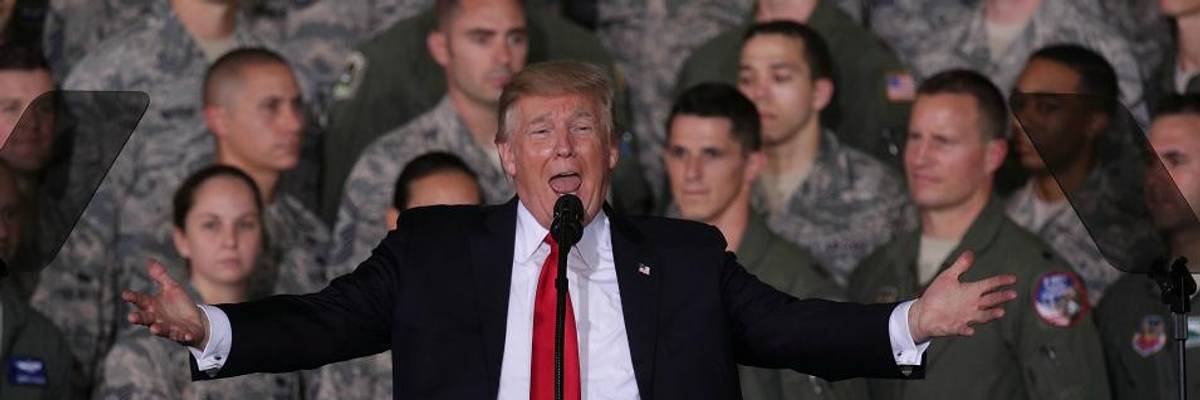
President Donald Trump speaks to Air Force personnel during an event Sept. 15, 2017 at Joint Base Andrews in Maryland. President Trump attended the event to celebrate the 70th birthday of the U.S. Air Force. (Photo: Alex Wong/Getty Images)
Progressives, human rights advocates, and journalists responded with outrage on Saturday to a New York Times report that President Donald Trump "has requested the immediate preparation of paperwork needed to pardon several American military members accused or convicted of war crimes."
Unnamed U.S. government officials told the Times that on or around Memorial Day, Trump may pardon multiple servicemembers involved with "high-profile cases of murder, attempted murder, and desecration of a corpse."
As the newspaper reported:
The requests are for Special Operations Chief Edward Gallagher of the Navy SEALs, who is scheduled to stand trial in the coming weeks on charges of shooting unarmed civilians and killing an enemy captive with a knife while deployed in Iraq.
They are also believed to include the case of a former Blackwater security contractor recently found guilty in the deadly 2007 shooting of dozens of unarmed Iraqis; the case of Maj. Mathew L. Golsteyn, the Army Green Beret accused of killing an unarmed Afghan in 2010; and the case of a group of Marine Corps snipers charged with urinating on the corpse of a dead Taliban fighter.
"These are all extremely complicated cases that have gone through a careful system of consideration," Gary Solis, a retired military judge and armor officer who served in Vietnam, told the Times. "A freewheeling pardon undermines that whole system."
Solis warned that pardoning servicemembers accused or convicted of war crimes "raises the prospect in the minds of the troops that says, 'Whatever we do, if we can get the folks back home behind us, maybe we can get let off.'"
The news on Saturday came after Trump, earlier this month, pardoned former Army 1st Lt. Michael Behenna, who was convicted of murdering an Iraqi prisoner in 2008. As Common Dreams reported at the time, human rights advocates decried that decision as "a presidential endorsement of a murder that violated the military's own code of justice."
The Times report--on which the White House and Justice Department declined to comment--was met with similar condemnation.
The Atlantic's Adam Serwer, who spoke out against Trump's pardon of Behenna, tweeted, "This incentivizes the commission of war crimes by our opponents and allies, and in doing so puts U.S. servicemembers at greater risk."
Human Rights Watch executive director Ken Roth said, "Think of the horrible message that sends to would-be war criminals around the world."
Murtaza Mohammad Hussain, a reporter at The Intercept, denounced Trump's expected move as "a huge injustice to those whose lives they destroyed and a message that America will tolerate war crimes."
Their criticism was echoed by others, including journalist Ryan Devereaux, who suggested that "if you were to make a list of 'top notorious U.S. war crimes of the post-9/11 era' it would look a lot like the president's pardoning plans."
Dear Common Dreams reader, It’s been nearly 30 years since I co-founded Common Dreams with my late wife, Lina Newhouser. We had the radical notion that journalism should serve the public good, not corporate profits. It was clear to us from the outset what it would take to build such a project. No paid advertisements. No corporate sponsors. No millionaire publisher telling us what to think or do. Many people said we wouldn't last a year, but we proved those doubters wrong. Together with a tremendous team of journalists and dedicated staff, we built an independent media outlet free from the constraints of profits and corporate control. Our mission has always been simple: To inform. To inspire. To ignite change for the common good. Building Common Dreams was not easy. Our survival was never guaranteed. When you take on the most powerful forces—Wall Street greed, fossil fuel industry destruction, Big Tech lobbyists, and uber-rich oligarchs who have spent billions upon billions rigging the economy and democracy in their favor—the only bulwark you have is supporters who believe in your work. But here’s the urgent message from me today. It's never been this bad out there. And it's never been this hard to keep us going. At the very moment Common Dreams is most needed, the threats we face are intensifying. We need your support now more than ever. We don't accept corporate advertising and never will. We don't have a paywall because we don't think people should be blocked from critical news based on their ability to pay. Everything we do is funded by the donations of readers like you. When everyone does the little they can afford, we are strong. But if that support retreats or dries up, so do we. Will you donate now to make sure Common Dreams not only survives but thrives? —Craig Brown, Co-founder |
Progressives, human rights advocates, and journalists responded with outrage on Saturday to a New York Times report that President Donald Trump "has requested the immediate preparation of paperwork needed to pardon several American military members accused or convicted of war crimes."
Unnamed U.S. government officials told the Times that on or around Memorial Day, Trump may pardon multiple servicemembers involved with "high-profile cases of murder, attempted murder, and desecration of a corpse."
As the newspaper reported:
The requests are for Special Operations Chief Edward Gallagher of the Navy SEALs, who is scheduled to stand trial in the coming weeks on charges of shooting unarmed civilians and killing an enemy captive with a knife while deployed in Iraq.
They are also believed to include the case of a former Blackwater security contractor recently found guilty in the deadly 2007 shooting of dozens of unarmed Iraqis; the case of Maj. Mathew L. Golsteyn, the Army Green Beret accused of killing an unarmed Afghan in 2010; and the case of a group of Marine Corps snipers charged with urinating on the corpse of a dead Taliban fighter.
"These are all extremely complicated cases that have gone through a careful system of consideration," Gary Solis, a retired military judge and armor officer who served in Vietnam, told the Times. "A freewheeling pardon undermines that whole system."
Solis warned that pardoning servicemembers accused or convicted of war crimes "raises the prospect in the minds of the troops that says, 'Whatever we do, if we can get the folks back home behind us, maybe we can get let off.'"
The news on Saturday came after Trump, earlier this month, pardoned former Army 1st Lt. Michael Behenna, who was convicted of murdering an Iraqi prisoner in 2008. As Common Dreams reported at the time, human rights advocates decried that decision as "a presidential endorsement of a murder that violated the military's own code of justice."
The Times report--on which the White House and Justice Department declined to comment--was met with similar condemnation.
The Atlantic's Adam Serwer, who spoke out against Trump's pardon of Behenna, tweeted, "This incentivizes the commission of war crimes by our opponents and allies, and in doing so puts U.S. servicemembers at greater risk."
Human Rights Watch executive director Ken Roth said, "Think of the horrible message that sends to would-be war criminals around the world."
Murtaza Mohammad Hussain, a reporter at The Intercept, denounced Trump's expected move as "a huge injustice to those whose lives they destroyed and a message that America will tolerate war crimes."
Their criticism was echoed by others, including journalist Ryan Devereaux, who suggested that "if you were to make a list of 'top notorious U.S. war crimes of the post-9/11 era' it would look a lot like the president's pardoning plans."
Progressives, human rights advocates, and journalists responded with outrage on Saturday to a New York Times report that President Donald Trump "has requested the immediate preparation of paperwork needed to pardon several American military members accused or convicted of war crimes."
Unnamed U.S. government officials told the Times that on or around Memorial Day, Trump may pardon multiple servicemembers involved with "high-profile cases of murder, attempted murder, and desecration of a corpse."
As the newspaper reported:
The requests are for Special Operations Chief Edward Gallagher of the Navy SEALs, who is scheduled to stand trial in the coming weeks on charges of shooting unarmed civilians and killing an enemy captive with a knife while deployed in Iraq.
They are also believed to include the case of a former Blackwater security contractor recently found guilty in the deadly 2007 shooting of dozens of unarmed Iraqis; the case of Maj. Mathew L. Golsteyn, the Army Green Beret accused of killing an unarmed Afghan in 2010; and the case of a group of Marine Corps snipers charged with urinating on the corpse of a dead Taliban fighter.
"These are all extremely complicated cases that have gone through a careful system of consideration," Gary Solis, a retired military judge and armor officer who served in Vietnam, told the Times. "A freewheeling pardon undermines that whole system."
Solis warned that pardoning servicemembers accused or convicted of war crimes "raises the prospect in the minds of the troops that says, 'Whatever we do, if we can get the folks back home behind us, maybe we can get let off.'"
The news on Saturday came after Trump, earlier this month, pardoned former Army 1st Lt. Michael Behenna, who was convicted of murdering an Iraqi prisoner in 2008. As Common Dreams reported at the time, human rights advocates decried that decision as "a presidential endorsement of a murder that violated the military's own code of justice."
The Times report--on which the White House and Justice Department declined to comment--was met with similar condemnation.
The Atlantic's Adam Serwer, who spoke out against Trump's pardon of Behenna, tweeted, "This incentivizes the commission of war crimes by our opponents and allies, and in doing so puts U.S. servicemembers at greater risk."
Human Rights Watch executive director Ken Roth said, "Think of the horrible message that sends to would-be war criminals around the world."
Murtaza Mohammad Hussain, a reporter at The Intercept, denounced Trump's expected move as "a huge injustice to those whose lives they destroyed and a message that America will tolerate war crimes."
Their criticism was echoed by others, including journalist Ryan Devereaux, who suggested that "if you were to make a list of 'top notorious U.S. war crimes of the post-9/11 era' it would look a lot like the president's pardoning plans."