SUBSCRIBE TO OUR FREE NEWSLETTER
Daily news & progressive opinion—funded by the people, not the corporations—delivered straight to your inbox.
5
#000000
#FFFFFF
To donate by check, phone, or other method, see our More Ways to Give page.
Daily news & progressive opinion—funded by the people, not the corporations—delivered straight to your inbox.
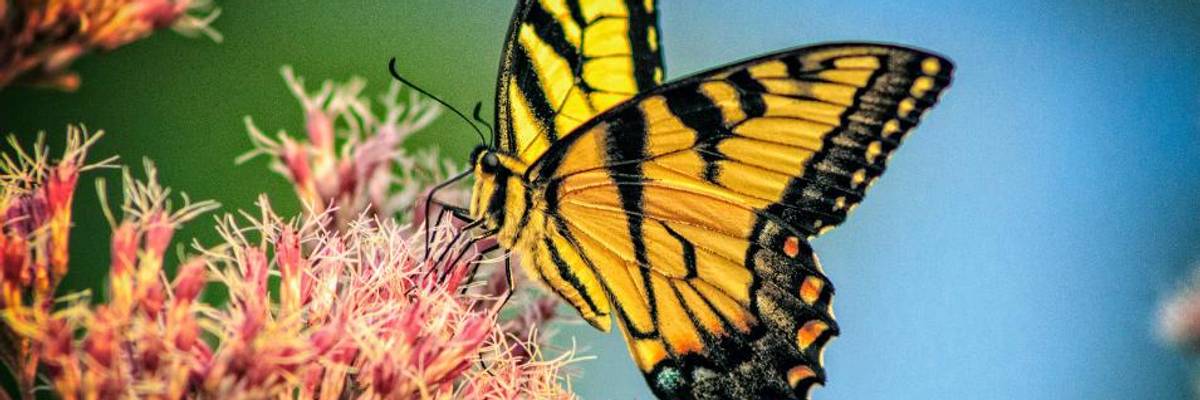
Anne Sverdrup-Thygeson, professor at the Norwegian University of Life Sciences, said humanity "should save insects, if not for their sake, then for our own sake." (Photo: Gerald Bray/Getty Images)
A leading scientist warned Tuesday that the rapid decline of insects around the world poses an existential threat to humanity and action must be taken to rescue them "while we still have time."
Anne Sverdrup-Thygeson, professor at the Norwegian University of Life Sciences and one of the world's top entomologists, said in an interview with The Guardian that the importance of insects to the planet should spur humans to take immediate action against one of the major causes of insect decline--the climate crisis.
"Insects are the glue in nature," said Sverdrup-Thygeson. "We should save insects, if not for their sake, then for our own sake."
"You can pull out some threads but at some stage the whole fabric unravels and then we will really see the consequences."
--Anne Sverdrup-Thygeson, Norwegian University of Life Sciences
Falling insect populations around the world is cause for serious alarm, Sverdrup-Thygeson said, given the enormous impact these tiny creatures have on the global ecosystem.
"I have read pretty much every study in English and I haven't seen a single one where entomologists don't believe the main message that a lot of insect species are definitely declining," said Sverdrup-Thygeson. "When you throw all the pesticides and climate change on top of that, it is not very cool to be an insect today."
If this decline continues unabated, Sverdrup-Thygeson warned, soon "it will not be fun to be a human on this planet either."
"[I]t will make it even more difficult than today to get enough food for the human population of the planet, to get good health and freshwater for everybody," said Sverdrup-Thygeson. "That should be a huge motivation for doing something while we still have time."
"You can pull out some threads," she added, "but at some stage the whole fabric unravels and then we will really see the consequences."
Sverdrup-Thygeson's call to action came after the Intergovernmental Science-Policy Platform on Biodiversity and Ecosystem Services (IPBES) released a comprehensive global biodiversity report, which warned that human activity has pushed a million plant and animal species to the brink of extinction.
According to the report, "available evidence supports a tentative estimate of 10 percent [of insect species] being threatened" by the climate crisis.
"It is not too late to make a difference," said IPBES chair Sir Robert Watson, "but only if we start now at every level from local to global."
Dear Common Dreams reader, It’s been nearly 30 years since I co-founded Common Dreams with my late wife, Lina Newhouser. We had the radical notion that journalism should serve the public good, not corporate profits. It was clear to us from the outset what it would take to build such a project. No paid advertisements. No corporate sponsors. No millionaire publisher telling us what to think or do. Many people said we wouldn't last a year, but we proved those doubters wrong. Together with a tremendous team of journalists and dedicated staff, we built an independent media outlet free from the constraints of profits and corporate control. Our mission has always been simple: To inform. To inspire. To ignite change for the common good. Building Common Dreams was not easy. Our survival was never guaranteed. When you take on the most powerful forces—Wall Street greed, fossil fuel industry destruction, Big Tech lobbyists, and uber-rich oligarchs who have spent billions upon billions rigging the economy and democracy in their favor—the only bulwark you have is supporters who believe in your work. But here’s the urgent message from me today. It's never been this bad out there. And it's never been this hard to keep us going. At the very moment Common Dreams is most needed, the threats we face are intensifying. We need your support now more than ever. We don't accept corporate advertising and never will. We don't have a paywall because we don't think people should be blocked from critical news based on their ability to pay. Everything we do is funded by the donations of readers like you. When everyone does the little they can afford, we are strong. But if that support retreats or dries up, so do we. Will you donate now to make sure Common Dreams not only survives but thrives? —Craig Brown, Co-founder |
A leading scientist warned Tuesday that the rapid decline of insects around the world poses an existential threat to humanity and action must be taken to rescue them "while we still have time."
Anne Sverdrup-Thygeson, professor at the Norwegian University of Life Sciences and one of the world's top entomologists, said in an interview with The Guardian that the importance of insects to the planet should spur humans to take immediate action against one of the major causes of insect decline--the climate crisis.
"Insects are the glue in nature," said Sverdrup-Thygeson. "We should save insects, if not for their sake, then for our own sake."
"You can pull out some threads but at some stage the whole fabric unravels and then we will really see the consequences."
--Anne Sverdrup-Thygeson, Norwegian University of Life Sciences
Falling insect populations around the world is cause for serious alarm, Sverdrup-Thygeson said, given the enormous impact these tiny creatures have on the global ecosystem.
"I have read pretty much every study in English and I haven't seen a single one where entomologists don't believe the main message that a lot of insect species are definitely declining," said Sverdrup-Thygeson. "When you throw all the pesticides and climate change on top of that, it is not very cool to be an insect today."
If this decline continues unabated, Sverdrup-Thygeson warned, soon "it will not be fun to be a human on this planet either."
"[I]t will make it even more difficult than today to get enough food for the human population of the planet, to get good health and freshwater for everybody," said Sverdrup-Thygeson. "That should be a huge motivation for doing something while we still have time."
"You can pull out some threads," she added, "but at some stage the whole fabric unravels and then we will really see the consequences."
Sverdrup-Thygeson's call to action came after the Intergovernmental Science-Policy Platform on Biodiversity and Ecosystem Services (IPBES) released a comprehensive global biodiversity report, which warned that human activity has pushed a million plant and animal species to the brink of extinction.
According to the report, "available evidence supports a tentative estimate of 10 percent [of insect species] being threatened" by the climate crisis.
"It is not too late to make a difference," said IPBES chair Sir Robert Watson, "but only if we start now at every level from local to global."
A leading scientist warned Tuesday that the rapid decline of insects around the world poses an existential threat to humanity and action must be taken to rescue them "while we still have time."
Anne Sverdrup-Thygeson, professor at the Norwegian University of Life Sciences and one of the world's top entomologists, said in an interview with The Guardian that the importance of insects to the planet should spur humans to take immediate action against one of the major causes of insect decline--the climate crisis.
"Insects are the glue in nature," said Sverdrup-Thygeson. "We should save insects, if not for their sake, then for our own sake."
"You can pull out some threads but at some stage the whole fabric unravels and then we will really see the consequences."
--Anne Sverdrup-Thygeson, Norwegian University of Life Sciences
Falling insect populations around the world is cause for serious alarm, Sverdrup-Thygeson said, given the enormous impact these tiny creatures have on the global ecosystem.
"I have read pretty much every study in English and I haven't seen a single one where entomologists don't believe the main message that a lot of insect species are definitely declining," said Sverdrup-Thygeson. "When you throw all the pesticides and climate change on top of that, it is not very cool to be an insect today."
If this decline continues unabated, Sverdrup-Thygeson warned, soon "it will not be fun to be a human on this planet either."
"[I]t will make it even more difficult than today to get enough food for the human population of the planet, to get good health and freshwater for everybody," said Sverdrup-Thygeson. "That should be a huge motivation for doing something while we still have time."
"You can pull out some threads," she added, "but at some stage the whole fabric unravels and then we will really see the consequences."
Sverdrup-Thygeson's call to action came after the Intergovernmental Science-Policy Platform on Biodiversity and Ecosystem Services (IPBES) released a comprehensive global biodiversity report, which warned that human activity has pushed a million plant and animal species to the brink of extinction.
According to the report, "available evidence supports a tentative estimate of 10 percent [of insect species] being threatened" by the climate crisis.
"It is not too late to make a difference," said IPBES chair Sir Robert Watson, "but only if we start now at every level from local to global."