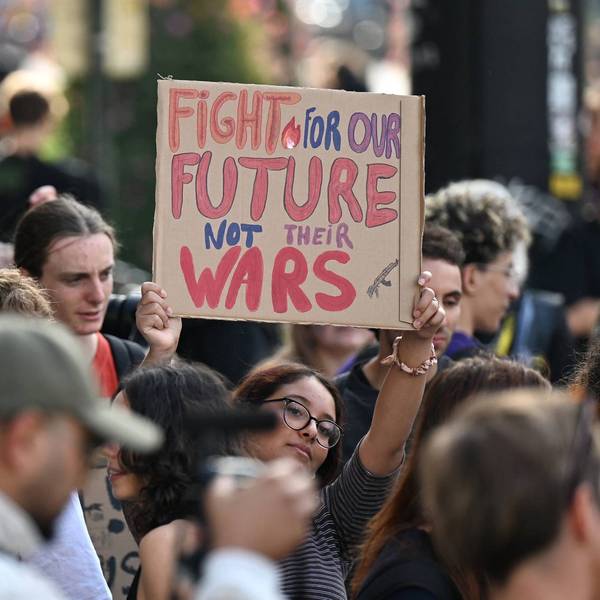
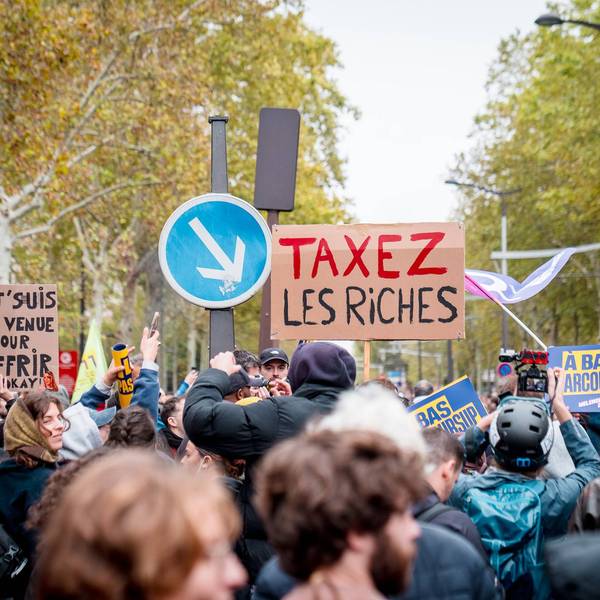

Supporters gather outside of the PSOE (Spanish Socialist Workers' Party) headquarters on April 28, 2019 in Madrid, Spain. (Photo: Pablo Blazquez Dominguez/Getty Images)
Running on Green New Deal and Economic Justice, Socialists Prevail in Spain's Snap Election
While the rise of the far-right, xenophobic Vox Party sparked alarm, it performed well below expectations
The Socialist Workers' Party emerged victorious in Spain's snap election on Sunday after running on a platform that included a Green New Deal to combat the climate crisis, a minimum wage increase, and higher taxes on the rich.
"Sanchez came out in support of the U.S. Green New Deal--sometimes translated as 'El New Deal Verde' or 'El Green New Deal de Espana'--in January and has campaigned on it throughout the election."
--Kate Aronoff, The Intercept
With more than 99 percent of the votes counted, the Socialist Party, or PSOE, won 123 of the 350 seats in Parliament. While not enough for an outright majority, the PSOE is now in a position to form a broad left-leaning coalition that would include the anti-austerity Podemos Party.
Speaking to supporters in Madrid following Sunday's election--which also saw the far-right Vox Party enter Parliament--Spanish Prime Minister Pedro Sanchez said the PSOE's win sends "a message to the world that it's possible to win against regression and authoritarianism."
"With that the future has won and the past has lost," said Sanchez at a victory rally.
As The Intercept's Kate Aronoff reported ahead of Sunday's election, "Sanchez came out in support of the U.S. Green New Deal--sometimes translated as 'El New Deal Verde' or 'El Green New Deal de Espana'--in January and has campaigned on it throughout the election."
"As outlined in the party's recently released 110-point manifesto," Aronoff wrote, "the overall goal of Spain's Green New Deal is an economy-wide mobilization involving participation from local communities, civil society, unions, and businesses, with an industrial policy that treats decarbonization as an engine of job creation."
Teresa Ribera, Spain's minister for ecological transition, told Aronoff that the Green New Deal "accepts that we are in an emergency moment where we need to transform."
"We cannot get as big a transformation as we need without [a] big dose of just transition and solidarity policies," Ribera said. "Otherwise there will be many people who are left behind."
While PSOE strengthened its position in the Spanish government, the rise of the xenophobic, anti-feminist Vox Party sparked alarm in the run-up to country's snap election.
As the New York Times reported, Vox--which won 24 seats in Parliament--"promised not only to quash the secessionist challenge in Catalonia but also to recentralize Spain by removing the powers of its regional governments."
But while acknowledging Vox's surge is certainly cause for serious concern, Washington Post reporter James McAuley noted that the far-right party performed well below expectations.
"Vox was supposed to do much better than it did. Its entry into Parliament is clearly huge but really not the story tonight," McAuley tweeted.
We are at a crossroads
This country and this world are at a monumental crossroads. In a few short weeks, US voters will have an opportunity to beat back the forces of fascism and confront the billionaires who are rigging the economy, our media system, and our democracy, making it increasingly impossible for ordinary people to get by. We’re not just talking about the election. We’re talking about what must be done once these fascist elements are vanquished from power. We need a bolder set of solutions than what either major party has so far been willing to offer and a working-class movement ready to fight like hell for it. Trump didn't emerge from nowhere. The conditions that fueled MAGA authoritarianism were created by decades of radical neoliberal economic policies and a corrupt political system dominated by corporate interests. They slashed taxes on the super-rich, promising that the benefits would trickle down. They said giveaways to the corporate titans would make life more affordable for the rest of us. It was all bullshit. And when a bitter, betrayed populace searches for someone to blame, right-wing demagogues have little trouble finding scapegoats. People know when they're being lied to, but you won't hear any of this from the corporate media. Only independent journalism—powered and funded by people who believe in building a better world—can deliver truly trustworthy daily news. Our Fall Campaign is underway, and we need your help. To power our newsroom through the rest of the year, we need to raise $125,000 by midnight on October 31. So if you share our vision, please contribute whatever you can to sustain our work. |
The Socialist Workers' Party emerged victorious in Spain's snap election on Sunday after running on a platform that included a Green New Deal to combat the climate crisis, a minimum wage increase, and higher taxes on the rich.
"Sanchez came out in support of the U.S. Green New Deal--sometimes translated as 'El New Deal Verde' or 'El Green New Deal de Espana'--in January and has campaigned on it throughout the election."
--Kate Aronoff, The Intercept
With more than 99 percent of the votes counted, the Socialist Party, or PSOE, won 123 of the 350 seats in Parliament. While not enough for an outright majority, the PSOE is now in a position to form a broad left-leaning coalition that would include the anti-austerity Podemos Party.
Speaking to supporters in Madrid following Sunday's election--which also saw the far-right Vox Party enter Parliament--Spanish Prime Minister Pedro Sanchez said the PSOE's win sends "a message to the world that it's possible to win against regression and authoritarianism."
"With that the future has won and the past has lost," said Sanchez at a victory rally.
As The Intercept's Kate Aronoff reported ahead of Sunday's election, "Sanchez came out in support of the U.S. Green New Deal--sometimes translated as 'El New Deal Verde' or 'El Green New Deal de Espana'--in January and has campaigned on it throughout the election."
"As outlined in the party's recently released 110-point manifesto," Aronoff wrote, "the overall goal of Spain's Green New Deal is an economy-wide mobilization involving participation from local communities, civil society, unions, and businesses, with an industrial policy that treats decarbonization as an engine of job creation."
Teresa Ribera, Spain's minister for ecological transition, told Aronoff that the Green New Deal "accepts that we are in an emergency moment where we need to transform."
"We cannot get as big a transformation as we need without [a] big dose of just transition and solidarity policies," Ribera said. "Otherwise there will be many people who are left behind."
While PSOE strengthened its position in the Spanish government, the rise of the xenophobic, anti-feminist Vox Party sparked alarm in the run-up to country's snap election.
As the New York Times reported, Vox--which won 24 seats in Parliament--"promised not only to quash the secessionist challenge in Catalonia but also to recentralize Spain by removing the powers of its regional governments."
But while acknowledging Vox's surge is certainly cause for serious concern, Washington Post reporter James McAuley noted that the far-right party performed well below expectations.
"Vox was supposed to do much better than it did. Its entry into Parliament is clearly huge but really not the story tonight," McAuley tweeted.