

SUBSCRIBE TO OUR FREE NEWSLETTER
Daily news & progressive opinion—funded by the people, not the corporations—delivered straight to your inbox.
5
#000000
#FFFFFF
To donate by check, phone, or other method, see our More Ways to Give page.
Daily news & progressive opinion—funded by the people, not the corporations—delivered straight to your inbox.
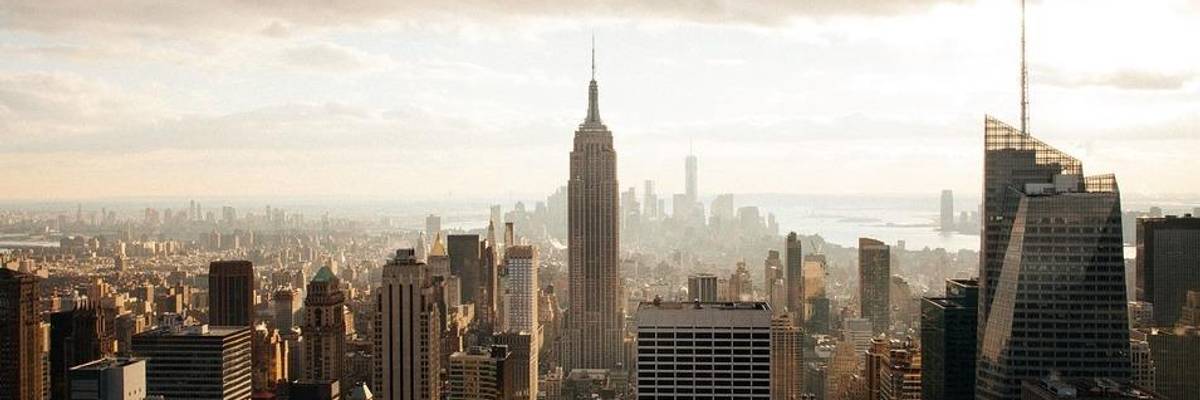
Buildings in New York will have to become greener and produce lower emissions under the city's new climate legislation. (Photo: pixabay)
The New York City Council passed the world's "largest single carbon reduction effort that any city, anywhere, has ever put forward" on Thursday afternoon, marking a major milestone in the fight against the climate crisis.
The Climate Mobilization Act contains ten provisions for a greener New York.
"It's a new day," tweeted Council Speaker Corey Johnson.
It's a new day in New York City. Climate change is an existential threat and we must rise to the occasion. The @NYCCouncil and @Costa4NY are taking aggressive action with our Climate Mobilization Act. https://t.co/JPqg6xKWVm
-- NYC Council Speaker Corey Johnson (@NYCSpeakerCoJo) April 18, 2019
Chief among the bill's provisions were regulations that directly affect city buildings.
The legislation packages together 10 separate bills and resolutions, and calls in its centerpiece bill for a 40 percent reduction in greenhouse gas emissions from city buildings. That level of reduction, and the associated costs of such a move, led real estate interests in New York to oppose the bill, which is known as Intro 1253 in the City Council.
Those efforts were unsuccessful, as the measure passed by a vote of 45-2.
Opponents of the legislation claimed it could have an adverse affect on the city's economy and lead to a drying up of jobs.
But, as HuffPost reported, that doom and gloom future is unlikely:
The new rules would create demand for more than 3,600 construction jobs per year, by one estimate, and another 4,400 jobs in maintenance, services and operations, fueled by the sheer magnitude of the investment required to meet the emissions goals.
According to The New York Times, buildings account for 67 percent of the city's emissions.
"We are answering the call for bold action we've heard from the [Intergovernmental Panel on Climate Change], Donald Trump's own National Climate Assessment, and the City's own panel on climate change," said Council Member Costa Constantinides, the chair of the Committee on Environmental Protection and the lead sponsor of Intro 1253.
The act is expected to be signed by Mayor Bill de Blasio, a Democrat who may be eying a run at the presidency in 2020.
"The bills will be the largest single reduction effort that any city has put forward," said City Councilman Keith Powers.
Activist groups hailed the move.
"This bold package of bills [serves] as a vivid reminder that communities at the front lines of the climate crisis are already, and must continue to be, at the forefront of solutions," said Tamara Toles O'Laughlin, the North American director for 350.org, in a statement. "New York is shaping up to be a model for real climate leadership for the rest of the country and world."
New York's move comes as the Green New Deal is gaining in popularity across the U.S.--and in Canada--and as Extinction Rebellion protesters in the U.K. are leading a week of aggressive civil disobedience against a "life-denying system."
"A climate justice movement is rising," said Rachel Rivera, a member of the activist group New York Communities for Change. "It's the beginning of a Green New Deal and it fills me with hope for our planet."
Dear Common Dreams reader, It’s been nearly 30 years since I co-founded Common Dreams with my late wife, Lina Newhouser. We had the radical notion that journalism should serve the public good, not corporate profits. It was clear to us from the outset what it would take to build such a project. No paid advertisements. No corporate sponsors. No millionaire publisher telling us what to think or do. Many people said we wouldn't last a year, but we proved those doubters wrong. Together with a tremendous team of journalists and dedicated staff, we built an independent media outlet free from the constraints of profits and corporate control. Our mission has always been simple: To inform. To inspire. To ignite change for the common good. Building Common Dreams was not easy. Our survival was never guaranteed. When you take on the most powerful forces—Wall Street greed, fossil fuel industry destruction, Big Tech lobbyists, and uber-rich oligarchs who have spent billions upon billions rigging the economy and democracy in their favor—the only bulwark you have is supporters who believe in your work. But here’s the urgent message from me today. It's never been this bad out there. And it's never been this hard to keep us going. At the very moment Common Dreams is most needed, the threats we face are intensifying. We need your support now more than ever. We don't accept corporate advertising and never will. We don't have a paywall because we don't think people should be blocked from critical news based on their ability to pay. Everything we do is funded by the donations of readers like you. When everyone does the little they can afford, we are strong. But if that support retreats or dries up, so do we. Will you donate now to make sure Common Dreams not only survives but thrives? —Craig Brown, Co-founder |
The New York City Council passed the world's "largest single carbon reduction effort that any city, anywhere, has ever put forward" on Thursday afternoon, marking a major milestone in the fight against the climate crisis.
The Climate Mobilization Act contains ten provisions for a greener New York.
"It's a new day," tweeted Council Speaker Corey Johnson.
It's a new day in New York City. Climate change is an existential threat and we must rise to the occasion. The @NYCCouncil and @Costa4NY are taking aggressive action with our Climate Mobilization Act. https://t.co/JPqg6xKWVm
-- NYC Council Speaker Corey Johnson (@NYCSpeakerCoJo) April 18, 2019
Chief among the bill's provisions were regulations that directly affect city buildings.
The legislation packages together 10 separate bills and resolutions, and calls in its centerpiece bill for a 40 percent reduction in greenhouse gas emissions from city buildings. That level of reduction, and the associated costs of such a move, led real estate interests in New York to oppose the bill, which is known as Intro 1253 in the City Council.
Those efforts were unsuccessful, as the measure passed by a vote of 45-2.
Opponents of the legislation claimed it could have an adverse affect on the city's economy and lead to a drying up of jobs.
But, as HuffPost reported, that doom and gloom future is unlikely:
The new rules would create demand for more than 3,600 construction jobs per year, by one estimate, and another 4,400 jobs in maintenance, services and operations, fueled by the sheer magnitude of the investment required to meet the emissions goals.
According to The New York Times, buildings account for 67 percent of the city's emissions.
"We are answering the call for bold action we've heard from the [Intergovernmental Panel on Climate Change], Donald Trump's own National Climate Assessment, and the City's own panel on climate change," said Council Member Costa Constantinides, the chair of the Committee on Environmental Protection and the lead sponsor of Intro 1253.
The act is expected to be signed by Mayor Bill de Blasio, a Democrat who may be eying a run at the presidency in 2020.
"The bills will be the largest single reduction effort that any city has put forward," said City Councilman Keith Powers.
Activist groups hailed the move.
"This bold package of bills [serves] as a vivid reminder that communities at the front lines of the climate crisis are already, and must continue to be, at the forefront of solutions," said Tamara Toles O'Laughlin, the North American director for 350.org, in a statement. "New York is shaping up to be a model for real climate leadership for the rest of the country and world."
New York's move comes as the Green New Deal is gaining in popularity across the U.S.--and in Canada--and as Extinction Rebellion protesters in the U.K. are leading a week of aggressive civil disobedience against a "life-denying system."
"A climate justice movement is rising," said Rachel Rivera, a member of the activist group New York Communities for Change. "It's the beginning of a Green New Deal and it fills me with hope for our planet."
The New York City Council passed the world's "largest single carbon reduction effort that any city, anywhere, has ever put forward" on Thursday afternoon, marking a major milestone in the fight against the climate crisis.
The Climate Mobilization Act contains ten provisions for a greener New York.
"It's a new day," tweeted Council Speaker Corey Johnson.
It's a new day in New York City. Climate change is an existential threat and we must rise to the occasion. The @NYCCouncil and @Costa4NY are taking aggressive action with our Climate Mobilization Act. https://t.co/JPqg6xKWVm
-- NYC Council Speaker Corey Johnson (@NYCSpeakerCoJo) April 18, 2019
Chief among the bill's provisions were regulations that directly affect city buildings.
The legislation packages together 10 separate bills and resolutions, and calls in its centerpiece bill for a 40 percent reduction in greenhouse gas emissions from city buildings. That level of reduction, and the associated costs of such a move, led real estate interests in New York to oppose the bill, which is known as Intro 1253 in the City Council.
Those efforts were unsuccessful, as the measure passed by a vote of 45-2.
Opponents of the legislation claimed it could have an adverse affect on the city's economy and lead to a drying up of jobs.
But, as HuffPost reported, that doom and gloom future is unlikely:
The new rules would create demand for more than 3,600 construction jobs per year, by one estimate, and another 4,400 jobs in maintenance, services and operations, fueled by the sheer magnitude of the investment required to meet the emissions goals.
According to The New York Times, buildings account for 67 percent of the city's emissions.
"We are answering the call for bold action we've heard from the [Intergovernmental Panel on Climate Change], Donald Trump's own National Climate Assessment, and the City's own panel on climate change," said Council Member Costa Constantinides, the chair of the Committee on Environmental Protection and the lead sponsor of Intro 1253.
The act is expected to be signed by Mayor Bill de Blasio, a Democrat who may be eying a run at the presidency in 2020.
"The bills will be the largest single reduction effort that any city has put forward," said City Councilman Keith Powers.
Activist groups hailed the move.
"This bold package of bills [serves] as a vivid reminder that communities at the front lines of the climate crisis are already, and must continue to be, at the forefront of solutions," said Tamara Toles O'Laughlin, the North American director for 350.org, in a statement. "New York is shaping up to be a model for real climate leadership for the rest of the country and world."
New York's move comes as the Green New Deal is gaining in popularity across the U.S.--and in Canada--and as Extinction Rebellion protesters in the U.K. are leading a week of aggressive civil disobedience against a "life-denying system."
"A climate justice movement is rising," said Rachel Rivera, a member of the activist group New York Communities for Change. "It's the beginning of a Green New Deal and it fills me with hope for our planet."

