

SUBSCRIBE TO OUR FREE NEWSLETTER
Daily news & progressive opinion—funded by the people, not the corporations—delivered straight to your inbox.
5
#000000
#FFFFFF
To donate by check, phone, or other method, see our More Ways to Give page.
Daily news & progressive opinion—funded by the people, not the corporations—delivered straight to your inbox.
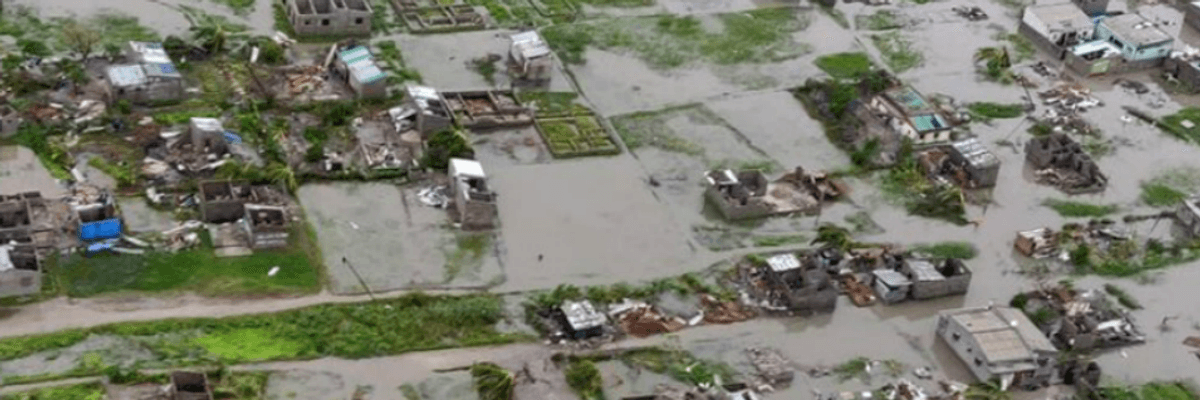
The International Federation of Red Cross and Red Crescent Societies found that 90 percent of Beira, Mozambique was destroyed by Tropical Cyclone Idai after experiencing a direct hit last Thursday. (Caroline Haga/IFRC)
Hundreds of people were killed and many more remain missing after a tropical cyclone destroyed 90 percent of the port city of Beira, Mozambique, before moving on to Malawi and Zimbabwe--eliciting fresh demands for bolder efforts to battle the climate crisis that is making extreme weather more common and devastating.
An initial assessment from the International Federation of Red Cross and Red Crescent Societies (IFRC) on Monday found that 90 percent of the city and the surrounding area "is completely destroyed" after experiencing a direct hit from Cyclone Idai last Thursday.
"The situation is terrible. The scale of devastation is enormous," said Jamie LeSueur, who is leading the IFRC team into Beira. "Communication lines have been completely cut and roads have been destroyed. Some affected communities are not accessible."
"I think this is the biggest natural disaster Mozambique has ever faced," Celso Correia, the country's environment minister, told the South Africa-based Mail & Guardian. "Everything is destroyed. Our priority now is to save human lives."
Citing the Red Cross and government officials, The Associated Press reported Monday that across the three African countries, "more than 215 people have been killed by the storm, hundreds more are missing, and more than 1.5 million people have been affected by the widespread destruction and flooding."
However, LeSueur noted, aid workers and government officials are still working to access the damage: "Beira has been severely battered. But we are also hearing that the situation outside the city could be even worse. [Sunday], a large dam burst and cut off the last road to the city."
Speaking to state-owned Radio Mozambique on Monday, President Filipe Nyusi said the death toll may surpass 1,000 people in his country alone.
As aerial footage began to circulate online Monday, the emerging sense of devastation provoked calls for the world to "wake up" to the reality of the global climate crisis:
Bill McKibben, co-founder of the environmental group 350.org, tweeted a reminder on Monday that "the people who've done the least to change the climate suffer the most."
An editorial published Monday by Zimbabwe's state-owned daily newspaper, The Herald, called the storm a "wake-up call to climate change." As the editorial reads:
The increase in cyclones and other extreme weather phenomena like droughts and floods, clearly indicate that climate change effects are intensifying... While we cannot completely stop climate change, there is much the government can do to adapt to the weather phenomenon. After all the tumult surrounding Cyclone Idai dies down, it will be critical for government to have a re-look at the adaptive strategies to climate change which it has put in place.
While recognizing that in the short term, "there is urgent need for medicines, shelter, food, and new homes for the survivors of Cyclone Idai," the editorial calls for a long-term "holistic approach to fighting the effects of climate change and ensure that communities are cushioned even in the event of devastating cyclones."
Dear Common Dreams reader, It’s been nearly 30 years since I co-founded Common Dreams with my late wife, Lina Newhouser. We had the radical notion that journalism should serve the public good, not corporate profits. It was clear to us from the outset what it would take to build such a project. No paid advertisements. No corporate sponsors. No millionaire publisher telling us what to think or do. Many people said we wouldn't last a year, but we proved those doubters wrong. Together with a tremendous team of journalists and dedicated staff, we built an independent media outlet free from the constraints of profits and corporate control. Our mission has always been simple: To inform. To inspire. To ignite change for the common good. Building Common Dreams was not easy. Our survival was never guaranteed. When you take on the most powerful forces—Wall Street greed, fossil fuel industry destruction, Big Tech lobbyists, and uber-rich oligarchs who have spent billions upon billions rigging the economy and democracy in their favor—the only bulwark you have is supporters who believe in your work. But here’s the urgent message from me today. It's never been this bad out there. And it's never been this hard to keep us going. At the very moment Common Dreams is most needed, the threats we face are intensifying. We need your support now more than ever. We don't accept corporate advertising and never will. We don't have a paywall because we don't think people should be blocked from critical news based on their ability to pay. Everything we do is funded by the donations of readers like you. When everyone does the little they can afford, we are strong. But if that support retreats or dries up, so do we. Will you donate now to make sure Common Dreams not only survives but thrives? —Craig Brown, Co-founder |
Hundreds of people were killed and many more remain missing after a tropical cyclone destroyed 90 percent of the port city of Beira, Mozambique, before moving on to Malawi and Zimbabwe--eliciting fresh demands for bolder efforts to battle the climate crisis that is making extreme weather more common and devastating.
An initial assessment from the International Federation of Red Cross and Red Crescent Societies (IFRC) on Monday found that 90 percent of the city and the surrounding area "is completely destroyed" after experiencing a direct hit from Cyclone Idai last Thursday.
"The situation is terrible. The scale of devastation is enormous," said Jamie LeSueur, who is leading the IFRC team into Beira. "Communication lines have been completely cut and roads have been destroyed. Some affected communities are not accessible."
"I think this is the biggest natural disaster Mozambique has ever faced," Celso Correia, the country's environment minister, told the South Africa-based Mail & Guardian. "Everything is destroyed. Our priority now is to save human lives."
Citing the Red Cross and government officials, The Associated Press reported Monday that across the three African countries, "more than 215 people have been killed by the storm, hundreds more are missing, and more than 1.5 million people have been affected by the widespread destruction and flooding."
However, LeSueur noted, aid workers and government officials are still working to access the damage: "Beira has been severely battered. But we are also hearing that the situation outside the city could be even worse. [Sunday], a large dam burst and cut off the last road to the city."
Speaking to state-owned Radio Mozambique on Monday, President Filipe Nyusi said the death toll may surpass 1,000 people in his country alone.
As aerial footage began to circulate online Monday, the emerging sense of devastation provoked calls for the world to "wake up" to the reality of the global climate crisis:
Bill McKibben, co-founder of the environmental group 350.org, tweeted a reminder on Monday that "the people who've done the least to change the climate suffer the most."
An editorial published Monday by Zimbabwe's state-owned daily newspaper, The Herald, called the storm a "wake-up call to climate change." As the editorial reads:
The increase in cyclones and other extreme weather phenomena like droughts and floods, clearly indicate that climate change effects are intensifying... While we cannot completely stop climate change, there is much the government can do to adapt to the weather phenomenon. After all the tumult surrounding Cyclone Idai dies down, it will be critical for government to have a re-look at the adaptive strategies to climate change which it has put in place.
While recognizing that in the short term, "there is urgent need for medicines, shelter, food, and new homes for the survivors of Cyclone Idai," the editorial calls for a long-term "holistic approach to fighting the effects of climate change and ensure that communities are cushioned even in the event of devastating cyclones."
Hundreds of people were killed and many more remain missing after a tropical cyclone destroyed 90 percent of the port city of Beira, Mozambique, before moving on to Malawi and Zimbabwe--eliciting fresh demands for bolder efforts to battle the climate crisis that is making extreme weather more common and devastating.
An initial assessment from the International Federation of Red Cross and Red Crescent Societies (IFRC) on Monday found that 90 percent of the city and the surrounding area "is completely destroyed" after experiencing a direct hit from Cyclone Idai last Thursday.
"The situation is terrible. The scale of devastation is enormous," said Jamie LeSueur, who is leading the IFRC team into Beira. "Communication lines have been completely cut and roads have been destroyed. Some affected communities are not accessible."
"I think this is the biggest natural disaster Mozambique has ever faced," Celso Correia, the country's environment minister, told the South Africa-based Mail & Guardian. "Everything is destroyed. Our priority now is to save human lives."
Citing the Red Cross and government officials, The Associated Press reported Monday that across the three African countries, "more than 215 people have been killed by the storm, hundreds more are missing, and more than 1.5 million people have been affected by the widespread destruction and flooding."
However, LeSueur noted, aid workers and government officials are still working to access the damage: "Beira has been severely battered. But we are also hearing that the situation outside the city could be even worse. [Sunday], a large dam burst and cut off the last road to the city."
Speaking to state-owned Radio Mozambique on Monday, President Filipe Nyusi said the death toll may surpass 1,000 people in his country alone.
As aerial footage began to circulate online Monday, the emerging sense of devastation provoked calls for the world to "wake up" to the reality of the global climate crisis:
Bill McKibben, co-founder of the environmental group 350.org, tweeted a reminder on Monday that "the people who've done the least to change the climate suffer the most."
An editorial published Monday by Zimbabwe's state-owned daily newspaper, The Herald, called the storm a "wake-up call to climate change." As the editorial reads:
The increase in cyclones and other extreme weather phenomena like droughts and floods, clearly indicate that climate change effects are intensifying... While we cannot completely stop climate change, there is much the government can do to adapt to the weather phenomenon. After all the tumult surrounding Cyclone Idai dies down, it will be critical for government to have a re-look at the adaptive strategies to climate change which it has put in place.
While recognizing that in the short term, "there is urgent need for medicines, shelter, food, and new homes for the survivors of Cyclone Idai," the editorial calls for a long-term "holistic approach to fighting the effects of climate change and ensure that communities are cushioned even in the event of devastating cyclones."

