SUBSCRIBE TO OUR FREE NEWSLETTER
Daily news & progressive opinion—funded by the people, not the corporations—delivered straight to your inbox.
5
#000000
#FFFFFF
To donate by check, phone, or other method, see our More Ways to Give page.
Daily news & progressive opinion—funded by the people, not the corporations—delivered straight to your inbox.
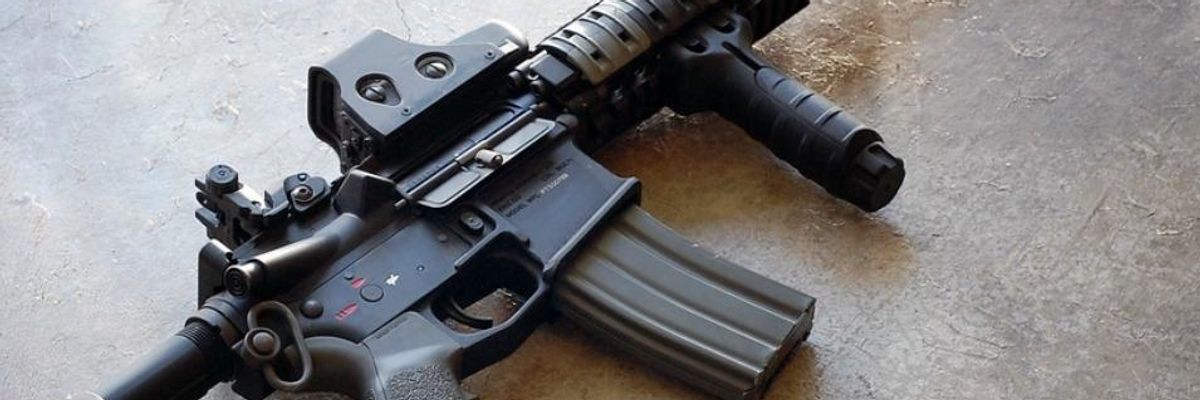
The families of some of the 26 people who were killed at Sandy Hook Elementary School won a major victory Thursday as the Connecticut State Supreme Court ruled that they can sue the maker of the gun that was used in the attack in 2012. (Photo: Chris Juliano/cc/flickr)
The maker of the semi-automatic assault rifle that was used in the Sandy Hook massacre in 2012 can potentially be held liable for the 26 killings the gun was used to commit, the Connecticut Supreme Court ruled Thursday.
The decision represents a major victory for the families of the 20 first-grade children and six educators who were killed in one of the deadliest mass shootings in U.S. history, which inflamed outrage among gun control advocates who demanded lawmakers work to prevent mass shooting.
"I am thrilled and tremendously grateful," Nicole Hockley, whose 6-year-old son Dylan was killed at Sandy Hook, told the New York Times. "No one has blanket immunity. There are consequences."
In a 4-3 ruling, the state Supreme Court upheld a lower court's earlier decision that Remington, the maker of the AR-15 Bushmaster, should not be considered automatically immune from liability and lawsuits when their product is used in a crime.
The company may be guilty of making unlawful marketing claims, the court ruled, due to its promotion of a military-grade weapon for hunting and "recreational" use by civilians; its use of images of combat when selling the AR-15; and its use of slogans like "Consider your man card reissued."
Such marketing schemes "reflected a deliberate effort to appeal to troubled young men" like the one who carried out the shooting, the families' lawsuit reads.
"Remington may never have known" the shooter, the families' attorney, Joshua Koskoff said, "but they had been courting him for years."
"The regulation of advertising that threatens the public's health, safety, and morals has long been considered a core exercise of the states' police powers," wrote Justice Richard Powers.
The families' lawsuit can now bypass the Protection of Lawful Commerce in Arms Act, which Congress passed in 2005, making it impossible for survivors of gun violence to hold manufacturers accountable for selling weapons to shooters.
It now "falls to a jury to decide whether the promotional schemes alleged in the present case rise to the level of illegal trade practices and whether fault for the tragedy can be laid at their feet," the state Supreme Court ruled.
Nine of the families originally filed the lawsuit in 2014, and have faced delays as the case was sent from federal to state-level courts and as Remington filed for bankruptcy last year.
"These families were not going to go away," Koskoff said in a statement after the ruling was handed down, "no matter how long it took."
Dear Common Dreams reader, It’s been nearly 30 years since I co-founded Common Dreams with my late wife, Lina Newhouser. We had the radical notion that journalism should serve the public good, not corporate profits. It was clear to us from the outset what it would take to build such a project. No paid advertisements. No corporate sponsors. No millionaire publisher telling us what to think or do. Many people said we wouldn't last a year, but we proved those doubters wrong. Together with a tremendous team of journalists and dedicated staff, we built an independent media outlet free from the constraints of profits and corporate control. Our mission has always been simple: To inform. To inspire. To ignite change for the common good. Building Common Dreams was not easy. Our survival was never guaranteed. When you take on the most powerful forces—Wall Street greed, fossil fuel industry destruction, Big Tech lobbyists, and uber-rich oligarchs who have spent billions upon billions rigging the economy and democracy in their favor—the only bulwark you have is supporters who believe in your work. But here’s the urgent message from me today. It's never been this bad out there. And it's never been this hard to keep us going. At the very moment Common Dreams is most needed, the threats we face are intensifying. We need your support now more than ever. We don't accept corporate advertising and never will. We don't have a paywall because we don't think people should be blocked from critical news based on their ability to pay. Everything we do is funded by the donations of readers like you. When everyone does the little they can afford, we are strong. But if that support retreats or dries up, so do we. Will you donate now to make sure Common Dreams not only survives but thrives? —Craig Brown, Co-founder |
The maker of the semi-automatic assault rifle that was used in the Sandy Hook massacre in 2012 can potentially be held liable for the 26 killings the gun was used to commit, the Connecticut Supreme Court ruled Thursday.
The decision represents a major victory for the families of the 20 first-grade children and six educators who were killed in one of the deadliest mass shootings in U.S. history, which inflamed outrage among gun control advocates who demanded lawmakers work to prevent mass shooting.
"I am thrilled and tremendously grateful," Nicole Hockley, whose 6-year-old son Dylan was killed at Sandy Hook, told the New York Times. "No one has blanket immunity. There are consequences."
In a 4-3 ruling, the state Supreme Court upheld a lower court's earlier decision that Remington, the maker of the AR-15 Bushmaster, should not be considered automatically immune from liability and lawsuits when their product is used in a crime.
The company may be guilty of making unlawful marketing claims, the court ruled, due to its promotion of a military-grade weapon for hunting and "recreational" use by civilians; its use of images of combat when selling the AR-15; and its use of slogans like "Consider your man card reissued."
Such marketing schemes "reflected a deliberate effort to appeal to troubled young men" like the one who carried out the shooting, the families' lawsuit reads.
"Remington may never have known" the shooter, the families' attorney, Joshua Koskoff said, "but they had been courting him for years."
"The regulation of advertising that threatens the public's health, safety, and morals has long been considered a core exercise of the states' police powers," wrote Justice Richard Powers.
The families' lawsuit can now bypass the Protection of Lawful Commerce in Arms Act, which Congress passed in 2005, making it impossible for survivors of gun violence to hold manufacturers accountable for selling weapons to shooters.
It now "falls to a jury to decide whether the promotional schemes alleged in the present case rise to the level of illegal trade practices and whether fault for the tragedy can be laid at their feet," the state Supreme Court ruled.
Nine of the families originally filed the lawsuit in 2014, and have faced delays as the case was sent from federal to state-level courts and as Remington filed for bankruptcy last year.
"These families were not going to go away," Koskoff said in a statement after the ruling was handed down, "no matter how long it took."
The maker of the semi-automatic assault rifle that was used in the Sandy Hook massacre in 2012 can potentially be held liable for the 26 killings the gun was used to commit, the Connecticut Supreme Court ruled Thursday.
The decision represents a major victory for the families of the 20 first-grade children and six educators who were killed in one of the deadliest mass shootings in U.S. history, which inflamed outrage among gun control advocates who demanded lawmakers work to prevent mass shooting.
"I am thrilled and tremendously grateful," Nicole Hockley, whose 6-year-old son Dylan was killed at Sandy Hook, told the New York Times. "No one has blanket immunity. There are consequences."
In a 4-3 ruling, the state Supreme Court upheld a lower court's earlier decision that Remington, the maker of the AR-15 Bushmaster, should not be considered automatically immune from liability and lawsuits when their product is used in a crime.
The company may be guilty of making unlawful marketing claims, the court ruled, due to its promotion of a military-grade weapon for hunting and "recreational" use by civilians; its use of images of combat when selling the AR-15; and its use of slogans like "Consider your man card reissued."
Such marketing schemes "reflected a deliberate effort to appeal to troubled young men" like the one who carried out the shooting, the families' lawsuit reads.
"Remington may never have known" the shooter, the families' attorney, Joshua Koskoff said, "but they had been courting him for years."
"The regulation of advertising that threatens the public's health, safety, and morals has long been considered a core exercise of the states' police powers," wrote Justice Richard Powers.
The families' lawsuit can now bypass the Protection of Lawful Commerce in Arms Act, which Congress passed in 2005, making it impossible for survivors of gun violence to hold manufacturers accountable for selling weapons to shooters.
It now "falls to a jury to decide whether the promotional schemes alleged in the present case rise to the level of illegal trade practices and whether fault for the tragedy can be laid at their feet," the state Supreme Court ruled.
Nine of the families originally filed the lawsuit in 2014, and have faced delays as the case was sent from federal to state-level courts and as Remington filed for bankruptcy last year.
"These families were not going to go away," Koskoff said in a statement after the ruling was handed down, "no matter how long it took."