SUBSCRIBE TO OUR FREE NEWSLETTER
Daily news & progressive opinion—funded by the people, not the corporations—delivered straight to your inbox.
5
#000000
#FFFFFF
To donate by check, phone, or other method, see our More Ways to Give page.
Daily news & progressive opinion—funded by the people, not the corporations—delivered straight to your inbox.
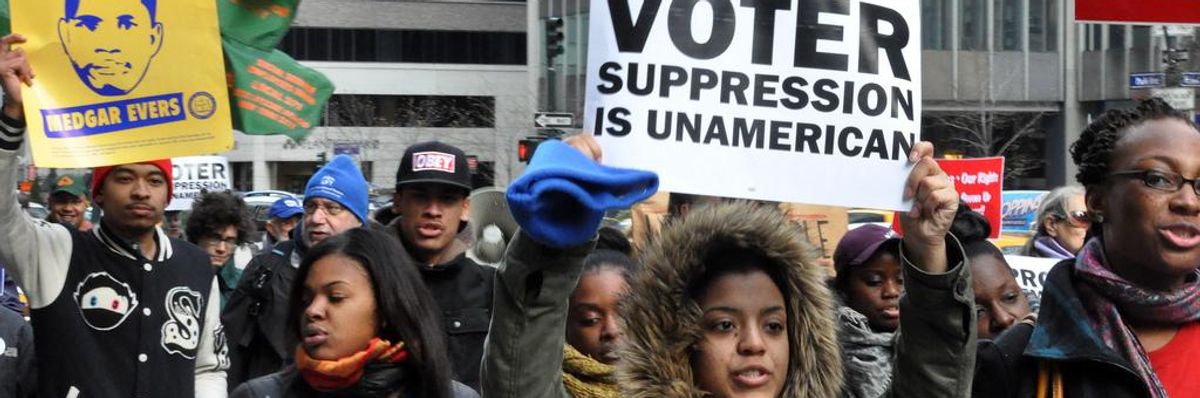
Occupy Wall Street joined the NAACP as thousands marched in midtown Manhattan on December 10, 2011 to defend voting rights (Photo: Flickr, fleshmanpix).
Voting rights advocates celebrated a federal judge's ruling Wednesday that ordered the state of Texas to stop removing voters from registration rolls.
The order came from U.S. district judge Fred Biery in response to a lawsuit filed by a group of rights groups against Texas Secretary of State David Whitley.
According to NBC News:
The federal judge slammed Whitley and his botched attempt to identify ineligible voters, saying the state officials came up with a solution "inherently paved with flawed results."
Whitley and his staff burdened "perfectly legal, naturalized Americans" with "ham-handed and threatening correspondence, which did not politely ask for information, but rather exemplifies the power of government to strike fear and anxiety and to intimidate the least powerful among us," the judge wrote.
In a statement, the American Civil Liberties Union of Texas, one of the plaintiffs in the suit, welcomed Biery's ruling--specifically the judge's rejection of the premise of the state's purge list.
"Today, the court recognized what we have been saying all along," said the ACLU Texas staff attorney Thomas Buser-Clancy. "This voter purge discriminates against naturalized citizens using a process that the court described as 'ham-handed' and 'threatening.'"
Other groups and advocates, including the national ACLU, weighed in on social media.
Whitley's "purge list," at the center of the suit, overwhelmingly targets naturalized citizens. And the list isn't a corrective to a temporary problem--it's meant to continue to purge voters on a rolling basis.
From the suit (pdf):
Whitley does not intend for the purge to be a one-time event. Rather, using the flawed methodology that uniquely targets naturalized citizens, he intends to provide Purge Lists to counties on a monthly basis, thus regularly subjecting naturalized citizens to voter registration requirements to which native-born citizens are not subject, and exposing them to a continuing and ongoing threat of being purged from the voter rolls.
Rights groups involved in the litigation have alleged that the list is meant to intimidate immigrants and make it harder for people to vote in Texas.
"Texas is stirring up anti-immigrant sentiment, undermining the public's faith in our democracy, and preparing to purge thousands of eligible citizens from the rolls," Chiraag Bains, director of legal strategies at Demos, said when the suit was initially filed in federal court.
For now, Biery's order only stops the purge from continuing--a temporary stoppage, but the language of the ruling indicates that Texas will have a difficult road ahead to prove the necessity of the purge.
"Let this be a message to the rest of the country," the Campaign Legal Center, one of the plaintiffs in the suit, said in a statement, "that states will face consequences when they threaten their citizens' right to vote."
Dear Common Dreams reader, It’s been nearly 30 years since I co-founded Common Dreams with my late wife, Lina Newhouser. We had the radical notion that journalism should serve the public good, not corporate profits. It was clear to us from the outset what it would take to build such a project. No paid advertisements. No corporate sponsors. No millionaire publisher telling us what to think or do. Many people said we wouldn't last a year, but we proved those doubters wrong. Together with a tremendous team of journalists and dedicated staff, we built an independent media outlet free from the constraints of profits and corporate control. Our mission has always been simple: To inform. To inspire. To ignite change for the common good. Building Common Dreams was not easy. Our survival was never guaranteed. When you take on the most powerful forces—Wall Street greed, fossil fuel industry destruction, Big Tech lobbyists, and uber-rich oligarchs who have spent billions upon billions rigging the economy and democracy in their favor—the only bulwark you have is supporters who believe in your work. But here’s the urgent message from me today. It's never been this bad out there. And it's never been this hard to keep us going. At the very moment Common Dreams is most needed, the threats we face are intensifying. We need your support now more than ever. We don't accept corporate advertising and never will. We don't have a paywall because we don't think people should be blocked from critical news based on their ability to pay. Everything we do is funded by the donations of readers like you. When everyone does the little they can afford, we are strong. But if that support retreats or dries up, so do we. Will you donate now to make sure Common Dreams not only survives but thrives? —Craig Brown, Co-founder |
Voting rights advocates celebrated a federal judge's ruling Wednesday that ordered the state of Texas to stop removing voters from registration rolls.
The order came from U.S. district judge Fred Biery in response to a lawsuit filed by a group of rights groups against Texas Secretary of State David Whitley.
According to NBC News:
The federal judge slammed Whitley and his botched attempt to identify ineligible voters, saying the state officials came up with a solution "inherently paved with flawed results."
Whitley and his staff burdened "perfectly legal, naturalized Americans" with "ham-handed and threatening correspondence, which did not politely ask for information, but rather exemplifies the power of government to strike fear and anxiety and to intimidate the least powerful among us," the judge wrote.
In a statement, the American Civil Liberties Union of Texas, one of the plaintiffs in the suit, welcomed Biery's ruling--specifically the judge's rejection of the premise of the state's purge list.
"Today, the court recognized what we have been saying all along," said the ACLU Texas staff attorney Thomas Buser-Clancy. "This voter purge discriminates against naturalized citizens using a process that the court described as 'ham-handed' and 'threatening.'"
Other groups and advocates, including the national ACLU, weighed in on social media.
Whitley's "purge list," at the center of the suit, overwhelmingly targets naturalized citizens. And the list isn't a corrective to a temporary problem--it's meant to continue to purge voters on a rolling basis.
From the suit (pdf):
Whitley does not intend for the purge to be a one-time event. Rather, using the flawed methodology that uniquely targets naturalized citizens, he intends to provide Purge Lists to counties on a monthly basis, thus regularly subjecting naturalized citizens to voter registration requirements to which native-born citizens are not subject, and exposing them to a continuing and ongoing threat of being purged from the voter rolls.
Rights groups involved in the litigation have alleged that the list is meant to intimidate immigrants and make it harder for people to vote in Texas.
"Texas is stirring up anti-immigrant sentiment, undermining the public's faith in our democracy, and preparing to purge thousands of eligible citizens from the rolls," Chiraag Bains, director of legal strategies at Demos, said when the suit was initially filed in federal court.
For now, Biery's order only stops the purge from continuing--a temporary stoppage, but the language of the ruling indicates that Texas will have a difficult road ahead to prove the necessity of the purge.
"Let this be a message to the rest of the country," the Campaign Legal Center, one of the plaintiffs in the suit, said in a statement, "that states will face consequences when they threaten their citizens' right to vote."
Voting rights advocates celebrated a federal judge's ruling Wednesday that ordered the state of Texas to stop removing voters from registration rolls.
The order came from U.S. district judge Fred Biery in response to a lawsuit filed by a group of rights groups against Texas Secretary of State David Whitley.
According to NBC News:
The federal judge slammed Whitley and his botched attempt to identify ineligible voters, saying the state officials came up with a solution "inherently paved with flawed results."
Whitley and his staff burdened "perfectly legal, naturalized Americans" with "ham-handed and threatening correspondence, which did not politely ask for information, but rather exemplifies the power of government to strike fear and anxiety and to intimidate the least powerful among us," the judge wrote.
In a statement, the American Civil Liberties Union of Texas, one of the plaintiffs in the suit, welcomed Biery's ruling--specifically the judge's rejection of the premise of the state's purge list.
"Today, the court recognized what we have been saying all along," said the ACLU Texas staff attorney Thomas Buser-Clancy. "This voter purge discriminates against naturalized citizens using a process that the court described as 'ham-handed' and 'threatening.'"
Other groups and advocates, including the national ACLU, weighed in on social media.
Whitley's "purge list," at the center of the suit, overwhelmingly targets naturalized citizens. And the list isn't a corrective to a temporary problem--it's meant to continue to purge voters on a rolling basis.
From the suit (pdf):
Whitley does not intend for the purge to be a one-time event. Rather, using the flawed methodology that uniquely targets naturalized citizens, he intends to provide Purge Lists to counties on a monthly basis, thus regularly subjecting naturalized citizens to voter registration requirements to which native-born citizens are not subject, and exposing them to a continuing and ongoing threat of being purged from the voter rolls.
Rights groups involved in the litigation have alleged that the list is meant to intimidate immigrants and make it harder for people to vote in Texas.
"Texas is stirring up anti-immigrant sentiment, undermining the public's faith in our democracy, and preparing to purge thousands of eligible citizens from the rolls," Chiraag Bains, director of legal strategies at Demos, said when the suit was initially filed in federal court.
For now, Biery's order only stops the purge from continuing--a temporary stoppage, but the language of the ruling indicates that Texas will have a difficult road ahead to prove the necessity of the purge.
"Let this be a message to the rest of the country," the Campaign Legal Center, one of the plaintiffs in the suit, said in a statement, "that states will face consequences when they threaten their citizens' right to vote."