SUBSCRIBE TO OUR FREE NEWSLETTER
Daily news & progressive opinion—funded by the people, not the corporations—delivered straight to your inbox.
5
#000000
#FFFFFF
To donate by check, phone, or other method, see our More Ways to Give page.
Daily news & progressive opinion—funded by the people, not the corporations—delivered straight to your inbox.
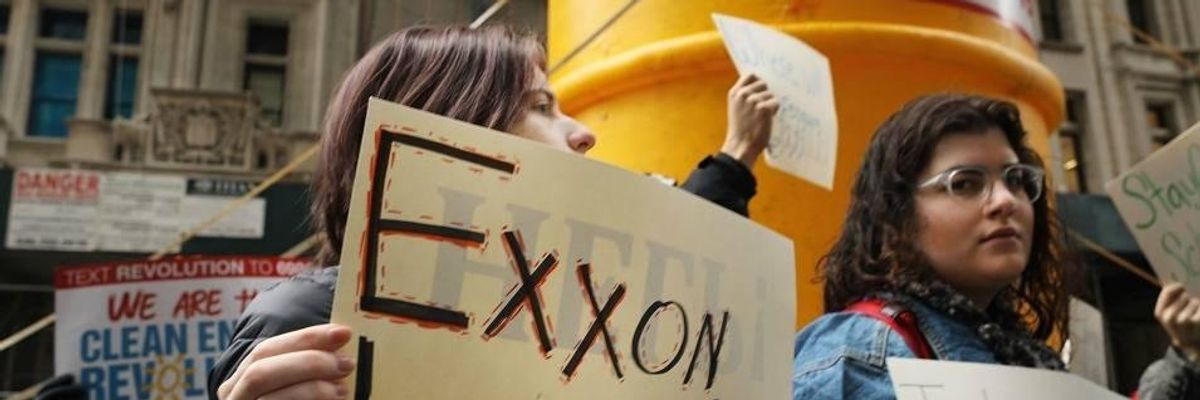
Climate campaigners--armed with investigative reports--maintain that ExxonMobil lied to investors and the public for decades about how fossil fuel production has contributed to and continues to drive the global climate crisis. (Photo: Spencer Platt/Getty Images)
In a win for climate campaigners and Massachusetts' Democratic Attorney General Maura Healey on Monday, the U.S. Supreme Court rejected ExxonMobil's attempt to block Healey's demand for documents related to her state's ongoing investigation into allegations that one of the world's largest oil and gas corporations deceived the public and investors for decades about how fossil fuels drive global warming.
"Executives at Exxon knew about climate change decades ago, but they chose to lie to the rest of us to line their oily pockets. Now, it's those who have done the least to cause the problem who are paying the cost of this deception."
--Thanu Yakupitiyage, 350.org
"The public deserves answers from this company about what it knew about the impacts of burning fossil fuels, and when," Healey said, responding on Twitter to the ruling. This victory, she added, "clears the way for our office to investigate Exxon's conduct toward consumers and investors."
The news, which followed a Massachusetts Supreme Court ruling against the company in April, was also welcomed by climate activists--including 350.org U.S. communications manager Thanu Yakupitiyage, who thanked Healey "for her vigilant leadership in standing up for people over polluters."
"Executives at Exxon knew about climate change decades ago, but they chose to lie to the rest of us to line their oily pockets," Yakupitiyage declared. "Now, it's those who have done the least to cause the problem who are paying the cost of this deception through our lives and livelihoods. In 2019, we'll use all our power to make sure Big Oil pays its fair share for climate destruction."
Richard Wiles, executive director of the Center for Climate Integrity, celebrated the high court's decision and said that the company's failed attempt to block Healey from obtaining internal records indicates concern over what the documents could mean for legal attempts to take the company to court over its alleged climate deception.
"Exxon's last ditch effort to avoid turning over additional documents to investigators suggests the company has a whole lot more it's still hiding from the public, shareholders, and policymakers."
--Richard Wiles, Center for Climate Integrity
"Exxon's last ditch effort to avoid turning over additional documents to investigators suggests the company has a whole lot more it's still hiding from the public, shareholders, and policymakers," he noted.
Wiles also posited that "Exxon fears nothing more than the truth these documents will reveal: that they have known for 50 years that their products cause climate change, and ran a massive deception campaign to confuse the public about it, consequences be damned."
Bill McKibben, co-founder of 350.org, said in response to the ruling on Monday, "This is an important moment."
As the #ExxonKnew campaign--run by a coalition of groups that aim to hold the company accountable--concluded, "No one is above the law."
Despite a series of damning investigative reports in recent years, ExxonMobil has dismissed allegations of deception as "meritless" and continued to battle against probes launched by the attorneys general of Massachusetts and New York as well as the Security and Exchange Commission (SEC), which ended its investigation in August without any further action.
New York's Democratic Attorney General Barbara Underwood, meanwhile, officially filed suit against ExxonMobil October, claiming the oil giant "built a facade to deceive investors into believing that the company was managing the risks of climate change regulation to its business when, in fact, it was intentionally and systematically underestimating or ignoring them, contrary to its public representations."
As Carroll Muffett, president of the Center for International Environmental Law (CIEL) pointed out in a statement on Monday, "The millions of pages of documents Exxon was compelled to turn over in the New York investigation evidenced widespread malfeasance reaching the highest levels of the company, and they led the New York attorney general to sue the company on multiple counts of securities fraud."
However, Muffett continued, "the Massachusetts investigation poses an even bigger risk for the company because the pool of Exxon's potential victims includes not only seven million citizens and consumers in Massachusetts, but also untold tens of millions more living in states with nearly identical consumer protection laws."
This post has been updated with comment from Bill McKibben of 350.org and Carroll Muffett of CIEL.
Dear Common Dreams reader, It’s been nearly 30 years since I co-founded Common Dreams with my late wife, Lina Newhouser. We had the radical notion that journalism should serve the public good, not corporate profits. It was clear to us from the outset what it would take to build such a project. No paid advertisements. No corporate sponsors. No millionaire publisher telling us what to think or do. Many people said we wouldn't last a year, but we proved those doubters wrong. Together with a tremendous team of journalists and dedicated staff, we built an independent media outlet free from the constraints of profits and corporate control. Our mission has always been simple: To inform. To inspire. To ignite change for the common good. Building Common Dreams was not easy. Our survival was never guaranteed. When you take on the most powerful forces—Wall Street greed, fossil fuel industry destruction, Big Tech lobbyists, and uber-rich oligarchs who have spent billions upon billions rigging the economy and democracy in their favor—the only bulwark you have is supporters who believe in your work. But here’s the urgent message from me today. It's never been this bad out there. And it's never been this hard to keep us going. At the very moment Common Dreams is most needed, the threats we face are intensifying. We need your support now more than ever. We don't accept corporate advertising and never will. We don't have a paywall because we don't think people should be blocked from critical news based on their ability to pay. Everything we do is funded by the donations of readers like you. When everyone does the little they can afford, we are strong. But if that support retreats or dries up, so do we. Will you donate now to make sure Common Dreams not only survives but thrives? —Craig Brown, Co-founder |
In a win for climate campaigners and Massachusetts' Democratic Attorney General Maura Healey on Monday, the U.S. Supreme Court rejected ExxonMobil's attempt to block Healey's demand for documents related to her state's ongoing investigation into allegations that one of the world's largest oil and gas corporations deceived the public and investors for decades about how fossil fuels drive global warming.
"Executives at Exxon knew about climate change decades ago, but they chose to lie to the rest of us to line their oily pockets. Now, it's those who have done the least to cause the problem who are paying the cost of this deception."
--Thanu Yakupitiyage, 350.org
"The public deserves answers from this company about what it knew about the impacts of burning fossil fuels, and when," Healey said, responding on Twitter to the ruling. This victory, she added, "clears the way for our office to investigate Exxon's conduct toward consumers and investors."
The news, which followed a Massachusetts Supreme Court ruling against the company in April, was also welcomed by climate activists--including 350.org U.S. communications manager Thanu Yakupitiyage, who thanked Healey "for her vigilant leadership in standing up for people over polluters."
"Executives at Exxon knew about climate change decades ago, but they chose to lie to the rest of us to line their oily pockets," Yakupitiyage declared. "Now, it's those who have done the least to cause the problem who are paying the cost of this deception through our lives and livelihoods. In 2019, we'll use all our power to make sure Big Oil pays its fair share for climate destruction."
Richard Wiles, executive director of the Center for Climate Integrity, celebrated the high court's decision and said that the company's failed attempt to block Healey from obtaining internal records indicates concern over what the documents could mean for legal attempts to take the company to court over its alleged climate deception.
"Exxon's last ditch effort to avoid turning over additional documents to investigators suggests the company has a whole lot more it's still hiding from the public, shareholders, and policymakers."
--Richard Wiles, Center for Climate Integrity
"Exxon's last ditch effort to avoid turning over additional documents to investigators suggests the company has a whole lot more it's still hiding from the public, shareholders, and policymakers," he noted.
Wiles also posited that "Exxon fears nothing more than the truth these documents will reveal: that they have known for 50 years that their products cause climate change, and ran a massive deception campaign to confuse the public about it, consequences be damned."
Bill McKibben, co-founder of 350.org, said in response to the ruling on Monday, "This is an important moment."
As the #ExxonKnew campaign--run by a coalition of groups that aim to hold the company accountable--concluded, "No one is above the law."
Despite a series of damning investigative reports in recent years, ExxonMobil has dismissed allegations of deception as "meritless" and continued to battle against probes launched by the attorneys general of Massachusetts and New York as well as the Security and Exchange Commission (SEC), which ended its investigation in August without any further action.
New York's Democratic Attorney General Barbara Underwood, meanwhile, officially filed suit against ExxonMobil October, claiming the oil giant "built a facade to deceive investors into believing that the company was managing the risks of climate change regulation to its business when, in fact, it was intentionally and systematically underestimating or ignoring them, contrary to its public representations."
As Carroll Muffett, president of the Center for International Environmental Law (CIEL) pointed out in a statement on Monday, "The millions of pages of documents Exxon was compelled to turn over in the New York investigation evidenced widespread malfeasance reaching the highest levels of the company, and they led the New York attorney general to sue the company on multiple counts of securities fraud."
However, Muffett continued, "the Massachusetts investigation poses an even bigger risk for the company because the pool of Exxon's potential victims includes not only seven million citizens and consumers in Massachusetts, but also untold tens of millions more living in states with nearly identical consumer protection laws."
This post has been updated with comment from Bill McKibben of 350.org and Carroll Muffett of CIEL.
In a win for climate campaigners and Massachusetts' Democratic Attorney General Maura Healey on Monday, the U.S. Supreme Court rejected ExxonMobil's attempt to block Healey's demand for documents related to her state's ongoing investigation into allegations that one of the world's largest oil and gas corporations deceived the public and investors for decades about how fossil fuels drive global warming.
"Executives at Exxon knew about climate change decades ago, but they chose to lie to the rest of us to line their oily pockets. Now, it's those who have done the least to cause the problem who are paying the cost of this deception."
--Thanu Yakupitiyage, 350.org
"The public deserves answers from this company about what it knew about the impacts of burning fossil fuels, and when," Healey said, responding on Twitter to the ruling. This victory, she added, "clears the way for our office to investigate Exxon's conduct toward consumers and investors."
The news, which followed a Massachusetts Supreme Court ruling against the company in April, was also welcomed by climate activists--including 350.org U.S. communications manager Thanu Yakupitiyage, who thanked Healey "for her vigilant leadership in standing up for people over polluters."
"Executives at Exxon knew about climate change decades ago, but they chose to lie to the rest of us to line their oily pockets," Yakupitiyage declared. "Now, it's those who have done the least to cause the problem who are paying the cost of this deception through our lives and livelihoods. In 2019, we'll use all our power to make sure Big Oil pays its fair share for climate destruction."
Richard Wiles, executive director of the Center for Climate Integrity, celebrated the high court's decision and said that the company's failed attempt to block Healey from obtaining internal records indicates concern over what the documents could mean for legal attempts to take the company to court over its alleged climate deception.
"Exxon's last ditch effort to avoid turning over additional documents to investigators suggests the company has a whole lot more it's still hiding from the public, shareholders, and policymakers."
--Richard Wiles, Center for Climate Integrity
"Exxon's last ditch effort to avoid turning over additional documents to investigators suggests the company has a whole lot more it's still hiding from the public, shareholders, and policymakers," he noted.
Wiles also posited that "Exxon fears nothing more than the truth these documents will reveal: that they have known for 50 years that their products cause climate change, and ran a massive deception campaign to confuse the public about it, consequences be damned."
Bill McKibben, co-founder of 350.org, said in response to the ruling on Monday, "This is an important moment."
As the #ExxonKnew campaign--run by a coalition of groups that aim to hold the company accountable--concluded, "No one is above the law."
Despite a series of damning investigative reports in recent years, ExxonMobil has dismissed allegations of deception as "meritless" and continued to battle against probes launched by the attorneys general of Massachusetts and New York as well as the Security and Exchange Commission (SEC), which ended its investigation in August without any further action.
New York's Democratic Attorney General Barbara Underwood, meanwhile, officially filed suit against ExxonMobil October, claiming the oil giant "built a facade to deceive investors into believing that the company was managing the risks of climate change regulation to its business when, in fact, it was intentionally and systematically underestimating or ignoring them, contrary to its public representations."
As Carroll Muffett, president of the Center for International Environmental Law (CIEL) pointed out in a statement on Monday, "The millions of pages of documents Exxon was compelled to turn over in the New York investigation evidenced widespread malfeasance reaching the highest levels of the company, and they led the New York attorney general to sue the company on multiple counts of securities fraud."
However, Muffett continued, "the Massachusetts investigation poses an even bigger risk for the company because the pool of Exxon's potential victims includes not only seven million citizens and consumers in Massachusetts, but also untold tens of millions more living in states with nearly identical consumer protection laws."
This post has been updated with comment from Bill McKibben of 350.org and Carroll Muffett of CIEL.