SUBSCRIBE TO OUR FREE NEWSLETTER
Daily news & progressive opinion—funded by the people, not the corporations—delivered straight to your inbox.
5
#000000
#FFFFFF
To donate by check, phone, or other method, see our More Ways to Give page.
Daily news & progressive opinion—funded by the people, not the corporations—delivered straight to your inbox.
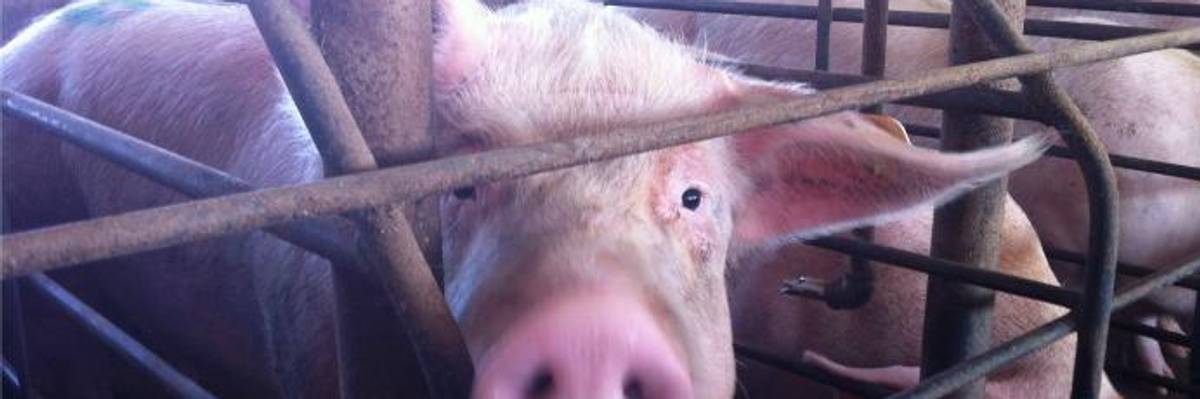
California voters this week passed Proposition 12, heralded by supporters as the world's strongest livestock protections. (Photo: Mercy for Animals/Flickr/cc)
In a clear rebuke of factory farming, California voters on Election Day passed the "ground-breaking" Proposition 12, which is being celebrated by some advocates as the world's "strongest animal welfare law for farmed animals in history."
Backed by 61 percent of voters, Proposition 12 establishes "minimum space requirements based on square feet for calves raised for veal, breeding pigs, and egg-laying hens"--which includes chickens, turkeys, ducks, geese, and guinea fowl--and and bans the sale of veal, pork, and eggs from livestock from other states that are confined in spaces deemed too small under California's standards.
The ballot measure--which builds on Proposition 2, passed by voters in 2008--has two rounds of new rules. By 2020, calves must have at least 43 square feet of usable floor space and hens at least 1 square foot. By 2022, breeding pigs and offspring must have at least 24 square feet of space and hens must be kept in indoor or outdoor cage-free housing systems based on the United Egg Producers' 2017 cage-free guidelines.
"California voters have sent a loud and clear message that they reject cruel cage confinement in the meat and egg industries," declared Kitty Block, acting president and CEO of the Humane Society of the United States. "Thanks to the dedication of thousands of volunteers and coalition partners who made this victory happen, millions of veal calves, mother pigs, and egg-laying hens will never know the misery of being locked in a tiny cage for the duration of their lives."
"California voters have sent a loud and clear message that they reject cruel cage confinement in the meat and egg industries."
--Kitty Block, Humane Society
"From voting at the ballot box to shopping at the supermarket," said ASPCA president and CEO Matt Bershadker, "consumers have played a significant role in demanding more humane food choices by rejecting cruel and unsafe methods still commonplace at industrial-style factory farms."
While supported by the majority of voters and a coalition of animal rights groups, not all activist organizations backed the ballot measure--particularly because of its provisions about egg-laying hens.
Friends of Animals, which advocates for veganism, had called it a "scam" that "won't do anything to spare the lives of animals." PETA, which claims that "the only way to reduce chickens' suffering is to stop supporting the egg industry by simply not eating eggs," also came out against the measure, arguing it "still allows tens of thousands of hens to be crammed into giant warehouses and does nothing to prevent routine cruelty."
As journalist Glenn Greenwald, a vocal advocate of animal rights, concluded, although the anticipated impact of the measure left activists divided, ultimately, its passage "clearly shows pro-animal-rights voter sentiment."
California wasn't the only state to adopt new animal rights rules on Election Day. Florida's Amendment 13--which aims to phase out greyhound racing by 2020--also passed after receiving support from 69 percent of voters across the state. The Committee to Protect Dogs, which backed the ban, called it "a knock-out blow to a cruel industry that has been hurting and killing dogs for nearly a century."
Dear Common Dreams reader, It’s been nearly 30 years since I co-founded Common Dreams with my late wife, Lina Newhouser. We had the radical notion that journalism should serve the public good, not corporate profits. It was clear to us from the outset what it would take to build such a project. No paid advertisements. No corporate sponsors. No millionaire publisher telling us what to think or do. Many people said we wouldn't last a year, but we proved those doubters wrong. Together with a tremendous team of journalists and dedicated staff, we built an independent media outlet free from the constraints of profits and corporate control. Our mission has always been simple: To inform. To inspire. To ignite change for the common good. Building Common Dreams was not easy. Our survival was never guaranteed. When you take on the most powerful forces—Wall Street greed, fossil fuel industry destruction, Big Tech lobbyists, and uber-rich oligarchs who have spent billions upon billions rigging the economy and democracy in their favor—the only bulwark you have is supporters who believe in your work. But here’s the urgent message from me today. It's never been this bad out there. And it's never been this hard to keep us going. At the very moment Common Dreams is most needed, the threats we face are intensifying. We need your support now more than ever. We don't accept corporate advertising and never will. We don't have a paywall because we don't think people should be blocked from critical news based on their ability to pay. Everything we do is funded by the donations of readers like you. When everyone does the little they can afford, we are strong. But if that support retreats or dries up, so do we. Will you donate now to make sure Common Dreams not only survives but thrives? —Craig Brown, Co-founder |
In a clear rebuke of factory farming, California voters on Election Day passed the "ground-breaking" Proposition 12, which is being celebrated by some advocates as the world's "strongest animal welfare law for farmed animals in history."
Backed by 61 percent of voters, Proposition 12 establishes "minimum space requirements based on square feet for calves raised for veal, breeding pigs, and egg-laying hens"--which includes chickens, turkeys, ducks, geese, and guinea fowl--and and bans the sale of veal, pork, and eggs from livestock from other states that are confined in spaces deemed too small under California's standards.
The ballot measure--which builds on Proposition 2, passed by voters in 2008--has two rounds of new rules. By 2020, calves must have at least 43 square feet of usable floor space and hens at least 1 square foot. By 2022, breeding pigs and offspring must have at least 24 square feet of space and hens must be kept in indoor or outdoor cage-free housing systems based on the United Egg Producers' 2017 cage-free guidelines.
"California voters have sent a loud and clear message that they reject cruel cage confinement in the meat and egg industries," declared Kitty Block, acting president and CEO of the Humane Society of the United States. "Thanks to the dedication of thousands of volunteers and coalition partners who made this victory happen, millions of veal calves, mother pigs, and egg-laying hens will never know the misery of being locked in a tiny cage for the duration of their lives."
"California voters have sent a loud and clear message that they reject cruel cage confinement in the meat and egg industries."
--Kitty Block, Humane Society
"From voting at the ballot box to shopping at the supermarket," said ASPCA president and CEO Matt Bershadker, "consumers have played a significant role in demanding more humane food choices by rejecting cruel and unsafe methods still commonplace at industrial-style factory farms."
While supported by the majority of voters and a coalition of animal rights groups, not all activist organizations backed the ballot measure--particularly because of its provisions about egg-laying hens.
Friends of Animals, which advocates for veganism, had called it a "scam" that "won't do anything to spare the lives of animals." PETA, which claims that "the only way to reduce chickens' suffering is to stop supporting the egg industry by simply not eating eggs," also came out against the measure, arguing it "still allows tens of thousands of hens to be crammed into giant warehouses and does nothing to prevent routine cruelty."
As journalist Glenn Greenwald, a vocal advocate of animal rights, concluded, although the anticipated impact of the measure left activists divided, ultimately, its passage "clearly shows pro-animal-rights voter sentiment."
California wasn't the only state to adopt new animal rights rules on Election Day. Florida's Amendment 13--which aims to phase out greyhound racing by 2020--also passed after receiving support from 69 percent of voters across the state. The Committee to Protect Dogs, which backed the ban, called it "a knock-out blow to a cruel industry that has been hurting and killing dogs for nearly a century."
In a clear rebuke of factory farming, California voters on Election Day passed the "ground-breaking" Proposition 12, which is being celebrated by some advocates as the world's "strongest animal welfare law for farmed animals in history."
Backed by 61 percent of voters, Proposition 12 establishes "minimum space requirements based on square feet for calves raised for veal, breeding pigs, and egg-laying hens"--which includes chickens, turkeys, ducks, geese, and guinea fowl--and and bans the sale of veal, pork, and eggs from livestock from other states that are confined in spaces deemed too small under California's standards.
The ballot measure--which builds on Proposition 2, passed by voters in 2008--has two rounds of new rules. By 2020, calves must have at least 43 square feet of usable floor space and hens at least 1 square foot. By 2022, breeding pigs and offspring must have at least 24 square feet of space and hens must be kept in indoor or outdoor cage-free housing systems based on the United Egg Producers' 2017 cage-free guidelines.
"California voters have sent a loud and clear message that they reject cruel cage confinement in the meat and egg industries," declared Kitty Block, acting president and CEO of the Humane Society of the United States. "Thanks to the dedication of thousands of volunteers and coalition partners who made this victory happen, millions of veal calves, mother pigs, and egg-laying hens will never know the misery of being locked in a tiny cage for the duration of their lives."
"California voters have sent a loud and clear message that they reject cruel cage confinement in the meat and egg industries."
--Kitty Block, Humane Society
"From voting at the ballot box to shopping at the supermarket," said ASPCA president and CEO Matt Bershadker, "consumers have played a significant role in demanding more humane food choices by rejecting cruel and unsafe methods still commonplace at industrial-style factory farms."
While supported by the majority of voters and a coalition of animal rights groups, not all activist organizations backed the ballot measure--particularly because of its provisions about egg-laying hens.
Friends of Animals, which advocates for veganism, had called it a "scam" that "won't do anything to spare the lives of animals." PETA, which claims that "the only way to reduce chickens' suffering is to stop supporting the egg industry by simply not eating eggs," also came out against the measure, arguing it "still allows tens of thousands of hens to be crammed into giant warehouses and does nothing to prevent routine cruelty."
As journalist Glenn Greenwald, a vocal advocate of animal rights, concluded, although the anticipated impact of the measure left activists divided, ultimately, its passage "clearly shows pro-animal-rights voter sentiment."
California wasn't the only state to adopt new animal rights rules on Election Day. Florida's Amendment 13--which aims to phase out greyhound racing by 2020--also passed after receiving support from 69 percent of voters across the state. The Committee to Protect Dogs, which backed the ban, called it "a knock-out blow to a cruel industry that has been hurting and killing dogs for nearly a century."