

SUBSCRIBE TO OUR FREE NEWSLETTER
Daily news & progressive opinion—funded by the people, not the corporations—delivered straight to your inbox.
5
#000000
#FFFFFF
To donate by check, phone, or other method, see our More Ways to Give page.
Daily news & progressive opinion—funded by the people, not the corporations—delivered straight to your inbox.
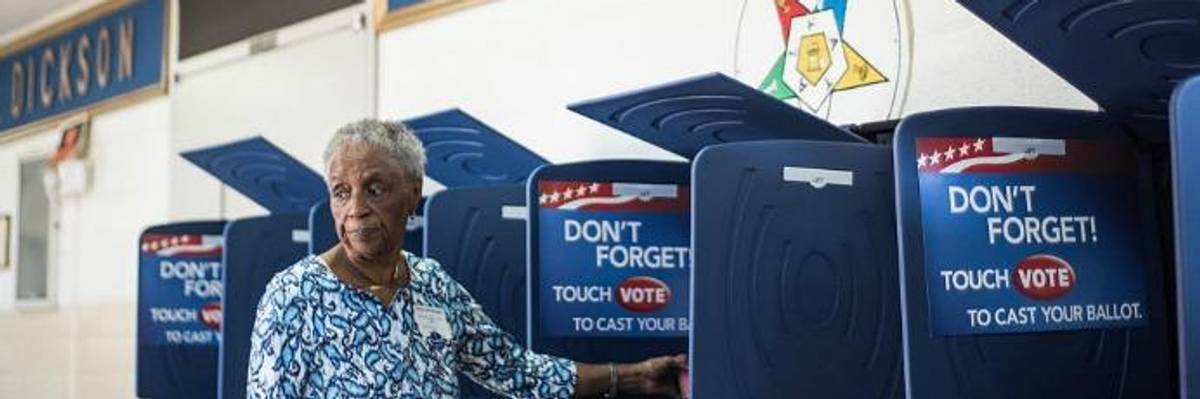
Poll worker Mary Ellison prepares a voting machine at the Prince Hall Masonic Lodge during the South Carolina Democratic Presidential Primary February 27, 2016 in Columbia, South Carolina. (Photo: Sean Rayford/Getty Images)
It's 2018, and the United States is the richest nation in the history of the world... but much of the country still doesn't have functional, glitch-free voting machines.
"This machine problem is essentially threatening to call into question the entire election in Texas."
--Beth Stevens, Texas Civil Rights ProjectAs if the barriers to voting erected by right-wing politicians looking to suppress minority turnout weren't enough, error-riddled, hack-prone, and outdated voting machines throughout the nation--from Texas to Georgia to Wisconsin--are wreaking havoc in the midst of an unprecedented surge in early voting and raising alarming questions about the integrity of vote counts less than 24 hours before millions cast their ballots in the critical midterm elections.
In Texas, where Democratic Rep. Beto O'Rourke is vying for Republican Sen. Ted Cruz's seat in an extremely close race that has drawn national attention, civil rights groups have alleged that voting machines are deleting Democratic votes entirely or switching them to the Republican candidate.
"This machine problem is essentially threatening to call into question the entire election in Texas," Beth Stevens, voting rights legal director for the Texas Civil Rights Project, told Politico.
In a tweet on Sunday, the Brennan Center for Justice called on voters to immediately notify poll workers if their votes are being switched to a different candidate:
Similar problems have marred Georgia's gubernatorial race, where Republican Secretary of State Brian Kemp--who is also in charge of overseeing the state's elections--is taking on Democrat Stacey Abrams, who recent polls show is less than three points away from the lead.
In the build-up to Tuesday's election, Kemp has deployed a number of tactics voting rights advocates have decried as dirty tricks to purge hundreds of thousands of voters from the rolls and prevent thousands more from exercising their constitutional right to the franchise.
"What we're seeing now is a concerted effort to make sure that our election system does not work for everyone."
--Sue Halpern, New Yorker
On top of these efforts, civil rights groups have accused Kemp of deliberately ignoring calls to replace Georgia's outdated voting machines, which the Georgia NAACP alleged during early voting in recent weeks were changing selections from Abrams to Kemp.
But because Georgia is one of five states that use entirely paperless voting machines, there is no paper trail to confirm and remedy machine errors.
"We've experienced this before," Phyllis Blake, president of the Georgia NAACP, told USA Today of the voting machine issues in an interview late last month. "They should have been replaced about 10 years ago."
As the New Yorker's Sue Halpern noted on Sunday, deeply flawed and outdated voting machines "reflect a wider crisis for American democracy," and the GOP's continued refusal to fix these flaws is intricately connected to the party's decades-long assault on voting rights.
"What we're seeing now... is a concerted effort to make sure that our election system does not work for everyone," Halpern concluded. "Voting machines that flip votes don't need to be hacked by a malicious foreign actor to undermine public confidence in the integrity of our democracy. That's being done for Americans, by Americans."
Writing for the New York Review of Books on Monday, attorney and election integrity advocate Jennifer Cohn also warned that unreliable voting machines pose an existential threat to the nation.
"This potential weakness is critical," writes Cohn, "because the entire system of our democracy depends on public trust--the belief that, however divided the country is and fiercely contested elections are, the result has integrity. Nothing is more insidious and corrosive than the idea that the tally of votes itself could be unreliable and exposed to fraud."
Dear Common Dreams reader, It’s been nearly 30 years since I co-founded Common Dreams with my late wife, Lina Newhouser. We had the radical notion that journalism should serve the public good, not corporate profits. It was clear to us from the outset what it would take to build such a project. No paid advertisements. No corporate sponsors. No millionaire publisher telling us what to think or do. Many people said we wouldn't last a year, but we proved those doubters wrong. Together with a tremendous team of journalists and dedicated staff, we built an independent media outlet free from the constraints of profits and corporate control. Our mission has always been simple: To inform. To inspire. To ignite change for the common good. Building Common Dreams was not easy. Our survival was never guaranteed. When you take on the most powerful forces—Wall Street greed, fossil fuel industry destruction, Big Tech lobbyists, and uber-rich oligarchs who have spent billions upon billions rigging the economy and democracy in their favor—the only bulwark you have is supporters who believe in your work. But here’s the urgent message from me today. It's never been this bad out there. And it's never been this hard to keep us going. At the very moment Common Dreams is most needed, the threats we face are intensifying. We need your support now more than ever. We don't accept corporate advertising and never will. We don't have a paywall because we don't think people should be blocked from critical news based on their ability to pay. Everything we do is funded by the donations of readers like you. When everyone does the little they can afford, we are strong. But if that support retreats or dries up, so do we. Will you donate now to make sure Common Dreams not only survives but thrives? —Craig Brown, Co-founder |
It's 2018, and the United States is the richest nation in the history of the world... but much of the country still doesn't have functional, glitch-free voting machines.
"This machine problem is essentially threatening to call into question the entire election in Texas."
--Beth Stevens, Texas Civil Rights ProjectAs if the barriers to voting erected by right-wing politicians looking to suppress minority turnout weren't enough, error-riddled, hack-prone, and outdated voting machines throughout the nation--from Texas to Georgia to Wisconsin--are wreaking havoc in the midst of an unprecedented surge in early voting and raising alarming questions about the integrity of vote counts less than 24 hours before millions cast their ballots in the critical midterm elections.
In Texas, where Democratic Rep. Beto O'Rourke is vying for Republican Sen. Ted Cruz's seat in an extremely close race that has drawn national attention, civil rights groups have alleged that voting machines are deleting Democratic votes entirely or switching them to the Republican candidate.
"This machine problem is essentially threatening to call into question the entire election in Texas," Beth Stevens, voting rights legal director for the Texas Civil Rights Project, told Politico.
In a tweet on Sunday, the Brennan Center for Justice called on voters to immediately notify poll workers if their votes are being switched to a different candidate:
Similar problems have marred Georgia's gubernatorial race, where Republican Secretary of State Brian Kemp--who is also in charge of overseeing the state's elections--is taking on Democrat Stacey Abrams, who recent polls show is less than three points away from the lead.
In the build-up to Tuesday's election, Kemp has deployed a number of tactics voting rights advocates have decried as dirty tricks to purge hundreds of thousands of voters from the rolls and prevent thousands more from exercising their constitutional right to the franchise.
"What we're seeing now is a concerted effort to make sure that our election system does not work for everyone."
--Sue Halpern, New Yorker
On top of these efforts, civil rights groups have accused Kemp of deliberately ignoring calls to replace Georgia's outdated voting machines, which the Georgia NAACP alleged during early voting in recent weeks were changing selections from Abrams to Kemp.
But because Georgia is one of five states that use entirely paperless voting machines, there is no paper trail to confirm and remedy machine errors.
"We've experienced this before," Phyllis Blake, president of the Georgia NAACP, told USA Today of the voting machine issues in an interview late last month. "They should have been replaced about 10 years ago."
As the New Yorker's Sue Halpern noted on Sunday, deeply flawed and outdated voting machines "reflect a wider crisis for American democracy," and the GOP's continued refusal to fix these flaws is intricately connected to the party's decades-long assault on voting rights.
"What we're seeing now... is a concerted effort to make sure that our election system does not work for everyone," Halpern concluded. "Voting machines that flip votes don't need to be hacked by a malicious foreign actor to undermine public confidence in the integrity of our democracy. That's being done for Americans, by Americans."
Writing for the New York Review of Books on Monday, attorney and election integrity advocate Jennifer Cohn also warned that unreliable voting machines pose an existential threat to the nation.
"This potential weakness is critical," writes Cohn, "because the entire system of our democracy depends on public trust--the belief that, however divided the country is and fiercely contested elections are, the result has integrity. Nothing is more insidious and corrosive than the idea that the tally of votes itself could be unreliable and exposed to fraud."
It's 2018, and the United States is the richest nation in the history of the world... but much of the country still doesn't have functional, glitch-free voting machines.
"This machine problem is essentially threatening to call into question the entire election in Texas."
--Beth Stevens, Texas Civil Rights ProjectAs if the barriers to voting erected by right-wing politicians looking to suppress minority turnout weren't enough, error-riddled, hack-prone, and outdated voting machines throughout the nation--from Texas to Georgia to Wisconsin--are wreaking havoc in the midst of an unprecedented surge in early voting and raising alarming questions about the integrity of vote counts less than 24 hours before millions cast their ballots in the critical midterm elections.
In Texas, where Democratic Rep. Beto O'Rourke is vying for Republican Sen. Ted Cruz's seat in an extremely close race that has drawn national attention, civil rights groups have alleged that voting machines are deleting Democratic votes entirely or switching them to the Republican candidate.
"This machine problem is essentially threatening to call into question the entire election in Texas," Beth Stevens, voting rights legal director for the Texas Civil Rights Project, told Politico.
In a tweet on Sunday, the Brennan Center for Justice called on voters to immediately notify poll workers if their votes are being switched to a different candidate:
Similar problems have marred Georgia's gubernatorial race, where Republican Secretary of State Brian Kemp--who is also in charge of overseeing the state's elections--is taking on Democrat Stacey Abrams, who recent polls show is less than three points away from the lead.
In the build-up to Tuesday's election, Kemp has deployed a number of tactics voting rights advocates have decried as dirty tricks to purge hundreds of thousands of voters from the rolls and prevent thousands more from exercising their constitutional right to the franchise.
"What we're seeing now is a concerted effort to make sure that our election system does not work for everyone."
--Sue Halpern, New Yorker
On top of these efforts, civil rights groups have accused Kemp of deliberately ignoring calls to replace Georgia's outdated voting machines, which the Georgia NAACP alleged during early voting in recent weeks were changing selections from Abrams to Kemp.
But because Georgia is one of five states that use entirely paperless voting machines, there is no paper trail to confirm and remedy machine errors.
"We've experienced this before," Phyllis Blake, president of the Georgia NAACP, told USA Today of the voting machine issues in an interview late last month. "They should have been replaced about 10 years ago."
As the New Yorker's Sue Halpern noted on Sunday, deeply flawed and outdated voting machines "reflect a wider crisis for American democracy," and the GOP's continued refusal to fix these flaws is intricately connected to the party's decades-long assault on voting rights.
"What we're seeing now... is a concerted effort to make sure that our election system does not work for everyone," Halpern concluded. "Voting machines that flip votes don't need to be hacked by a malicious foreign actor to undermine public confidence in the integrity of our democracy. That's being done for Americans, by Americans."
Writing for the New York Review of Books on Monday, attorney and election integrity advocate Jennifer Cohn also warned that unreliable voting machines pose an existential threat to the nation.
"This potential weakness is critical," writes Cohn, "because the entire system of our democracy depends on public trust--the belief that, however divided the country is and fiercely contested elections are, the result has integrity. Nothing is more insidious and corrosive than the idea that the tally of votes itself could be unreliable and exposed to fraud."

