
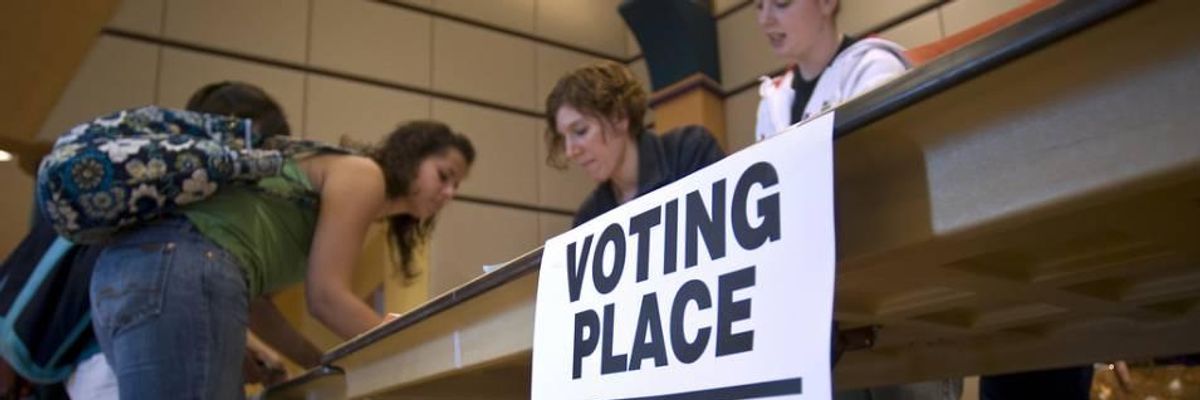
More than 100,000 Georgia voters were purged from the rolls last year because they had not voted in recent years. (Photo: Penn State/flickr/cc)
With GOP Candidate Also Overseeing Georgia Elections, 107,000 Voters Purged in Yet Another Suppression Effort
"When you oversee your own election and know the only way you can win is by suppressing minority votes."
A new report uncovered yet another voter suppression tactic employed by Georgia's Republican Secretary of State Brian Kemp--who is also running for governor--which scrubbed more than 100,000 voters from the state's rolls.
AMP Reports revealed Friday how, under the state's "use it or lose it" law, 107,000 residents were removed from voter lists in July 2017 simply because they had not voted in elections or made contact with the board of elections over the previous three years.
"Many of those previously registered voters may not even realize they've been dropped from the rolls. If they show up at the polls on November 6 to vote in the heated Georgia governor's race, they won't be allowed to cast a ballot," wrote Angela Caputo, Geoff Hing, and Johnny Kauffman.
The race between Abrams and Kemp is close, with Kemp leading by two points in recent polls--and could be decided by just a few thousand votes.
AMP Reports detailed the voter purge following numerous reports in recent months about other cases of widespread voter suppression in Georgia--frequently in majority-black counties and affecting tens of thousands of African American voters--ahead of a close election in which the state could elect Democrat Stacey Abrams as the country's first black female governor.
As Common Dreams reported, earlier this week dozens of elderly black voters were forced off a bus operated by the grassroots group Black Voters Matter, after a county clerk deemed the group's planned trip to early voting locations a "political activity."
About 53,000 voters were also eliminated from the voter rolls earlier this month under another Georgia law stipulating that voter registration forms must exactly match state-issued ID's. Seventy percent of the voters who were purged, many due to clerical errors like missing hyphens or misspellings, were black.
And in August, a Georgia county rejected a plan--pushed by a consultant sent by Kemp's office--to close seven of its nine polling places.
As Secretary of State, Kemp presides over the office responsible for overseeing the state's elections. Critics say his widespread efforts to limit voting rights for as many Georgians as possible is in keeping with GOP election tactics.
"He has not, in my view, seen it really as his mission as secretary of state to encourage people to vote," Bryan Sells, an Atlanta-based voting rights attorney who is suing Kemp over the "exact match" voter purge, told Mother Jones. "I think he's been a willing player in a much larger strategy to do just the opposite, to prevent people from voting and discourage people from voting."
As AMP reported, the voter purge affecting 107,000 people was part of an even larger effort to rid Georgia's voter rolls of names that election officials felt should no longer be included:
Even by Georgia standards, the voter purge of late July 2017 was remarkable. In a single day, more than half a million people -- eight percent of Georgia's registered voters -- were cut from the voter rolls.
Georgia is one of nine states that have recently adopted "use it or lose it" laws aimed at purging voters from the rolls if they have not voted in recent elections--which critics say undermines the democratic process.
Amid the news of voter suppression in her state, Abrams has called on voters whose rights are still intact to go to the polls in large numbers, both during early voting and on November 6, in order to offset Kemp's efforts to suppress likely Democratic voters.
We are at a crossroads
This country and this world are at a monumental crossroads. US voters have an opportunity to beat back the forces of fascism and confront the billionaires who are rigging the economy, our media system, and our democracy, making it increasingly impossible for ordinary people to get by. We’re not just talking about the election. We’re talking about what must be done once these fascist elements are vanquished from power. We need a bolder set of solutions than what either major party has so far been willing to offer and a working-class movement ready to fight like hell for it. Trump didn't emerge from nowhere. The conditions that fueled MAGA authoritarianism were created by decades of radical neoliberal economic policies and a corrupt political system dominated by corporate interests. They slashed taxes on the super-rich, promising that the benefits would trickle down. They said giveaways to the corporate titans would make life more affordable for the rest of us. It was all bullshit. And when a bitter, betrayed populace searches for someone to blame, right-wing demagogues have little trouble finding scapegoats. People know when they're being lied to, but you won't hear any of this from the corporate media. Only independent journalism—powered and funded by people who believe in building a better world—can deliver truly trustworthy daily news. Our Fall Campaign is underway, and we need your help. To power our newsroom through the rest of the year, we need to raise $125,000 by midnight on October 31. So if you share our vision, please contribute whatever you can to sustain our work. |
A new report uncovered yet another voter suppression tactic employed by Georgia's Republican Secretary of State Brian Kemp--who is also running for governor--which scrubbed more than 100,000 voters from the state's rolls.
AMP Reports revealed Friday how, under the state's "use it or lose it" law, 107,000 residents were removed from voter lists in July 2017 simply because they had not voted in elections or made contact with the board of elections over the previous three years.
"Many of those previously registered voters may not even realize they've been dropped from the rolls. If they show up at the polls on November 6 to vote in the heated Georgia governor's race, they won't be allowed to cast a ballot," wrote Angela Caputo, Geoff Hing, and Johnny Kauffman.
The race between Abrams and Kemp is close, with Kemp leading by two points in recent polls--and could be decided by just a few thousand votes.
AMP Reports detailed the voter purge following numerous reports in recent months about other cases of widespread voter suppression in Georgia--frequently in majority-black counties and affecting tens of thousands of African American voters--ahead of a close election in which the state could elect Democrat Stacey Abrams as the country's first black female governor.
As Common Dreams reported, earlier this week dozens of elderly black voters were forced off a bus operated by the grassroots group Black Voters Matter, after a county clerk deemed the group's planned trip to early voting locations a "political activity."
About 53,000 voters were also eliminated from the voter rolls earlier this month under another Georgia law stipulating that voter registration forms must exactly match state-issued ID's. Seventy percent of the voters who were purged, many due to clerical errors like missing hyphens or misspellings, were black.
And in August, a Georgia county rejected a plan--pushed by a consultant sent by Kemp's office--to close seven of its nine polling places.
As Secretary of State, Kemp presides over the office responsible for overseeing the state's elections. Critics say his widespread efforts to limit voting rights for as many Georgians as possible is in keeping with GOP election tactics.
"He has not, in my view, seen it really as his mission as secretary of state to encourage people to vote," Bryan Sells, an Atlanta-based voting rights attorney who is suing Kemp over the "exact match" voter purge, told Mother Jones. "I think he's been a willing player in a much larger strategy to do just the opposite, to prevent people from voting and discourage people from voting."
As AMP reported, the voter purge affecting 107,000 people was part of an even larger effort to rid Georgia's voter rolls of names that election officials felt should no longer be included:
Even by Georgia standards, the voter purge of late July 2017 was remarkable. In a single day, more than half a million people -- eight percent of Georgia's registered voters -- were cut from the voter rolls.
Georgia is one of nine states that have recently adopted "use it or lose it" laws aimed at purging voters from the rolls if they have not voted in recent elections--which critics say undermines the democratic process.
Amid the news of voter suppression in her state, Abrams has called on voters whose rights are still intact to go to the polls in large numbers, both during early voting and on November 6, in order to offset Kemp's efforts to suppress likely Democratic voters.