SUBSCRIBE TO OUR FREE NEWSLETTER
Daily news & progressive opinion—funded by the people, not the corporations—delivered straight to your inbox.
5
#000000
#FFFFFF
To donate by check, phone, or other method, see our More Ways to Give page.
Daily news & progressive opinion—funded by the people, not the corporations—delivered straight to your inbox.
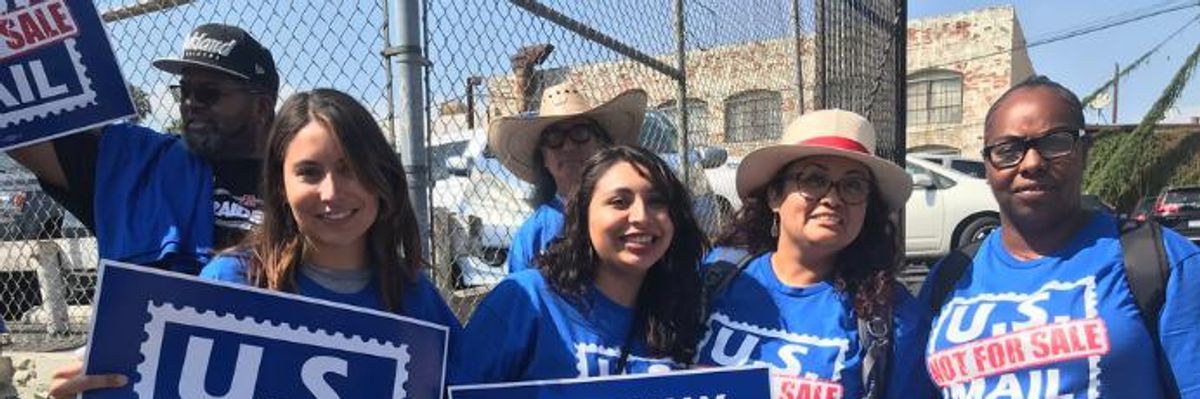
Postal workers and critics of the Trump administration's plans to privatize the United States Postal Service (USPS) carried signs at a Los Angeles protest on Oct. 8, 2018. (Photo: Chloe Osmer/Twitter)
As the United States Postal Service (USPS) closed on Monday for a national holiday celebrated by many municipalities as Indigenous Peoples Day, workers across the country held a day of action to protest President Donald Trump's proposal to privatize the postal service.
Under the proposal--unveiled in June as part of a 32-point plan (pdf) to significantly reorganize the federal government--USPS would "transition to a model of private management and private or shared ownership." The White House argued that "freeing USPS to more fully negotiate pay and benefits rather than prescribing participation in costly federal personnel benefit programs, and allowing it to follow private sector practices in compensation and labor relations, could further reduce costs."
Critics warn that such a transition would not only negatively impact service but also bring awful consequences for postal workers, who demonstrated on their day off in cities across the United States on Monday to tell the president that USPS is #NotForSale.
"Postal workers are rallying to urge lawmakers to stop the selling off of the public postal service for private profit--and to remind everyone the Postal Service is yours," Julie Bates, a 22-year postal worker, wrote last week.
Pointing to similar moves by other countries--including the United Kingdom--as cautionary tales, Bates warned that if USPS is sold off to private interests, the public should anticipate "higher prices, slower delivery, and an end to universal, uniform, and affordable service to every corner of the country."
While recognizing that the national mail service has faced problems in recent years, as Bates explained:
The truth is that the USPS's problems were largely created by Congress.
A bipartisan 2006 law, the Postal Accountability and Enhancement Act, mandated that the USPS pre-fund future retiree health benefits 75 years into the future. That means we have to fund retirement benefits for postal employees who haven't even been born yet.
It's a crushing burden that no other agency or company--public or private--is required to meet, or could even survive.
Some Democratic members of Congress--including Sen. Dick Durbin (Ill.) as well as Reps. Grace Meng (N.Y.) and Dwight Evans (Penn.)--joined demonstrations in their states:
"Our postal system is older than the country itself. It was a vital component of our country's public good then. It still is today," Bates concluded. "And along the way, one fundamental fact has always been true: Our postal system has never belonged to any president, any political party, or any company. It's belonged to the people of this country."
Dear Common Dreams reader, It’s been nearly 30 years since I co-founded Common Dreams with my late wife, Lina Newhouser. We had the radical notion that journalism should serve the public good, not corporate profits. It was clear to us from the outset what it would take to build such a project. No paid advertisements. No corporate sponsors. No millionaire publisher telling us what to think or do. Many people said we wouldn't last a year, but we proved those doubters wrong. Together with a tremendous team of journalists and dedicated staff, we built an independent media outlet free from the constraints of profits and corporate control. Our mission has always been simple: To inform. To inspire. To ignite change for the common good. Building Common Dreams was not easy. Our survival was never guaranteed. When you take on the most powerful forces—Wall Street greed, fossil fuel industry destruction, Big Tech lobbyists, and uber-rich oligarchs who have spent billions upon billions rigging the economy and democracy in their favor—the only bulwark you have is supporters who believe in your work. But here’s the urgent message from me today. It's never been this bad out there. And it's never been this hard to keep us going. At the very moment Common Dreams is most needed, the threats we face are intensifying. We need your support now more than ever. We don't accept corporate advertising and never will. We don't have a paywall because we don't think people should be blocked from critical news based on their ability to pay. Everything we do is funded by the donations of readers like you. When everyone does the little they can afford, we are strong. But if that support retreats or dries up, so do we. Will you donate now to make sure Common Dreams not only survives but thrives? —Craig Brown, Co-founder |
As the United States Postal Service (USPS) closed on Monday for a national holiday celebrated by many municipalities as Indigenous Peoples Day, workers across the country held a day of action to protest President Donald Trump's proposal to privatize the postal service.
Under the proposal--unveiled in June as part of a 32-point plan (pdf) to significantly reorganize the federal government--USPS would "transition to a model of private management and private or shared ownership." The White House argued that "freeing USPS to more fully negotiate pay and benefits rather than prescribing participation in costly federal personnel benefit programs, and allowing it to follow private sector practices in compensation and labor relations, could further reduce costs."
Critics warn that such a transition would not only negatively impact service but also bring awful consequences for postal workers, who demonstrated on their day off in cities across the United States on Monday to tell the president that USPS is #NotForSale.
"Postal workers are rallying to urge lawmakers to stop the selling off of the public postal service for private profit--and to remind everyone the Postal Service is yours," Julie Bates, a 22-year postal worker, wrote last week.
Pointing to similar moves by other countries--including the United Kingdom--as cautionary tales, Bates warned that if USPS is sold off to private interests, the public should anticipate "higher prices, slower delivery, and an end to universal, uniform, and affordable service to every corner of the country."
While recognizing that the national mail service has faced problems in recent years, as Bates explained:
The truth is that the USPS's problems were largely created by Congress.
A bipartisan 2006 law, the Postal Accountability and Enhancement Act, mandated that the USPS pre-fund future retiree health benefits 75 years into the future. That means we have to fund retirement benefits for postal employees who haven't even been born yet.
It's a crushing burden that no other agency or company--public or private--is required to meet, or could even survive.
Some Democratic members of Congress--including Sen. Dick Durbin (Ill.) as well as Reps. Grace Meng (N.Y.) and Dwight Evans (Penn.)--joined demonstrations in their states:
"Our postal system is older than the country itself. It was a vital component of our country's public good then. It still is today," Bates concluded. "And along the way, one fundamental fact has always been true: Our postal system has never belonged to any president, any political party, or any company. It's belonged to the people of this country."
As the United States Postal Service (USPS) closed on Monday for a national holiday celebrated by many municipalities as Indigenous Peoples Day, workers across the country held a day of action to protest President Donald Trump's proposal to privatize the postal service.
Under the proposal--unveiled in June as part of a 32-point plan (pdf) to significantly reorganize the federal government--USPS would "transition to a model of private management and private or shared ownership." The White House argued that "freeing USPS to more fully negotiate pay and benefits rather than prescribing participation in costly federal personnel benefit programs, and allowing it to follow private sector practices in compensation and labor relations, could further reduce costs."
Critics warn that such a transition would not only negatively impact service but also bring awful consequences for postal workers, who demonstrated on their day off in cities across the United States on Monday to tell the president that USPS is #NotForSale.
"Postal workers are rallying to urge lawmakers to stop the selling off of the public postal service for private profit--and to remind everyone the Postal Service is yours," Julie Bates, a 22-year postal worker, wrote last week.
Pointing to similar moves by other countries--including the United Kingdom--as cautionary tales, Bates warned that if USPS is sold off to private interests, the public should anticipate "higher prices, slower delivery, and an end to universal, uniform, and affordable service to every corner of the country."
While recognizing that the national mail service has faced problems in recent years, as Bates explained:
The truth is that the USPS's problems were largely created by Congress.
A bipartisan 2006 law, the Postal Accountability and Enhancement Act, mandated that the USPS pre-fund future retiree health benefits 75 years into the future. That means we have to fund retirement benefits for postal employees who haven't even been born yet.
It's a crushing burden that no other agency or company--public or private--is required to meet, or could even survive.
Some Democratic members of Congress--including Sen. Dick Durbin (Ill.) as well as Reps. Grace Meng (N.Y.) and Dwight Evans (Penn.)--joined demonstrations in their states:
"Our postal system is older than the country itself. It was a vital component of our country's public good then. It still is today," Bates concluded. "And along the way, one fundamental fact has always been true: Our postal system has never belonged to any president, any political party, or any company. It's belonged to the people of this country."