SUBSCRIBE TO OUR FREE NEWSLETTER
Daily news & progressive opinion—funded by the people, not the corporations—delivered straight to your inbox.
5
#000000
#FFFFFF
To donate by check, phone, or other method, see our More Ways to Give page.
Daily news & progressive opinion—funded by the people, not the corporations—delivered straight to your inbox.
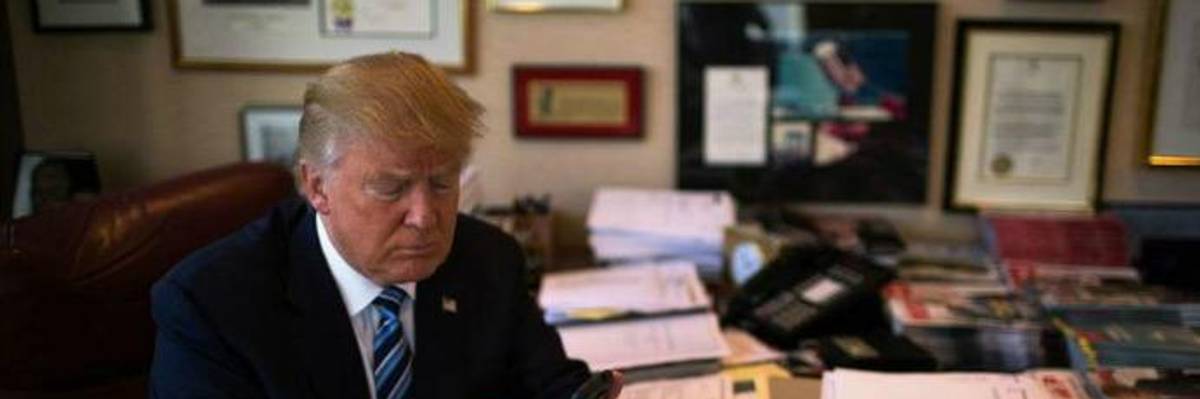
Noting that Trump has already "weaponized disinformation" through his Twitter account, the activists argue that the presidential alert system is "unconstitutionally vague" and could be vulnerable to manipulation by an erratic president who has shown complete disdain for the truth. (Photo: Reuters)
With President Donald Trump set to send out the first unblockable "presidential alert" to every single U.S. resident with a cellphone on Wednesday, three New Yorkers are attemping to stop the intrusive text messages with a lawsuit arguing that the new emergency alert system "is tantamount to hijacking private property for the purpose of planting a government-controlled loudspeaker in the home and on the person of every American."
"Just as a pamphleteer cannot compel a passerby to accept a screed, so, too, government cannot send messages to peoples' cellular devices without being invited to do so."
--Lawsuit
Filed last week in the U.S. District Court in Manhattan by three New York activists--J.B. Nicholas, Kristine Rakowsky and Liane Nikitovich--the suit (pdf) claims the presidential alert system violates "Americans' First and Fourth Amendment rights to be free from government-compelled listening, as well as warrantless, non-consensual trespass into and seizure of their cellular devices."
While it is possible to opt out of Amber Alerts and other emergency notifications, it is not possible to block or turn off presidential alerts. (You won't be able to text back, either.)
Noting that Trump has already "weaponized disinformation" through his Twitter account, the activists argue that the presidential alert system--established by a 2006 law signed by former President George W. Bush--is "unconstitutionally vague" and could be vulnerable to manipulation by an erratic president who has shown complete disdain for the truth.
While the law states that presidential alerts can only be sent in the case of genuine national emergencies--like a terrorist attack or a natural disaster--the lawsuit points out that Trump and other federal officials are "free to define 'act of terrorism' and 'threat to public safety' as they see fit, potentially broadcasting arbitrary, biased, irrational, and/or content-based messages to hundreds of millions of people."
"Just as a pamphleteer cannot compel a passerby to accept a screed, so, too, government cannot send messages to peoples' cellular devices without being invited to do so," the lawsuit concludes. "The compulsory presidential alert scheme violates the Constitution. This court should not hesitate to so declare."
Ahead of the presidential alert system's debut, as Common Dreams has previously reported, many have echoed the concerns raised in the New Yorkers' lawsuit and warned that Trump will be able to blast out potentially false and self-serving messages to every U.S. resident with a cellphone.
Experts have also expressed concern that there are not sufficient safeguards to prevent Trump from exploiting the alert system for his own political needs.
"I'm not sure that the system would protect us from rogue announcements by a president who has exhibited the kind of behavior President Trump has over the last two years," Irwin Redlener, director of the National Center for Disaster Preparedness at Columbia University, told Vox in an interview last month. "I personally would not give this microphone to Donald Trump."
Dear Common Dreams reader, It’s been nearly 30 years since I co-founded Common Dreams with my late wife, Lina Newhouser. We had the radical notion that journalism should serve the public good, not corporate profits. It was clear to us from the outset what it would take to build such a project. No paid advertisements. No corporate sponsors. No millionaire publisher telling us what to think or do. Many people said we wouldn't last a year, but we proved those doubters wrong. Together with a tremendous team of journalists and dedicated staff, we built an independent media outlet free from the constraints of profits and corporate control. Our mission has always been simple: To inform. To inspire. To ignite change for the common good. Building Common Dreams was not easy. Our survival was never guaranteed. When you take on the most powerful forces—Wall Street greed, fossil fuel industry destruction, Big Tech lobbyists, and uber-rich oligarchs who have spent billions upon billions rigging the economy and democracy in their favor—the only bulwark you have is supporters who believe in your work. But here’s the urgent message from me today. It's never been this bad out there. And it's never been this hard to keep us going. At the very moment Common Dreams is most needed, the threats we face are intensifying. We need your support now more than ever. We don't accept corporate advertising and never will. We don't have a paywall because we don't think people should be blocked from critical news based on their ability to pay. Everything we do is funded by the donations of readers like you. When everyone does the little they can afford, we are strong. But if that support retreats or dries up, so do we. Will you donate now to make sure Common Dreams not only survives but thrives? —Craig Brown, Co-founder |
With President Donald Trump set to send out the first unblockable "presidential alert" to every single U.S. resident with a cellphone on Wednesday, three New Yorkers are attemping to stop the intrusive text messages with a lawsuit arguing that the new emergency alert system "is tantamount to hijacking private property for the purpose of planting a government-controlled loudspeaker in the home and on the person of every American."
"Just as a pamphleteer cannot compel a passerby to accept a screed, so, too, government cannot send messages to peoples' cellular devices without being invited to do so."
--Lawsuit
Filed last week in the U.S. District Court in Manhattan by three New York activists--J.B. Nicholas, Kristine Rakowsky and Liane Nikitovich--the suit (pdf) claims the presidential alert system violates "Americans' First and Fourth Amendment rights to be free from government-compelled listening, as well as warrantless, non-consensual trespass into and seizure of their cellular devices."
While it is possible to opt out of Amber Alerts and other emergency notifications, it is not possible to block or turn off presidential alerts. (You won't be able to text back, either.)
Noting that Trump has already "weaponized disinformation" through his Twitter account, the activists argue that the presidential alert system--established by a 2006 law signed by former President George W. Bush--is "unconstitutionally vague" and could be vulnerable to manipulation by an erratic president who has shown complete disdain for the truth.
While the law states that presidential alerts can only be sent in the case of genuine national emergencies--like a terrorist attack or a natural disaster--the lawsuit points out that Trump and other federal officials are "free to define 'act of terrorism' and 'threat to public safety' as they see fit, potentially broadcasting arbitrary, biased, irrational, and/or content-based messages to hundreds of millions of people."
"Just as a pamphleteer cannot compel a passerby to accept a screed, so, too, government cannot send messages to peoples' cellular devices without being invited to do so," the lawsuit concludes. "The compulsory presidential alert scheme violates the Constitution. This court should not hesitate to so declare."
Ahead of the presidential alert system's debut, as Common Dreams has previously reported, many have echoed the concerns raised in the New Yorkers' lawsuit and warned that Trump will be able to blast out potentially false and self-serving messages to every U.S. resident with a cellphone.
Experts have also expressed concern that there are not sufficient safeguards to prevent Trump from exploiting the alert system for his own political needs.
"I'm not sure that the system would protect us from rogue announcements by a president who has exhibited the kind of behavior President Trump has over the last two years," Irwin Redlener, director of the National Center for Disaster Preparedness at Columbia University, told Vox in an interview last month. "I personally would not give this microphone to Donald Trump."
With President Donald Trump set to send out the first unblockable "presidential alert" to every single U.S. resident with a cellphone on Wednesday, three New Yorkers are attemping to stop the intrusive text messages with a lawsuit arguing that the new emergency alert system "is tantamount to hijacking private property for the purpose of planting a government-controlled loudspeaker in the home and on the person of every American."
"Just as a pamphleteer cannot compel a passerby to accept a screed, so, too, government cannot send messages to peoples' cellular devices without being invited to do so."
--Lawsuit
Filed last week in the U.S. District Court in Manhattan by three New York activists--J.B. Nicholas, Kristine Rakowsky and Liane Nikitovich--the suit (pdf) claims the presidential alert system violates "Americans' First and Fourth Amendment rights to be free from government-compelled listening, as well as warrantless, non-consensual trespass into and seizure of their cellular devices."
While it is possible to opt out of Amber Alerts and other emergency notifications, it is not possible to block or turn off presidential alerts. (You won't be able to text back, either.)
Noting that Trump has already "weaponized disinformation" through his Twitter account, the activists argue that the presidential alert system--established by a 2006 law signed by former President George W. Bush--is "unconstitutionally vague" and could be vulnerable to manipulation by an erratic president who has shown complete disdain for the truth.
While the law states that presidential alerts can only be sent in the case of genuine national emergencies--like a terrorist attack or a natural disaster--the lawsuit points out that Trump and other federal officials are "free to define 'act of terrorism' and 'threat to public safety' as they see fit, potentially broadcasting arbitrary, biased, irrational, and/or content-based messages to hundreds of millions of people."
"Just as a pamphleteer cannot compel a passerby to accept a screed, so, too, government cannot send messages to peoples' cellular devices without being invited to do so," the lawsuit concludes. "The compulsory presidential alert scheme violates the Constitution. This court should not hesitate to so declare."
Ahead of the presidential alert system's debut, as Common Dreams has previously reported, many have echoed the concerns raised in the New Yorkers' lawsuit and warned that Trump will be able to blast out potentially false and self-serving messages to every U.S. resident with a cellphone.
Experts have also expressed concern that there are not sufficient safeguards to prevent Trump from exploiting the alert system for his own political needs.
"I'm not sure that the system would protect us from rogue announcements by a president who has exhibited the kind of behavior President Trump has over the last two years," Irwin Redlener, director of the National Center for Disaster Preparedness at Columbia University, told Vox in an interview last month. "I personally would not give this microphone to Donald Trump."