SUBSCRIBE TO OUR FREE NEWSLETTER
Daily news & progressive opinion—funded by the people, not the corporations—delivered straight to your inbox.
5
#000000
#FFFFFF
To donate by check, phone, or other method, see our More Ways to Give page.
Daily news & progressive opinion—funded by the people, not the corporations—delivered straight to your inbox.
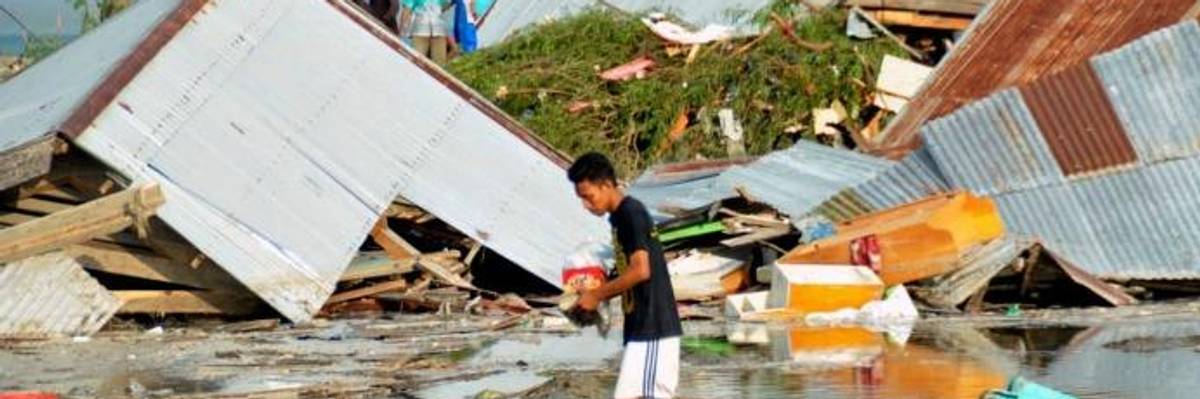
Amid the wreckage in Palu on Saturday morning. Officials had yet to make contact with other vulnerable coastal areas where communications were down. (Photo: Rifki/Associated Press)
Nearly 400 people were killed and thousands of homes and buildings were destroyed Friday night after a catastrophic earthquake and tsunami struck the Indonesian island of Sulawesi.
As the Washington Post reported:
More than 384 people have died in the city of Palu alone, one of the two cities worst-hit by the tsunami, according to Sutopo Purwo Nugroho, spokesman for Indonesia's National Disaster Management Agency. Rescue officials were struggling Saturday afternoon to reach the nearby city of Donggala, home to 300,000 people, and the surrounding areas after a large bridge collapsed. Authorities fear that the death toll, which was at 48 several hours earlier, could continue to rise quickly.
The estimated 10-foot tsunami that slammed Sulawesi Friday night was triggered by a 7.5 magnitude earthquake that hit the island just hours before.
Cellphone video posted to social media shows the moment a massive wave completely overtook several one-story buildings in Palu:
More than 500 people are reportedly injured, dozens more are missing, and the island is currently without electricity.
"At the moment, in our hospital, electricity is out all over Palu, roads are cracked, the phone network doesn't work," said Dr. Komang Adi Sujendra, director of Undata Hospital in Palu. "We are hoping for any help."
Dear Common Dreams reader, It’s been nearly 30 years since I co-founded Common Dreams with my late wife, Lina Newhouser. We had the radical notion that journalism should serve the public good, not corporate profits. It was clear to us from the outset what it would take to build such a project. No paid advertisements. No corporate sponsors. No millionaire publisher telling us what to think or do. Many people said we wouldn't last a year, but we proved those doubters wrong. Together with a tremendous team of journalists and dedicated staff, we built an independent media outlet free from the constraints of profits and corporate control. Our mission has always been simple: To inform. To inspire. To ignite change for the common good. Building Common Dreams was not easy. Our survival was never guaranteed. When you take on the most powerful forces—Wall Street greed, fossil fuel industry destruction, Big Tech lobbyists, and uber-rich oligarchs who have spent billions upon billions rigging the economy and democracy in their favor—the only bulwark you have is supporters who believe in your work. But here’s the urgent message from me today. It's never been this bad out there. And it's never been this hard to keep us going. At the very moment Common Dreams is most needed, the threats we face are intensifying. We need your support now more than ever. We don't accept corporate advertising and never will. We don't have a paywall because we don't think people should be blocked from critical news based on their ability to pay. Everything we do is funded by the donations of readers like you. When everyone does the little they can afford, we are strong. But if that support retreats or dries up, so do we. Will you donate now to make sure Common Dreams not only survives but thrives? —Craig Brown, Co-founder |
Nearly 400 people were killed and thousands of homes and buildings were destroyed Friday night after a catastrophic earthquake and tsunami struck the Indonesian island of Sulawesi.
As the Washington Post reported:
More than 384 people have died in the city of Palu alone, one of the two cities worst-hit by the tsunami, according to Sutopo Purwo Nugroho, spokesman for Indonesia's National Disaster Management Agency. Rescue officials were struggling Saturday afternoon to reach the nearby city of Donggala, home to 300,000 people, and the surrounding areas after a large bridge collapsed. Authorities fear that the death toll, which was at 48 several hours earlier, could continue to rise quickly.
The estimated 10-foot tsunami that slammed Sulawesi Friday night was triggered by a 7.5 magnitude earthquake that hit the island just hours before.
Cellphone video posted to social media shows the moment a massive wave completely overtook several one-story buildings in Palu:
More than 500 people are reportedly injured, dozens more are missing, and the island is currently without electricity.
"At the moment, in our hospital, electricity is out all over Palu, roads are cracked, the phone network doesn't work," said Dr. Komang Adi Sujendra, director of Undata Hospital in Palu. "We are hoping for any help."
Nearly 400 people were killed and thousands of homes and buildings were destroyed Friday night after a catastrophic earthquake and tsunami struck the Indonesian island of Sulawesi.
As the Washington Post reported:
More than 384 people have died in the city of Palu alone, one of the two cities worst-hit by the tsunami, according to Sutopo Purwo Nugroho, spokesman for Indonesia's National Disaster Management Agency. Rescue officials were struggling Saturday afternoon to reach the nearby city of Donggala, home to 300,000 people, and the surrounding areas after a large bridge collapsed. Authorities fear that the death toll, which was at 48 several hours earlier, could continue to rise quickly.
The estimated 10-foot tsunami that slammed Sulawesi Friday night was triggered by a 7.5 magnitude earthquake that hit the island just hours before.
Cellphone video posted to social media shows the moment a massive wave completely overtook several one-story buildings in Palu:
More than 500 people are reportedly injured, dozens more are missing, and the island is currently without electricity.
"At the moment, in our hospital, electricity is out all over Palu, roads are cracked, the phone network doesn't work," said Dr. Komang Adi Sujendra, director of Undata Hospital in Palu. "We are hoping for any help."