SUBSCRIBE TO OUR FREE NEWSLETTER
Daily news & progressive opinion—funded by the people, not the corporations—delivered straight to your inbox.
5
#000000
#FFFFFF
To donate by check, phone, or other method, see our More Ways to Give page.
Daily news & progressive opinion—funded by the people, not the corporations—delivered straight to your inbox.
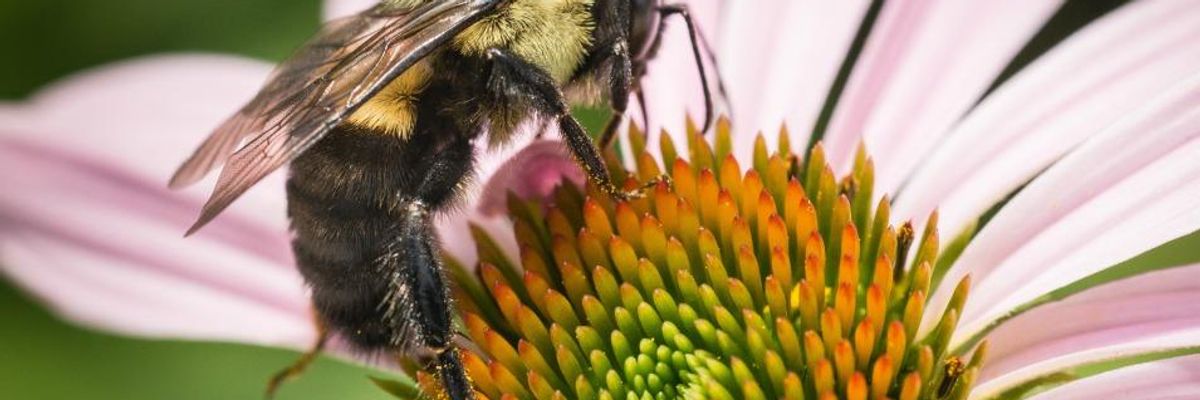
Echinacea and bee gather pollen in the People's Garden, Washington, D.C. (Photo: Smith Collection/Gado/Getty Images)
While it has been widely established by the scientific community that the class of pesticides known as neonicotinoids (or neonics) have had devastating impacts on honey bees and other pollinators, new research shows that Monsanto's glyphosate--the world's most widely used chemical weed-killer--is also extremely harmful to the health of bees and their ability to fend off disease.
Documented in a new study by scientists at the University of Texas at Austin and published in the Proceedings of the National Academy of Sciences, the findings show, according to the Guardian, that glyphosate negatively impacts "beneficial bacteria in the guts of honeybees and makes them more prone to deadly infections" by damaging "the microbiota that honeybees need to grow and to fight off pathogens."
Erick Motta, one of the researchers and co-author of the study, said, "We demonstrated that the abundances of dominant gut microbiota species are decreased in bees exposed to glyphosate at concentrations documented in the environment."
Based on their study, Motta and her colleagues are urging farmers and homeowners to avoid spraying glysophate-based herbicides on flowering plants that are likely to attract bees.
Bee experts and advocates worldwide in recent years have been warning that humanity's insatiable use of pesticides has been causing serious harm to bee populations that are essential to the global food supply.
While previous research has shown that use of glyphosate--the main active ingredient in Monsanto's pesticide Roundup--indirectly harms bees by devastating certain flowers on which they depend, the new research is significant for showing the direct harm it has on the health of bees.
"The biggest impact of glyphosate on bees is the destruction of the wildflowers on which they depend," Matt Sharlow, with the conservation group Buglife, told the Guardian. "Evidence to date suggests direct toxicity to bees is fairly low, however the new study clearly demonstrates that pesticide use can have significant unintended consequences."
According to Motta, "We need better guidelines for glyphosate use, especially regarding bee exposure, because right now the guidelines assume bees are not harmed by the herbicide. Our study shows that's not true."
Speaking to The Advocate, Professor Dave Goulson, a bee expert from the University of Sussex, added: "Those of us that study bees have long ago come to the conclusion that colony health is adversely affected by a number of interacting stressors, including exposure to cocktails of insecticides and fungicides, impacts of pathogens, and effects of poor nutrition."
Now, he said, "It now seems that we have to add glyphosate to the list of problems that they face."
Dear Common Dreams reader, It’s been nearly 30 years since I co-founded Common Dreams with my late wife, Lina Newhouser. We had the radical notion that journalism should serve the public good, not corporate profits. It was clear to us from the outset what it would take to build such a project. No paid advertisements. No corporate sponsors. No millionaire publisher telling us what to think or do. Many people said we wouldn't last a year, but we proved those doubters wrong. Together with a tremendous team of journalists and dedicated staff, we built an independent media outlet free from the constraints of profits and corporate control. Our mission has always been simple: To inform. To inspire. To ignite change for the common good. Building Common Dreams was not easy. Our survival was never guaranteed. When you take on the most powerful forces—Wall Street greed, fossil fuel industry destruction, Big Tech lobbyists, and uber-rich oligarchs who have spent billions upon billions rigging the economy and democracy in their favor—the only bulwark you have is supporters who believe in your work. But here’s the urgent message from me today. It's never been this bad out there. And it's never been this hard to keep us going. At the very moment Common Dreams is most needed, the threats we face are intensifying. We need your support now more than ever. We don't accept corporate advertising and never will. We don't have a paywall because we don't think people should be blocked from critical news based on their ability to pay. Everything we do is funded by the donations of readers like you. When everyone does the little they can afford, we are strong. But if that support retreats or dries up, so do we. Will you donate now to make sure Common Dreams not only survives but thrives? —Craig Brown, Co-founder |
While it has been widely established by the scientific community that the class of pesticides known as neonicotinoids (or neonics) have had devastating impacts on honey bees and other pollinators, new research shows that Monsanto's glyphosate--the world's most widely used chemical weed-killer--is also extremely harmful to the health of bees and their ability to fend off disease.
Documented in a new study by scientists at the University of Texas at Austin and published in the Proceedings of the National Academy of Sciences, the findings show, according to the Guardian, that glyphosate negatively impacts "beneficial bacteria in the guts of honeybees and makes them more prone to deadly infections" by damaging "the microbiota that honeybees need to grow and to fight off pathogens."
Erick Motta, one of the researchers and co-author of the study, said, "We demonstrated that the abundances of dominant gut microbiota species are decreased in bees exposed to glyphosate at concentrations documented in the environment."
Based on their study, Motta and her colleagues are urging farmers and homeowners to avoid spraying glysophate-based herbicides on flowering plants that are likely to attract bees.
Bee experts and advocates worldwide in recent years have been warning that humanity's insatiable use of pesticides has been causing serious harm to bee populations that are essential to the global food supply.
While previous research has shown that use of glyphosate--the main active ingredient in Monsanto's pesticide Roundup--indirectly harms bees by devastating certain flowers on which they depend, the new research is significant for showing the direct harm it has on the health of bees.
"The biggest impact of glyphosate on bees is the destruction of the wildflowers on which they depend," Matt Sharlow, with the conservation group Buglife, told the Guardian. "Evidence to date suggests direct toxicity to bees is fairly low, however the new study clearly demonstrates that pesticide use can have significant unintended consequences."
According to Motta, "We need better guidelines for glyphosate use, especially regarding bee exposure, because right now the guidelines assume bees are not harmed by the herbicide. Our study shows that's not true."
Speaking to The Advocate, Professor Dave Goulson, a bee expert from the University of Sussex, added: "Those of us that study bees have long ago come to the conclusion that colony health is adversely affected by a number of interacting stressors, including exposure to cocktails of insecticides and fungicides, impacts of pathogens, and effects of poor nutrition."
Now, he said, "It now seems that we have to add glyphosate to the list of problems that they face."
While it has been widely established by the scientific community that the class of pesticides known as neonicotinoids (or neonics) have had devastating impacts on honey bees and other pollinators, new research shows that Monsanto's glyphosate--the world's most widely used chemical weed-killer--is also extremely harmful to the health of bees and their ability to fend off disease.
Documented in a new study by scientists at the University of Texas at Austin and published in the Proceedings of the National Academy of Sciences, the findings show, according to the Guardian, that glyphosate negatively impacts "beneficial bacteria in the guts of honeybees and makes them more prone to deadly infections" by damaging "the microbiota that honeybees need to grow and to fight off pathogens."
Erick Motta, one of the researchers and co-author of the study, said, "We demonstrated that the abundances of dominant gut microbiota species are decreased in bees exposed to glyphosate at concentrations documented in the environment."
Based on their study, Motta and her colleagues are urging farmers and homeowners to avoid spraying glysophate-based herbicides on flowering plants that are likely to attract bees.
Bee experts and advocates worldwide in recent years have been warning that humanity's insatiable use of pesticides has been causing serious harm to bee populations that are essential to the global food supply.
While previous research has shown that use of glyphosate--the main active ingredient in Monsanto's pesticide Roundup--indirectly harms bees by devastating certain flowers on which they depend, the new research is significant for showing the direct harm it has on the health of bees.
"The biggest impact of glyphosate on bees is the destruction of the wildflowers on which they depend," Matt Sharlow, with the conservation group Buglife, told the Guardian. "Evidence to date suggests direct toxicity to bees is fairly low, however the new study clearly demonstrates that pesticide use can have significant unintended consequences."
According to Motta, "We need better guidelines for glyphosate use, especially regarding bee exposure, because right now the guidelines assume bees are not harmed by the herbicide. Our study shows that's not true."
Speaking to The Advocate, Professor Dave Goulson, a bee expert from the University of Sussex, added: "Those of us that study bees have long ago come to the conclusion that colony health is adversely affected by a number of interacting stressors, including exposure to cocktails of insecticides and fungicides, impacts of pathogens, and effects of poor nutrition."
Now, he said, "It now seems that we have to add glyphosate to the list of problems that they face."