
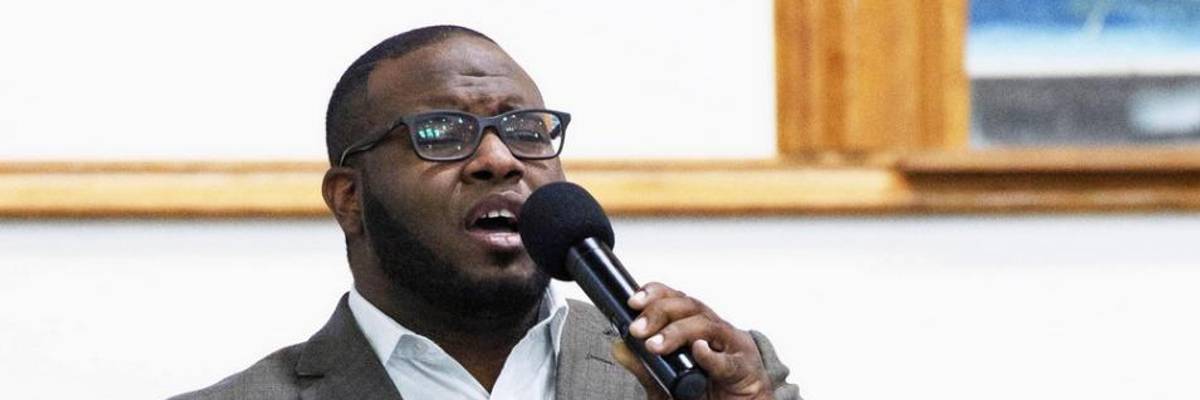
Botham Jean was shot by an off-duty police officer last week after she reportedly entered his home thinking it was hers. On Thursday, Dallas police and a Fox News affiliate drew outrage when it was reported that authorities had found marijuana in Jean's apartment. (Photo: @ShaunKing/Twitter)
The Clear Victim, Not the 'Perpetrator of a Crime': Outrage After Police and Local News Outlet Smear Botham Jean
"There is literally no scenario where a black man killed by police (even an off-duty one) cannot be blamed for his own death."
A local news report as well as the Dallas Police Department drew outrage overnight after it was reported that authorities had found marijuana in the apartment of Botham Jean, a 26-year-old black man who was fatally shot by an off-duty police officer who entered his home on September 6.
A search warrant was obtained for the home following the shooting.
The firestorm was spurred by a Fox 4 news report on the police search and a subsequent tweet that suggested that Jean--and not the officer who shot him--as one critic put it, was "being treated like the perpetrator of a crime."
The report came out on the same day Jean's family attended his funeral on Thursday--one week after Amber Guyger, an off-duty Dallas police officer, who lived just below him in an apartment complex, shot him after she allegedly entered his home while believing it to be her own. She claims she shot him after he ignored her "verbal commands," though other witnesses have contested her version of events. Guyger has been charged with manslaughter.
Lee Merritt, a civil rights attorney representing Jean's family, suggested after details of the police department's search warrant became public that authorities and the media should be focusing on evidence related to the suspect--not the victim of the crime.
"I would love to see more information coming out about warrants executed on the home of the shooter, who lived just below him. I haven't seen any of those," Merritt said.
Meanwhile, National Rifle Association (NRA) spokesperson Dana Loesch used the shooting to promote her organization's position that more private citizens should own guns for self-protection, suggesting this week, "This could have been very different if Botham Jean had been, say he was a law-abiding gun owner and he saw somebody coming into his apartment."
As Adam Serwer pointed out at The Atlantic, Loesch's suggestion directly contradicted the NRA's failure to come to the defense of Philando Castile, a black man who was shot and killed by a police officer during a traffic stop, after informing the officer that he had a concealed-carry permit and a firearm.
Loesch's reaction is an example of what one might call the "Rice rule," after Tamir Rice, the 12-year old killed by a white police officer while playing in a park with a toy gun: There are no circumstances in which the responsibility for a police shooting of an unarmed black person cannot be placed on the victim.
[...]
The NRA's conspicuous lack of outrage after the shootings of Philando Castile, Jason Washington, and Alton Sterling, all black men killed by police while in possession of a firearm, suggests an impossible double standard. When armed black men are shot by the police, the NRA says nothing about the rights of gun owners; when unarmed black men are shot, its spokesperson says they should have been armed. To this day, Loesch defends Castile's shooting as justified...
Castile's mother called Loesch's comments "reckless" and "one-sided."
"That officer was dead wrong. Just hold her accountable. Don't try to spin the story," Valerie Castile told the New York Daily News. "If he was telling her he had a weapon, it would have been a shootout. He would have been a black man with a gun. You can't use those three words in one sentence."
Nikole Hannah-Jones, a reporter on race in the U.S. for the New York Times Magazine, wrote that the reporting of the marijuana found by the police offered another way for Jean to be subtly blamed for his own shooting.
An Urgent Message From Our Co-Founder
Dear Common Dreams reader, It’s been nearly 30 years since I co-founded Common Dreams with my late wife, Lina Newhouser. We had the radical notion that journalism should serve the public good, not corporate profits. It was clear to us from the outset what it would take to build such a project. No paid advertisements. No corporate sponsors. No millionaire publisher telling us what to think or do. Many people said we wouldn't last a year, but we proved those doubters wrong. Together with a tremendous team of journalists and dedicated staff, we built an independent media outlet free from the constraints of profits and corporate control. Our mission has always been simple: To inform. To inspire. To ignite change for the common good. Building Common Dreams was not easy. Our survival was never guaranteed. When you take on the most powerful forces—Wall Street greed, fossil fuel industry destruction, Big Tech lobbyists, and uber-rich oligarchs who have spent billions upon billions rigging the economy and democracy in their favor—the only bulwark you have is supporters who believe in your work. But here’s the urgent message from me today. It's never been this bad out there. And it's never been this hard to keep us going. At the very moment Common Dreams is most needed, the threats we face are intensifying. We need your support now more than ever. We don't accept corporate advertising and never will. We don't have a paywall because we don't think people should be blocked from critical news based on their ability to pay. Everything we do is funded by the donations of readers like you. When everyone does the little they can afford, we are strong. But if that support retreats or dries up, so do we. Will you donate now to make sure Common Dreams not only survives but thrives? —Craig Brown, Co-founder |
A local news report as well as the Dallas Police Department drew outrage overnight after it was reported that authorities had found marijuana in the apartment of Botham Jean, a 26-year-old black man who was fatally shot by an off-duty police officer who entered his home on September 6.
A search warrant was obtained for the home following the shooting.
The firestorm was spurred by a Fox 4 news report on the police search and a subsequent tweet that suggested that Jean--and not the officer who shot him--as one critic put it, was "being treated like the perpetrator of a crime."
The report came out on the same day Jean's family attended his funeral on Thursday--one week after Amber Guyger, an off-duty Dallas police officer, who lived just below him in an apartment complex, shot him after she allegedly entered his home while believing it to be her own. She claims she shot him after he ignored her "verbal commands," though other witnesses have contested her version of events. Guyger has been charged with manslaughter.
Lee Merritt, a civil rights attorney representing Jean's family, suggested after details of the police department's search warrant became public that authorities and the media should be focusing on evidence related to the suspect--not the victim of the crime.
"I would love to see more information coming out about warrants executed on the home of the shooter, who lived just below him. I haven't seen any of those," Merritt said.
Meanwhile, National Rifle Association (NRA) spokesperson Dana Loesch used the shooting to promote her organization's position that more private citizens should own guns for self-protection, suggesting this week, "This could have been very different if Botham Jean had been, say he was a law-abiding gun owner and he saw somebody coming into his apartment."
As Adam Serwer pointed out at The Atlantic, Loesch's suggestion directly contradicted the NRA's failure to come to the defense of Philando Castile, a black man who was shot and killed by a police officer during a traffic stop, after informing the officer that he had a concealed-carry permit and a firearm.
Loesch's reaction is an example of what one might call the "Rice rule," after Tamir Rice, the 12-year old killed by a white police officer while playing in a park with a toy gun: There are no circumstances in which the responsibility for a police shooting of an unarmed black person cannot be placed on the victim.
[...]
The NRA's conspicuous lack of outrage after the shootings of Philando Castile, Jason Washington, and Alton Sterling, all black men killed by police while in possession of a firearm, suggests an impossible double standard. When armed black men are shot by the police, the NRA says nothing about the rights of gun owners; when unarmed black men are shot, its spokesperson says they should have been armed. To this day, Loesch defends Castile's shooting as justified...
Castile's mother called Loesch's comments "reckless" and "one-sided."
"That officer was dead wrong. Just hold her accountable. Don't try to spin the story," Valerie Castile told the New York Daily News. "If he was telling her he had a weapon, it would have been a shootout. He would have been a black man with a gun. You can't use those three words in one sentence."
Nikole Hannah-Jones, a reporter on race in the U.S. for the New York Times Magazine, wrote that the reporting of the marijuana found by the police offered another way for Jean to be subtly blamed for his own shooting.
A local news report as well as the Dallas Police Department drew outrage overnight after it was reported that authorities had found marijuana in the apartment of Botham Jean, a 26-year-old black man who was fatally shot by an off-duty police officer who entered his home on September 6.
A search warrant was obtained for the home following the shooting.
The firestorm was spurred by a Fox 4 news report on the police search and a subsequent tweet that suggested that Jean--and not the officer who shot him--as one critic put it, was "being treated like the perpetrator of a crime."
The report came out on the same day Jean's family attended his funeral on Thursday--one week after Amber Guyger, an off-duty Dallas police officer, who lived just below him in an apartment complex, shot him after she allegedly entered his home while believing it to be her own. She claims she shot him after he ignored her "verbal commands," though other witnesses have contested her version of events. Guyger has been charged with manslaughter.
Lee Merritt, a civil rights attorney representing Jean's family, suggested after details of the police department's search warrant became public that authorities and the media should be focusing on evidence related to the suspect--not the victim of the crime.
"I would love to see more information coming out about warrants executed on the home of the shooter, who lived just below him. I haven't seen any of those," Merritt said.
Meanwhile, National Rifle Association (NRA) spokesperson Dana Loesch used the shooting to promote her organization's position that more private citizens should own guns for self-protection, suggesting this week, "This could have been very different if Botham Jean had been, say he was a law-abiding gun owner and he saw somebody coming into his apartment."
As Adam Serwer pointed out at The Atlantic, Loesch's suggestion directly contradicted the NRA's failure to come to the defense of Philando Castile, a black man who was shot and killed by a police officer during a traffic stop, after informing the officer that he had a concealed-carry permit and a firearm.
Loesch's reaction is an example of what one might call the "Rice rule," after Tamir Rice, the 12-year old killed by a white police officer while playing in a park with a toy gun: There are no circumstances in which the responsibility for a police shooting of an unarmed black person cannot be placed on the victim.
[...]
The NRA's conspicuous lack of outrage after the shootings of Philando Castile, Jason Washington, and Alton Sterling, all black men killed by police while in possession of a firearm, suggests an impossible double standard. When armed black men are shot by the police, the NRA says nothing about the rights of gun owners; when unarmed black men are shot, its spokesperson says they should have been armed. To this day, Loesch defends Castile's shooting as justified...
Castile's mother called Loesch's comments "reckless" and "one-sided."
"That officer was dead wrong. Just hold her accountable. Don't try to spin the story," Valerie Castile told the New York Daily News. "If he was telling her he had a weapon, it would have been a shootout. He would have been a black man with a gun. You can't use those three words in one sentence."
Nikole Hannah-Jones, a reporter on race in the U.S. for the New York Times Magazine, wrote that the reporting of the marijuana found by the police offered another way for Jean to be subtly blamed for his own shooting.