SUBSCRIBE TO OUR FREE NEWSLETTER
Daily news & progressive opinion—funded by the people, not the corporations—delivered straight to your inbox.
5
#000000
#FFFFFF
To donate by check, phone, or other method, see our More Ways to Give page.
Daily news & progressive opinion—funded by the people, not the corporations—delivered straight to your inbox.
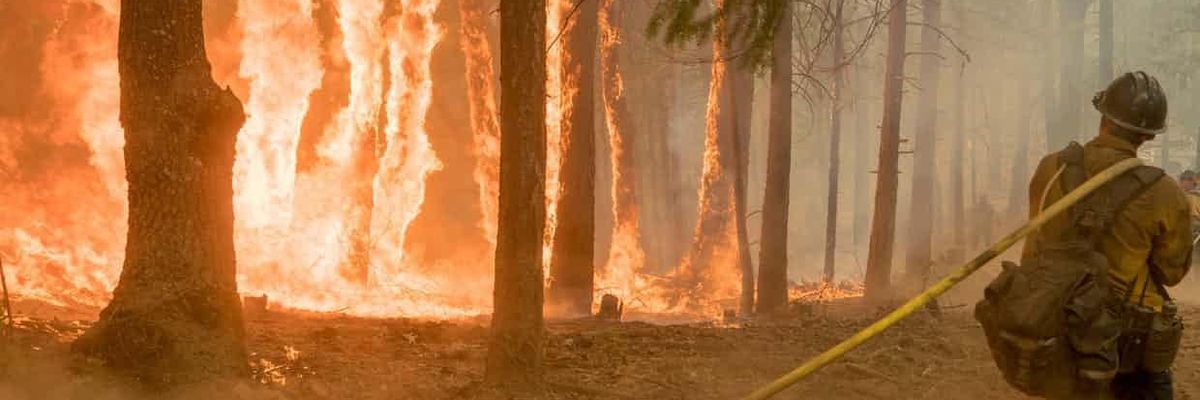
A wildfire burns near Yosemite national park. (Photo: US forest service/Reuters)
After U.S. Secretary of the Interior Ryan Zinke over the weekend outrageously and falsely declared that the largest wildfires in the history of California have "nothing to do with climate change," it was up to people who actually understand the science--and give a shit about the future of the planet--to set him straight.
Last week, as Common Dreams reported, Zinke went to the pages of USA TODAY to blame the wildfires ravaging California and elsewhere on so-called "radicial environmentalists" who are somehow preventing forest management - an argument he repeated over the weekend while visiting destroyed areas in California. Of course, as real and not-at-all-radical environmentalists pointed out, what ZInke is really saying is that he wants to give the nation's forests over to the timber industry for clear-cutting, consequences and destruction of natural habitat be damned.
Randi Spivak, public lands program director at the Center for Biological Diversity, explained to The Hill thatZinke is just straight up wrong about the clear role that warming temperatures--now increasingly driven by human-caused global warming--are playing in creating larger and more powerful wildfires.
" Climate change creates drought, high wind conditions, low humidity. Fire creates its own weather," Spivak said. "You can thin all you want till the cows come home but fire will overtake that ... what is misleading is people like Zinke and other people who refuse to talk about climate change and how we need to tackle that."
And as Eric Holthaus, a meteorologist and staff writer for Grist, wrote on Monday regarding Zinke's weekend comments in California and ongoing fires in Montana's Glacier National Park, "This summer has felt like a global warming turning point." But in the end, he said, it does matter what people like Zinke and President Trump say about the cause and the solution.
The current best-practice for reducing fire risk is cutting down smaller trees and underbrush, but that's expensive and time-consuming -- the kind of work that logging companies aren't interested in. Even that approach, however, can reduce forests' ability to adapt to climate change. There's no easy answer," says Holthaus.
"And yes, Zinke, it does matter if you believe in climate change," he concluded. "The only thing that will save forests and glaciers as we know them is ending our dependence on fossil fuels as quickly as possible. But we're at the point where we know irreversible change is already locked in. That's a scary reality, but instead of driving us to despair, it should motivate us to strive to save what we still can."
Dear Common Dreams reader, It’s been nearly 30 years since I co-founded Common Dreams with my late wife, Lina Newhouser. We had the radical notion that journalism should serve the public good, not corporate profits. It was clear to us from the outset what it would take to build such a project. No paid advertisements. No corporate sponsors. No millionaire publisher telling us what to think or do. Many people said we wouldn't last a year, but we proved those doubters wrong. Together with a tremendous team of journalists and dedicated staff, we built an independent media outlet free from the constraints of profits and corporate control. Our mission has always been simple: To inform. To inspire. To ignite change for the common good. Building Common Dreams was not easy. Our survival was never guaranteed. When you take on the most powerful forces—Wall Street greed, fossil fuel industry destruction, Big Tech lobbyists, and uber-rich oligarchs who have spent billions upon billions rigging the economy and democracy in their favor—the only bulwark you have is supporters who believe in your work. But here’s the urgent message from me today. It's never been this bad out there. And it's never been this hard to keep us going. At the very moment Common Dreams is most needed, the threats we face are intensifying. We need your support now more than ever. We don't accept corporate advertising and never will. We don't have a paywall because we don't think people should be blocked from critical news based on their ability to pay. Everything we do is funded by the donations of readers like you. When everyone does the little they can afford, we are strong. But if that support retreats or dries up, so do we. Will you donate now to make sure Common Dreams not only survives but thrives? —Craig Brown, Co-founder |
After U.S. Secretary of the Interior Ryan Zinke over the weekend outrageously and falsely declared that the largest wildfires in the history of California have "nothing to do with climate change," it was up to people who actually understand the science--and give a shit about the future of the planet--to set him straight.
Last week, as Common Dreams reported, Zinke went to the pages of USA TODAY to blame the wildfires ravaging California and elsewhere on so-called "radicial environmentalists" who are somehow preventing forest management - an argument he repeated over the weekend while visiting destroyed areas in California. Of course, as real and not-at-all-radical environmentalists pointed out, what ZInke is really saying is that he wants to give the nation's forests over to the timber industry for clear-cutting, consequences and destruction of natural habitat be damned.
Randi Spivak, public lands program director at the Center for Biological Diversity, explained to The Hill thatZinke is just straight up wrong about the clear role that warming temperatures--now increasingly driven by human-caused global warming--are playing in creating larger and more powerful wildfires.
" Climate change creates drought, high wind conditions, low humidity. Fire creates its own weather," Spivak said. "You can thin all you want till the cows come home but fire will overtake that ... what is misleading is people like Zinke and other people who refuse to talk about climate change and how we need to tackle that."
And as Eric Holthaus, a meteorologist and staff writer for Grist, wrote on Monday regarding Zinke's weekend comments in California and ongoing fires in Montana's Glacier National Park, "This summer has felt like a global warming turning point." But in the end, he said, it does matter what people like Zinke and President Trump say about the cause and the solution.
The current best-practice for reducing fire risk is cutting down smaller trees and underbrush, but that's expensive and time-consuming -- the kind of work that logging companies aren't interested in. Even that approach, however, can reduce forests' ability to adapt to climate change. There's no easy answer," says Holthaus.
"And yes, Zinke, it does matter if you believe in climate change," he concluded. "The only thing that will save forests and glaciers as we know them is ending our dependence on fossil fuels as quickly as possible. But we're at the point where we know irreversible change is already locked in. That's a scary reality, but instead of driving us to despair, it should motivate us to strive to save what we still can."
After U.S. Secretary of the Interior Ryan Zinke over the weekend outrageously and falsely declared that the largest wildfires in the history of California have "nothing to do with climate change," it was up to people who actually understand the science--and give a shit about the future of the planet--to set him straight.
Last week, as Common Dreams reported, Zinke went to the pages of USA TODAY to blame the wildfires ravaging California and elsewhere on so-called "radicial environmentalists" who are somehow preventing forest management - an argument he repeated over the weekend while visiting destroyed areas in California. Of course, as real and not-at-all-radical environmentalists pointed out, what ZInke is really saying is that he wants to give the nation's forests over to the timber industry for clear-cutting, consequences and destruction of natural habitat be damned.
Randi Spivak, public lands program director at the Center for Biological Diversity, explained to The Hill thatZinke is just straight up wrong about the clear role that warming temperatures--now increasingly driven by human-caused global warming--are playing in creating larger and more powerful wildfires.
" Climate change creates drought, high wind conditions, low humidity. Fire creates its own weather," Spivak said. "You can thin all you want till the cows come home but fire will overtake that ... what is misleading is people like Zinke and other people who refuse to talk about climate change and how we need to tackle that."
And as Eric Holthaus, a meteorologist and staff writer for Grist, wrote on Monday regarding Zinke's weekend comments in California and ongoing fires in Montana's Glacier National Park, "This summer has felt like a global warming turning point." But in the end, he said, it does matter what people like Zinke and President Trump say about the cause and the solution.
The current best-practice for reducing fire risk is cutting down smaller trees and underbrush, but that's expensive and time-consuming -- the kind of work that logging companies aren't interested in. Even that approach, however, can reduce forests' ability to adapt to climate change. There's no easy answer," says Holthaus.
"And yes, Zinke, it does matter if you believe in climate change," he concluded. "The only thing that will save forests and glaciers as we know them is ending our dependence on fossil fuels as quickly as possible. But we're at the point where we know irreversible change is already locked in. That's a scary reality, but instead of driving us to despair, it should motivate us to strive to save what we still can."