SUBSCRIBE TO OUR FREE NEWSLETTER
Daily news & progressive opinion—funded by the people, not the corporations—delivered straight to your inbox.
5
#000000
#FFFFFF
To donate by check, phone, or other method, see our More Ways to Give page.
Daily news & progressive opinion—funded by the people, not the corporations—delivered straight to your inbox.
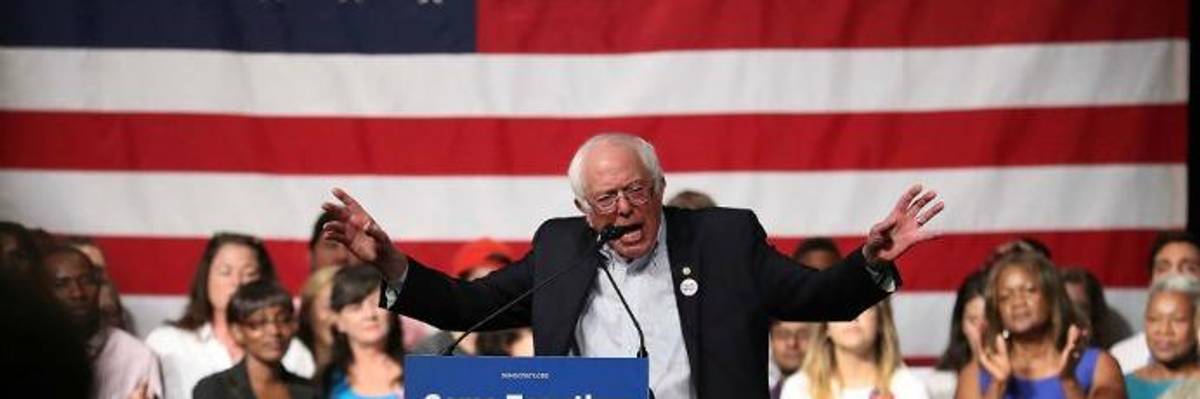
Sen. Bernie Sanders (I-Vt.) speaks during a 'Come Together and Fight Back' tour at the James L Knight Center on April 19, 2017 in Miami, Florida. (Photo: Joe Raedle/Getty Images)
In an important and long-overdue step toward making the Democratic Party more accountable to voters and less captive to the interests of establishment insiders, the Democratic National Committee's (DNC) Rules and Bylaws arm voted overwhelmingly on Wednesday to drastically curtail the influence of superdelegates by barring them from voting on the first ballot of the presidential nomination.
"This is a major step forward in making the Democratic Party more open and transparent, and I applaud their action."
--Sen. Bernie SandersSen. Bernie Sanders (I-Vt.), who has long criticized the party's superdelegate system as undemocratic, congratulated DNC chair Tom Perez and the Rules and Bylaws Committee for the move in a statement following the 27-1 vote, saying the "decision will ensure that delegates elected by voters in primaries and caucuses will have the primary role in selecting the Democratic Party's nominee at the 2020 convention."
"This is a major step forward in making the Democratic Party more open and transparent, and I applaud their action," Sanders added.
Nomiki Konst, a Sanders appointee to the DNC's Unity Reform Commission, similarly praised the DNC's move to limit superdelegates' power in a series of tweets late Wednesday, attributing the nearly unanimous vote to a wave of grassroots activism that began during the 2016 Democratic presidential primary, when progressives recognized the way in which the system tilted the scales in favor of Hillary Clinton over Sanders' insurgent campaign.
"This is a YUGE deal," Konst wrote shortly following the committee's vote. "Thanks to all of the incredible activism, superdelegates will soon be a thing of the past."
The push by progressives to scale back the influence of superdelegates intensified in the wake of the heated 2016 Democratic primaries, when former Secretary of State Hillary Clinton secured the support of hundreds of superdelegates before a single vote was cast.
"No candidate should have an accumulated lead, whether real or perceived, before a first ballot is cast," DNC chair Tom Perez said during a conference call about the new rule on Wednesday. "We have to make sure that we rebuild the trust among many who feel alienated from our party."
The Rules and Bylaws Committee is set to officially certify the new superdelegate restrictions next month before they are adopted by the full DNC in August.
Dear Common Dreams reader, It’s been nearly 30 years since I co-founded Common Dreams with my late wife, Lina Newhouser. We had the radical notion that journalism should serve the public good, not corporate profits. It was clear to us from the outset what it would take to build such a project. No paid advertisements. No corporate sponsors. No millionaire publisher telling us what to think or do. Many people said we wouldn't last a year, but we proved those doubters wrong. Together with a tremendous team of journalists and dedicated staff, we built an independent media outlet free from the constraints of profits and corporate control. Our mission has always been simple: To inform. To inspire. To ignite change for the common good. Building Common Dreams was not easy. Our survival was never guaranteed. When you take on the most powerful forces—Wall Street greed, fossil fuel industry destruction, Big Tech lobbyists, and uber-rich oligarchs who have spent billions upon billions rigging the economy and democracy in their favor—the only bulwark you have is supporters who believe in your work. But here’s the urgent message from me today. It's never been this bad out there. And it's never been this hard to keep us going. At the very moment Common Dreams is most needed, the threats we face are intensifying. We need your support now more than ever. We don't accept corporate advertising and never will. We don't have a paywall because we don't think people should be blocked from critical news based on their ability to pay. Everything we do is funded by the donations of readers like you. When everyone does the little they can afford, we are strong. But if that support retreats or dries up, so do we. Will you donate now to make sure Common Dreams not only survives but thrives? —Craig Brown, Co-founder |
In an important and long-overdue step toward making the Democratic Party more accountable to voters and less captive to the interests of establishment insiders, the Democratic National Committee's (DNC) Rules and Bylaws arm voted overwhelmingly on Wednesday to drastically curtail the influence of superdelegates by barring them from voting on the first ballot of the presidential nomination.
"This is a major step forward in making the Democratic Party more open and transparent, and I applaud their action."
--Sen. Bernie SandersSen. Bernie Sanders (I-Vt.), who has long criticized the party's superdelegate system as undemocratic, congratulated DNC chair Tom Perez and the Rules and Bylaws Committee for the move in a statement following the 27-1 vote, saying the "decision will ensure that delegates elected by voters in primaries and caucuses will have the primary role in selecting the Democratic Party's nominee at the 2020 convention."
"This is a major step forward in making the Democratic Party more open and transparent, and I applaud their action," Sanders added.
Nomiki Konst, a Sanders appointee to the DNC's Unity Reform Commission, similarly praised the DNC's move to limit superdelegates' power in a series of tweets late Wednesday, attributing the nearly unanimous vote to a wave of grassroots activism that began during the 2016 Democratic presidential primary, when progressives recognized the way in which the system tilted the scales in favor of Hillary Clinton over Sanders' insurgent campaign.
"This is a YUGE deal," Konst wrote shortly following the committee's vote. "Thanks to all of the incredible activism, superdelegates will soon be a thing of the past."
The push by progressives to scale back the influence of superdelegates intensified in the wake of the heated 2016 Democratic primaries, when former Secretary of State Hillary Clinton secured the support of hundreds of superdelegates before a single vote was cast.
"No candidate should have an accumulated lead, whether real or perceived, before a first ballot is cast," DNC chair Tom Perez said during a conference call about the new rule on Wednesday. "We have to make sure that we rebuild the trust among many who feel alienated from our party."
The Rules and Bylaws Committee is set to officially certify the new superdelegate restrictions next month before they are adopted by the full DNC in August.
In an important and long-overdue step toward making the Democratic Party more accountable to voters and less captive to the interests of establishment insiders, the Democratic National Committee's (DNC) Rules and Bylaws arm voted overwhelmingly on Wednesday to drastically curtail the influence of superdelegates by barring them from voting on the first ballot of the presidential nomination.
"This is a major step forward in making the Democratic Party more open and transparent, and I applaud their action."
--Sen. Bernie SandersSen. Bernie Sanders (I-Vt.), who has long criticized the party's superdelegate system as undemocratic, congratulated DNC chair Tom Perez and the Rules and Bylaws Committee for the move in a statement following the 27-1 vote, saying the "decision will ensure that delegates elected by voters in primaries and caucuses will have the primary role in selecting the Democratic Party's nominee at the 2020 convention."
"This is a major step forward in making the Democratic Party more open and transparent, and I applaud their action," Sanders added.
Nomiki Konst, a Sanders appointee to the DNC's Unity Reform Commission, similarly praised the DNC's move to limit superdelegates' power in a series of tweets late Wednesday, attributing the nearly unanimous vote to a wave of grassroots activism that began during the 2016 Democratic presidential primary, when progressives recognized the way in which the system tilted the scales in favor of Hillary Clinton over Sanders' insurgent campaign.
"This is a YUGE deal," Konst wrote shortly following the committee's vote. "Thanks to all of the incredible activism, superdelegates will soon be a thing of the past."
The push by progressives to scale back the influence of superdelegates intensified in the wake of the heated 2016 Democratic primaries, when former Secretary of State Hillary Clinton secured the support of hundreds of superdelegates before a single vote was cast.
"No candidate should have an accumulated lead, whether real or perceived, before a first ballot is cast," DNC chair Tom Perez said during a conference call about the new rule on Wednesday. "We have to make sure that we rebuild the trust among many who feel alienated from our party."
The Rules and Bylaws Committee is set to officially certify the new superdelegate restrictions next month before they are adopted by the full DNC in August.