


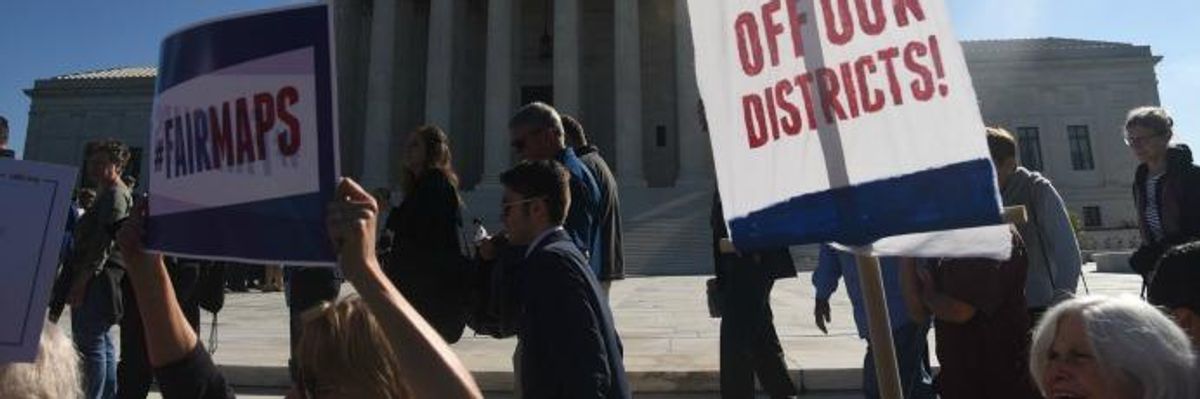
Demonstrators gather outside of the Supreme Court during oral arguments in Gill v. Whitford last October. (Photo: Olivier Douliery/Getty Images)
To donate by check, phone, or other method, see our More Ways to Give page.
Demonstrators gather outside of the Supreme Court during oral arguments in Gill v. Whitford last October. (Photo: Olivier Douliery/Getty Images)
In a victory for "GOP racial gerrymanders everywhere" and a significant loss for voting rights, the Supreme Court's conservative majority on Monday overturned a lower court ruling and revived electoral districts drawn by Texas Republicans that many experts say are blatantly designed to discriminate against minorities.
"After years of litigation and undeniable proof of intentional discrimination, minority voters in Texas--despite constituting a majority of the population within the state--will continue to be underrepresented in the political process."
--Supreme Court Justice Sonia SotomayorCompounding what has already been a rough several days for activists and legal experts working to combat gerrymandering nationwide, the Supreme Court also decided to send a major North Carolina partisan gerrymandering case back to a lower court, leaving intact congressional maps that rights groups argue were drawn to discriminate against Democratic voters.
Common Cause--an advocacy organization that is one of the main plaintiffs in the North Carolina case--expressed dismay at both of the high court's rulings on Monday but vowed to continue fighting for the voting rights of all Americans.
"Voting rights in Texas were dealt a severe blow today by the U.S. Supreme Court as the Roberts Court upheld the legislature's extreme racial gerrymander that robbed hundreds of thousands of minority residents of a voice in Austin," Anthony Gutierrez, executive director of Common Cause Texas, said in a statement following the court's 5-4 ruling.
Bob Phillips, executive director of Common Cause North Carolina, added, "We must end gerrymandering to ensure all voters have a voice in our democracy."
The Supreme Court's decision to allow the North Carolina and Texas gerrymanders to stand comes on the fifth anniversary of the court's infamous 2013 Shelby County v. Holder ruling, which gutted key provisions of the Voting Rights Act of 1965 and opened the door to the GOP's aggressive, nationwide effort to suppress the minority vote.
\u201cAnd if Trump ever gets to replace Kennedy or one of the liberals with another Gorsuch, the Supreme Court could be well on its way to throwing out the rest of the Voting Rights Act as far as racial gerrymandering & intentional discrimination in redistricting are concerned https://t.co/B9rK2c6nJF\u201d— Stephen Wolf (@Stephen Wolf) 1529935562
\u201cRemember that Kagan wrote, a week ago today, that gerrymandering is placing our democracy is in crisis. That crisis just deepened further. https://t.co/QZwA3xaYwW\u201d— Angus Johnston (@Angus Johnston) 1529935079
In her dissent against the conservative majority's ruling in the Texas case on Monday, Justice Sonia Sotomayor argued that the court's decision "goes out of its way to permit the state of Texas to use maps that the three-judge district court unanimously found were adopted for the purpose of preserving the racial discrimination that tainted its previous maps."
"After years of litigation and undeniable proof of intentional discrimination, minority voters in Texas--despite constituting a majority of the population within the state--will continue to be underrepresented in the political process," Sotomayor concluded. "Our democracy rests on the ability of all individuals, regardless of race, income, or status, to exercise their right to vote. Because our duty is to safeguard that fundamental right, I dissent."
Donald Trump’s attacks on democracy, justice, and a free press are escalating — putting everything we stand for at risk. We believe a better world is possible, but we can’t get there without your support. Common Dreams stands apart. We answer only to you — our readers, activists, and changemakers — not to billionaires or corporations. Our independence allows us to cover the vital stories that others won’t, spotlighting movements for peace, equality, and human rights. Right now, our work faces unprecedented challenges. Misinformation is spreading, journalists are under attack, and financial pressures are mounting. As a reader-supported, nonprofit newsroom, your support is crucial to keep this journalism alive. Whatever you can give — $10, $25, or $100 — helps us stay strong and responsive when the world needs us most. Together, we’ll continue to build the independent, courageous journalism our movement relies on. Thank you for being part of this community. |
In a victory for "GOP racial gerrymanders everywhere" and a significant loss for voting rights, the Supreme Court's conservative majority on Monday overturned a lower court ruling and revived electoral districts drawn by Texas Republicans that many experts say are blatantly designed to discriminate against minorities.
"After years of litigation and undeniable proof of intentional discrimination, minority voters in Texas--despite constituting a majority of the population within the state--will continue to be underrepresented in the political process."
--Supreme Court Justice Sonia SotomayorCompounding what has already been a rough several days for activists and legal experts working to combat gerrymandering nationwide, the Supreme Court also decided to send a major North Carolina partisan gerrymandering case back to a lower court, leaving intact congressional maps that rights groups argue were drawn to discriminate against Democratic voters.
Common Cause--an advocacy organization that is one of the main plaintiffs in the North Carolina case--expressed dismay at both of the high court's rulings on Monday but vowed to continue fighting for the voting rights of all Americans.
"Voting rights in Texas were dealt a severe blow today by the U.S. Supreme Court as the Roberts Court upheld the legislature's extreme racial gerrymander that robbed hundreds of thousands of minority residents of a voice in Austin," Anthony Gutierrez, executive director of Common Cause Texas, said in a statement following the court's 5-4 ruling.
Bob Phillips, executive director of Common Cause North Carolina, added, "We must end gerrymandering to ensure all voters have a voice in our democracy."
The Supreme Court's decision to allow the North Carolina and Texas gerrymanders to stand comes on the fifth anniversary of the court's infamous 2013 Shelby County v. Holder ruling, which gutted key provisions of the Voting Rights Act of 1965 and opened the door to the GOP's aggressive, nationwide effort to suppress the minority vote.
\u201cAnd if Trump ever gets to replace Kennedy or one of the liberals with another Gorsuch, the Supreme Court could be well on its way to throwing out the rest of the Voting Rights Act as far as racial gerrymandering & intentional discrimination in redistricting are concerned https://t.co/B9rK2c6nJF\u201d— Stephen Wolf (@Stephen Wolf) 1529935562
\u201cRemember that Kagan wrote, a week ago today, that gerrymandering is placing our democracy is in crisis. That crisis just deepened further. https://t.co/QZwA3xaYwW\u201d— Angus Johnston (@Angus Johnston) 1529935079
In her dissent against the conservative majority's ruling in the Texas case on Monday, Justice Sonia Sotomayor argued that the court's decision "goes out of its way to permit the state of Texas to use maps that the three-judge district court unanimously found were adopted for the purpose of preserving the racial discrimination that tainted its previous maps."
"After years of litigation and undeniable proof of intentional discrimination, minority voters in Texas--despite constituting a majority of the population within the state--will continue to be underrepresented in the political process," Sotomayor concluded. "Our democracy rests on the ability of all individuals, regardless of race, income, or status, to exercise their right to vote. Because our duty is to safeguard that fundamental right, I dissent."
In a victory for "GOP racial gerrymanders everywhere" and a significant loss for voting rights, the Supreme Court's conservative majority on Monday overturned a lower court ruling and revived electoral districts drawn by Texas Republicans that many experts say are blatantly designed to discriminate against minorities.
"After years of litigation and undeniable proof of intentional discrimination, minority voters in Texas--despite constituting a majority of the population within the state--will continue to be underrepresented in the political process."
--Supreme Court Justice Sonia SotomayorCompounding what has already been a rough several days for activists and legal experts working to combat gerrymandering nationwide, the Supreme Court also decided to send a major North Carolina partisan gerrymandering case back to a lower court, leaving intact congressional maps that rights groups argue were drawn to discriminate against Democratic voters.
Common Cause--an advocacy organization that is one of the main plaintiffs in the North Carolina case--expressed dismay at both of the high court's rulings on Monday but vowed to continue fighting for the voting rights of all Americans.
"Voting rights in Texas were dealt a severe blow today by the U.S. Supreme Court as the Roberts Court upheld the legislature's extreme racial gerrymander that robbed hundreds of thousands of minority residents of a voice in Austin," Anthony Gutierrez, executive director of Common Cause Texas, said in a statement following the court's 5-4 ruling.
Bob Phillips, executive director of Common Cause North Carolina, added, "We must end gerrymandering to ensure all voters have a voice in our democracy."
The Supreme Court's decision to allow the North Carolina and Texas gerrymanders to stand comes on the fifth anniversary of the court's infamous 2013 Shelby County v. Holder ruling, which gutted key provisions of the Voting Rights Act of 1965 and opened the door to the GOP's aggressive, nationwide effort to suppress the minority vote.
\u201cAnd if Trump ever gets to replace Kennedy or one of the liberals with another Gorsuch, the Supreme Court could be well on its way to throwing out the rest of the Voting Rights Act as far as racial gerrymandering & intentional discrimination in redistricting are concerned https://t.co/B9rK2c6nJF\u201d— Stephen Wolf (@Stephen Wolf) 1529935562
\u201cRemember that Kagan wrote, a week ago today, that gerrymandering is placing our democracy is in crisis. That crisis just deepened further. https://t.co/QZwA3xaYwW\u201d— Angus Johnston (@Angus Johnston) 1529935079
In her dissent against the conservative majority's ruling in the Texas case on Monday, Justice Sonia Sotomayor argued that the court's decision "goes out of its way to permit the state of Texas to use maps that the three-judge district court unanimously found were adopted for the purpose of preserving the racial discrimination that tainted its previous maps."
"After years of litigation and undeniable proof of intentional discrimination, minority voters in Texas--despite constituting a majority of the population within the state--will continue to be underrepresented in the political process," Sotomayor concluded. "Our democracy rests on the ability of all individuals, regardless of race, income, or status, to exercise their right to vote. Because our duty is to safeguard that fundamental right, I dissent."