

SUBSCRIBE TO OUR FREE NEWSLETTER
Daily news & progressive opinion—funded by the people, not the corporations—delivered straight to your inbox.
5
#000000
#FFFFFF
To donate by check, phone, or other method, see our More Ways to Give page.
Daily news & progressive opinion—funded by the people, not the corporations—delivered straight to your inbox.
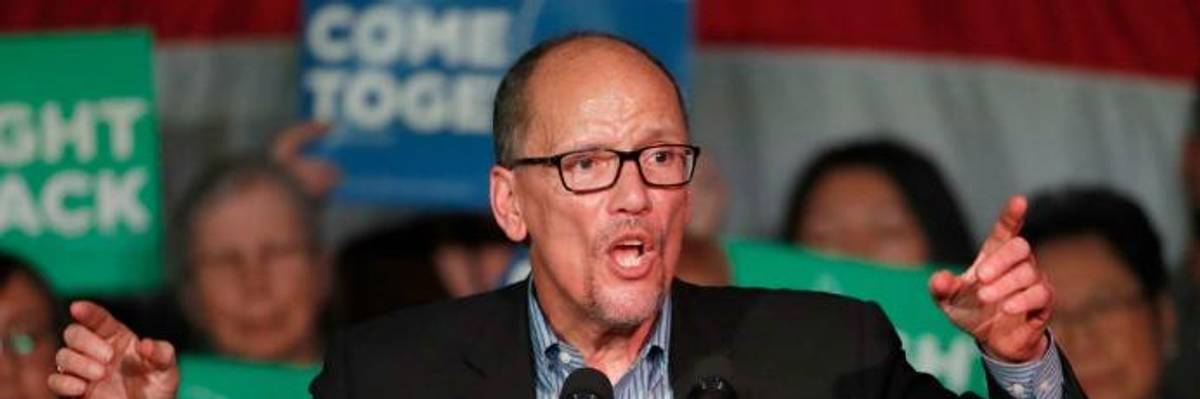
DNC Chairman Tom Perez, speaks to a crowd of supporters at a Democratic unity rally at the Rail Event Center on April 21, 2017 in Salt Lake City, Utah. (Photo: George Frey/Getty Images)
"The DNC has learned nothing."
That was how the advocacy group People for Bernie reacted to reports late Friday that the rules and bylaws arm of the Democratic National Committee has moved ahead with a new resolution that, according to Yahoo News, would "force candidates in Democratic presidential primaries to state that they are Democrats" and "to 'run and serve' as a member" of the party.
"We just came off a devastating presidential loss in 2016. It would seem to me the actual impetus would be to expand the Democratic Party. I just for the life of me don't see any motivation for this beyond personal spite."
--Mark Longabaugh
While allies of Sen. Bernie Sanders (I-Vt.)--who ran as a Democrat in the 2016 presidential primary while still identifying as an independent--said they don't expect the new rules to hinder Sanders' chances of running for the Democratic nomination in 2020 if he chooses to do so, many supporters of the Vermont senator characterized the rule change as a completely unnecessary "slap in the face" to progressive outsiders.
"We just came off a devastating presidential loss in 2016. It would seem to me the actual impetus would be to expand the Democratic Party. I just for the life of me don't see any motivation for this beyond personal spite," Mark Longabaugh, a senior adviser to Sanders' 2016 presidential campaign, told Yahoo News. "I scratch my head and ask why they would want to make the party more narrow and more exclusive."
Other progressives echoed Longabaugh's critique of the new rule on social media, with many noting that such restrictions could demobilize large constituencies that are disaffected with both major political parties.
Following his 2016 presidential campaign, Sanders--who is now far-and-away the most popular politician in the country--repeatedly emphasized the importance of creating a more inclusive party organized around the needs of the poor and working class, not corporate donors.
"If the Democratic Party is going to succeed... it's gonna have to open its door to independents," Sanders said in an interview last April. "There are probably more independents in this country than Democrats or Republicans. It's got to open its doors to working people and to young people, create a grassroots party."
Speaking with Politico on Friday, Longabaugh argued that the DNC's new rule would do precisely the opposite, moving the party even closer to becoming an "exclusive club."
"I really don't get the motivation for the resolution at all," he said. "You know, Bernie Sanders got 13 million votes in 2016. Thousands, if not millions, of those votes were young people and independents he brought into the Democratic Party."
The full DNC is expected to hold a final vote on the new resolution in August.
Dear Common Dreams reader, It’s been nearly 30 years since I co-founded Common Dreams with my late wife, Lina Newhouser. We had the radical notion that journalism should serve the public good, not corporate profits. It was clear to us from the outset what it would take to build such a project. No paid advertisements. No corporate sponsors. No millionaire publisher telling us what to think or do. Many people said we wouldn't last a year, but we proved those doubters wrong. Together with a tremendous team of journalists and dedicated staff, we built an independent media outlet free from the constraints of profits and corporate control. Our mission has always been simple: To inform. To inspire. To ignite change for the common good. Building Common Dreams was not easy. Our survival was never guaranteed. When you take on the most powerful forces—Wall Street greed, fossil fuel industry destruction, Big Tech lobbyists, and uber-rich oligarchs who have spent billions upon billions rigging the economy and democracy in their favor—the only bulwark you have is supporters who believe in your work. But here’s the urgent message from me today. It's never been this bad out there. And it's never been this hard to keep us going. At the very moment Common Dreams is most needed, the threats we face are intensifying. We need your support now more than ever. We don't accept corporate advertising and never will. We don't have a paywall because we don't think people should be blocked from critical news based on their ability to pay. Everything we do is funded by the donations of readers like you. When everyone does the little they can afford, we are strong. But if that support retreats or dries up, so do we. Will you donate now to make sure Common Dreams not only survives but thrives? —Craig Brown, Co-founder |
"The DNC has learned nothing."
That was how the advocacy group People for Bernie reacted to reports late Friday that the rules and bylaws arm of the Democratic National Committee has moved ahead with a new resolution that, according to Yahoo News, would "force candidates in Democratic presidential primaries to state that they are Democrats" and "to 'run and serve' as a member" of the party.
"We just came off a devastating presidential loss in 2016. It would seem to me the actual impetus would be to expand the Democratic Party. I just for the life of me don't see any motivation for this beyond personal spite."
--Mark Longabaugh
While allies of Sen. Bernie Sanders (I-Vt.)--who ran as a Democrat in the 2016 presidential primary while still identifying as an independent--said they don't expect the new rules to hinder Sanders' chances of running for the Democratic nomination in 2020 if he chooses to do so, many supporters of the Vermont senator characterized the rule change as a completely unnecessary "slap in the face" to progressive outsiders.
"We just came off a devastating presidential loss in 2016. It would seem to me the actual impetus would be to expand the Democratic Party. I just for the life of me don't see any motivation for this beyond personal spite," Mark Longabaugh, a senior adviser to Sanders' 2016 presidential campaign, told Yahoo News. "I scratch my head and ask why they would want to make the party more narrow and more exclusive."
Other progressives echoed Longabaugh's critique of the new rule on social media, with many noting that such restrictions could demobilize large constituencies that are disaffected with both major political parties.
Following his 2016 presidential campaign, Sanders--who is now far-and-away the most popular politician in the country--repeatedly emphasized the importance of creating a more inclusive party organized around the needs of the poor and working class, not corporate donors.
"If the Democratic Party is going to succeed... it's gonna have to open its door to independents," Sanders said in an interview last April. "There are probably more independents in this country than Democrats or Republicans. It's got to open its doors to working people and to young people, create a grassroots party."
Speaking with Politico on Friday, Longabaugh argued that the DNC's new rule would do precisely the opposite, moving the party even closer to becoming an "exclusive club."
"I really don't get the motivation for the resolution at all," he said. "You know, Bernie Sanders got 13 million votes in 2016. Thousands, if not millions, of those votes were young people and independents he brought into the Democratic Party."
The full DNC is expected to hold a final vote on the new resolution in August.
"The DNC has learned nothing."
That was how the advocacy group People for Bernie reacted to reports late Friday that the rules and bylaws arm of the Democratic National Committee has moved ahead with a new resolution that, according to Yahoo News, would "force candidates in Democratic presidential primaries to state that they are Democrats" and "to 'run and serve' as a member" of the party.
"We just came off a devastating presidential loss in 2016. It would seem to me the actual impetus would be to expand the Democratic Party. I just for the life of me don't see any motivation for this beyond personal spite."
--Mark Longabaugh
While allies of Sen. Bernie Sanders (I-Vt.)--who ran as a Democrat in the 2016 presidential primary while still identifying as an independent--said they don't expect the new rules to hinder Sanders' chances of running for the Democratic nomination in 2020 if he chooses to do so, many supporters of the Vermont senator characterized the rule change as a completely unnecessary "slap in the face" to progressive outsiders.
"We just came off a devastating presidential loss in 2016. It would seem to me the actual impetus would be to expand the Democratic Party. I just for the life of me don't see any motivation for this beyond personal spite," Mark Longabaugh, a senior adviser to Sanders' 2016 presidential campaign, told Yahoo News. "I scratch my head and ask why they would want to make the party more narrow and more exclusive."
Other progressives echoed Longabaugh's critique of the new rule on social media, with many noting that such restrictions could demobilize large constituencies that are disaffected with both major political parties.
Following his 2016 presidential campaign, Sanders--who is now far-and-away the most popular politician in the country--repeatedly emphasized the importance of creating a more inclusive party organized around the needs of the poor and working class, not corporate donors.
"If the Democratic Party is going to succeed... it's gonna have to open its door to independents," Sanders said in an interview last April. "There are probably more independents in this country than Democrats or Republicans. It's got to open its doors to working people and to young people, create a grassroots party."
Speaking with Politico on Friday, Longabaugh argued that the DNC's new rule would do precisely the opposite, moving the party even closer to becoming an "exclusive club."
"I really don't get the motivation for the resolution at all," he said. "You know, Bernie Sanders got 13 million votes in 2016. Thousands, if not millions, of those votes were young people and independents he brought into the Democratic Party."
The full DNC is expected to hold a final vote on the new resolution in August.

