SUBSCRIBE TO OUR FREE NEWSLETTER
Daily news & progressive opinion—funded by the people, not the corporations—delivered straight to your inbox.
5
#000000
#FFFFFF
To donate by check, phone, or other method, see our More Ways to Give page.
Daily news & progressive opinion—funded by the people, not the corporations—delivered straight to your inbox.

April 1938: A dust bowl farmstead in Dallam County, Texas, showing the desolation produced by the dust and wind on the countryside adding to the problems of the depression in the USA. (Photo: Three Lions/Getty Images)
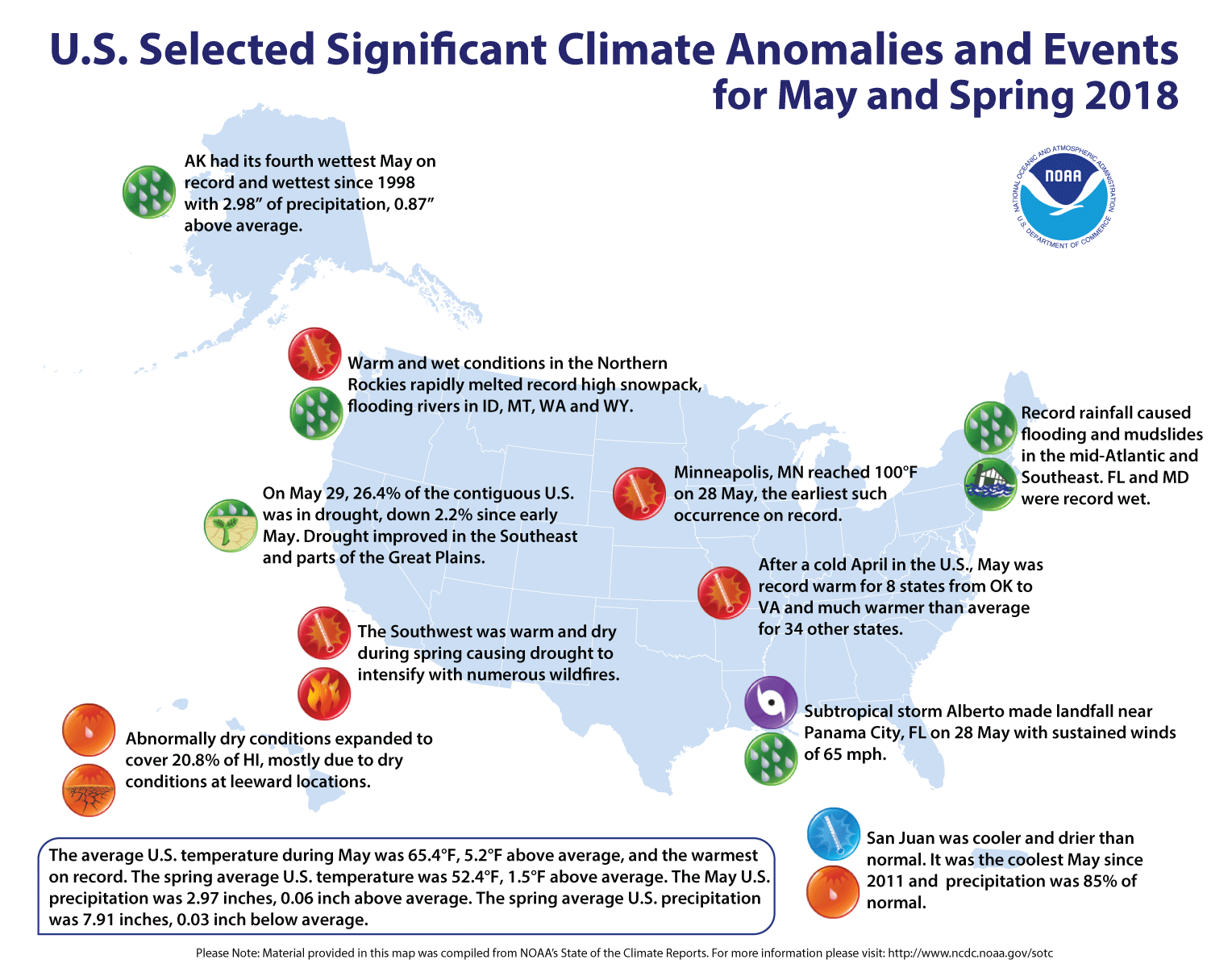
Surpassing a mark set during the peak of the Dust Bowl in 1934, the continental United States just had its hottest May on record thanks in large part to the human-caused climate crisis, the National Oceanic and Atmospheric Administration (NOAA) announced on Wednesday.
"For May, the average contiguous U.S. temperature was 65.4degF, 5.2degF above the 20th century average," NOAA observed in its breakdown of the new data. "The first five months of 2018 were marked by large month-to-month swings in temperature, but when averaged, the contiguous U.S. temperature was 45.0degF, 1.6degF above the 20th century average and was the 21st warmest January-May on record."
"The warmth was coast-to-coast," Jake Crouch, a climate scientist with NOAA's National Center for Environmental Information, said in an interview with USA Today.
While acknowledging that tropical storms--in addition to other "climate anomalies"--played a role in driving up May's average temperature, Crouch told USA Today that the man-made climate change contributed significantly the record-breaking heat.
In addition to surpassing the average temperature over the entirety of the month, May also saw "more than 8,590 daily warm temperature station records broken or tied," NOAA notes.
"This was 18 times more than the approximately 460 daily cold temperature station records during the month," NOAA found. "Several of the daily records were noteworthy, including 100degF on May 28 in Minneapolis, Minnesota--the earliest such occurrence on record."
Dear Common Dreams reader, It’s been nearly 30 years since I co-founded Common Dreams with my late wife, Lina Newhouser. We had the radical notion that journalism should serve the public good, not corporate profits. It was clear to us from the outset what it would take to build such a project. No paid advertisements. No corporate sponsors. No millionaire publisher telling us what to think or do. Many people said we wouldn't last a year, but we proved those doubters wrong. Together with a tremendous team of journalists and dedicated staff, we built an independent media outlet free from the constraints of profits and corporate control. Our mission has always been simple: To inform. To inspire. To ignite change for the common good. Building Common Dreams was not easy. Our survival was never guaranteed. When you take on the most powerful forces—Wall Street greed, fossil fuel industry destruction, Big Tech lobbyists, and uber-rich oligarchs who have spent billions upon billions rigging the economy and democracy in their favor—the only bulwark you have is supporters who believe in your work. But here’s the urgent message from me today. It's never been this bad out there. And it's never been this hard to keep us going. At the very moment Common Dreams is most needed, the threats we face are intensifying. We need your support now more than ever. We don't accept corporate advertising and never will. We don't have a paywall because we don't think people should be blocked from critical news based on their ability to pay. Everything we do is funded by the donations of readers like you. When everyone does the little they can afford, we are strong. But if that support retreats or dries up, so do we. Will you donate now to make sure Common Dreams not only survives but thrives? —Craig Brown, Co-founder |
Surpassing a mark set during the peak of the Dust Bowl in 1934, the continental United States just had its hottest May on record thanks in large part to the human-caused climate crisis, the National Oceanic and Atmospheric Administration (NOAA) announced on Wednesday.
"For May, the average contiguous U.S. temperature was 65.4degF, 5.2degF above the 20th century average," NOAA observed in its breakdown of the new data. "The first five months of 2018 were marked by large month-to-month swings in temperature, but when averaged, the contiguous U.S. temperature was 45.0degF, 1.6degF above the 20th century average and was the 21st warmest January-May on record."
"The warmth was coast-to-coast," Jake Crouch, a climate scientist with NOAA's National Center for Environmental Information, said in an interview with USA Today.
While acknowledging that tropical storms--in addition to other "climate anomalies"--played a role in driving up May's average temperature, Crouch told USA Today that the man-made climate change contributed significantly the record-breaking heat.
In addition to surpassing the average temperature over the entirety of the month, May also saw "more than 8,590 daily warm temperature station records broken or tied," NOAA notes.
"This was 18 times more than the approximately 460 daily cold temperature station records during the month," NOAA found. "Several of the daily records were noteworthy, including 100degF on May 28 in Minneapolis, Minnesota--the earliest such occurrence on record."
Surpassing a mark set during the peak of the Dust Bowl in 1934, the continental United States just had its hottest May on record thanks in large part to the human-caused climate crisis, the National Oceanic and Atmospheric Administration (NOAA) announced on Wednesday.
"For May, the average contiguous U.S. temperature was 65.4degF, 5.2degF above the 20th century average," NOAA observed in its breakdown of the new data. "The first five months of 2018 were marked by large month-to-month swings in temperature, but when averaged, the contiguous U.S. temperature was 45.0degF, 1.6degF above the 20th century average and was the 21st warmest January-May on record."
"The warmth was coast-to-coast," Jake Crouch, a climate scientist with NOAA's National Center for Environmental Information, said in an interview with USA Today.
While acknowledging that tropical storms--in addition to other "climate anomalies"--played a role in driving up May's average temperature, Crouch told USA Today that the man-made climate change contributed significantly the record-breaking heat.
In addition to surpassing the average temperature over the entirety of the month, May also saw "more than 8,590 daily warm temperature station records broken or tied," NOAA notes.
"This was 18 times more than the approximately 460 daily cold temperature station records during the month," NOAA found. "Several of the daily records were noteworthy, including 100degF on May 28 in Minneapolis, Minnesota--the earliest such occurrence on record."