

SUBSCRIBE TO OUR FREE NEWSLETTER
Daily news & progressive opinion—funded by the people, not the corporations—delivered straight to your inbox.
5
#000000
#FFFFFF
To donate by check, phone, or other method, see our More Ways to Give page.
Daily news & progressive opinion—funded by the people, not the corporations—delivered straight to your inbox.
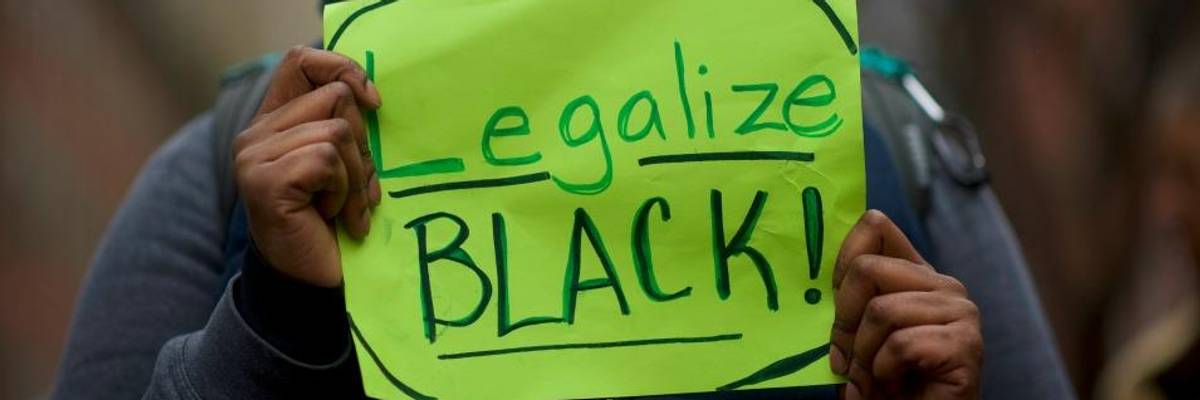
A protestor demonstrates outside a Starbucks in Philadelphia, Pennsylvania, after a store employee reported two black men who were waiting inside one of the chain's stores. The two men were arrested after the police arrived. (Photo: Mark Makela/Getty Images)
Recent experiences of black Americans who have been harassed by neighbors and strangers have led a group to call for congressional hearings on racial profiling by companies as well as individuals.
"Over the last few years high profile cases of racial profiling that have turned deadly have made national headlines and prompted long-overdue calls for criminal justice reform and transparency," wrote the group. "It is within this focus, then, that we are calling on the Senate and House Judiciary Committees to hold a hearing on racial profiling."
The letter was signed by six people who have recently been targeted for calls to law enforcement while going about everyday activities.
Darren Martin was mistaken for an armed robber by one of his new neighbors while he was moving into an apartment in New York while Donisha Prendergast had a similar experience while loading suitcases into a car at a home she had rented. Lolade Siyonbola found herself showing her Yale student ID to police and explaining that she had every right to be on campus, after a classmate reported her for taking a nap in a common area in a dormitory.
"These egregious affronts on human rights, eerily reminiscent of some of the darkest chapters in our nation's history, are the sad reality for black people in America," the letter says.
Racial profiling has a long history in the U.S., the letter notes. But recent cases of kneejerk phone calls to the police have taken place amid widespread national coverage of police killings of unarmed black Americans.
"The domino effect that ensues from a racially-biased 911 call is a costly one, from the financial and time resources pulled from 911 operators to the protocol police officers must then follow," reads the letter. "By assuming an excessive response, which risks arrest, incarceration, and death, generations of black lives pay the ultimate cost. Holding false accusers accountable and examining protocol practices should be a focus of this hearing."
Recent high-profile cases of people calling the police on black community members also include that of a woman reporting two men barbecuing at a park in Oakland, Calif., an airline passenger reporting a woman whose arm was touching hers on a flight, and two men being handcuffed in a Starbucks after an employee called the police to report that they were sitting in the store. On social media, others have shared their own stories and some have argued that police should fine callers once it is determined that the person who a call was about was taking part in an activity that should not have reasonably provoked suspicion.
"It is a crime to file a false police report," wrote Stacey Patton and Anthony Paul Farley in the Washington Post recently. "When places of public accommodation enlist the police to remove people based on race, the owners and managers should be investigated and prosecuted for filing false police reports. At the Philly Starbucks, the Yale dorm, the golf course, or the Oakland park, the police investigation should have focused on the frivolous and possibly criminal abuses of the 911 emergency system rather than on the people who were doing nothing wrong when someone called about them."
As of now, noted Patton and Farley, summoning the police to engage a black person who has simply made the caller "uncomfortable" carries few consequences for white people. Examination of the issue by lawmakers could bring about more understanding of potential solutions that could deter frivolous calls to the police.
"Right now, calling 911 on innocent black people is a costless form of indulgence in racialized fear--or worse, racist amusement," wrote Patton and Farley. "But lawsuits and publicity might make callers think twice and decrease the danger of false arrest and death."
Dear Common Dreams reader, It’s been nearly 30 years since I co-founded Common Dreams with my late wife, Lina Newhouser. We had the radical notion that journalism should serve the public good, not corporate profits. It was clear to us from the outset what it would take to build such a project. No paid advertisements. No corporate sponsors. No millionaire publisher telling us what to think or do. Many people said we wouldn't last a year, but we proved those doubters wrong. Together with a tremendous team of journalists and dedicated staff, we built an independent media outlet free from the constraints of profits and corporate control. Our mission has always been simple: To inform. To inspire. To ignite change for the common good. Building Common Dreams was not easy. Our survival was never guaranteed. When you take on the most powerful forces—Wall Street greed, fossil fuel industry destruction, Big Tech lobbyists, and uber-rich oligarchs who have spent billions upon billions rigging the economy and democracy in their favor—the only bulwark you have is supporters who believe in your work. But here’s the urgent message from me today. It's never been this bad out there. And it's never been this hard to keep us going. At the very moment Common Dreams is most needed, the threats we face are intensifying. We need your support now more than ever. We don't accept corporate advertising and never will. We don't have a paywall because we don't think people should be blocked from critical news based on their ability to pay. Everything we do is funded by the donations of readers like you. When everyone does the little they can afford, we are strong. But if that support retreats or dries up, so do we. Will you donate now to make sure Common Dreams not only survives but thrives? —Craig Brown, Co-founder |
Recent experiences of black Americans who have been harassed by neighbors and strangers have led a group to call for congressional hearings on racial profiling by companies as well as individuals.
"Over the last few years high profile cases of racial profiling that have turned deadly have made national headlines and prompted long-overdue calls for criminal justice reform and transparency," wrote the group. "It is within this focus, then, that we are calling on the Senate and House Judiciary Committees to hold a hearing on racial profiling."
The letter was signed by six people who have recently been targeted for calls to law enforcement while going about everyday activities.
Darren Martin was mistaken for an armed robber by one of his new neighbors while he was moving into an apartment in New York while Donisha Prendergast had a similar experience while loading suitcases into a car at a home she had rented. Lolade Siyonbola found herself showing her Yale student ID to police and explaining that she had every right to be on campus, after a classmate reported her for taking a nap in a common area in a dormitory.
"These egregious affronts on human rights, eerily reminiscent of some of the darkest chapters in our nation's history, are the sad reality for black people in America," the letter says.
Racial profiling has a long history in the U.S., the letter notes. But recent cases of kneejerk phone calls to the police have taken place amid widespread national coverage of police killings of unarmed black Americans.
"The domino effect that ensues from a racially-biased 911 call is a costly one, from the financial and time resources pulled from 911 operators to the protocol police officers must then follow," reads the letter. "By assuming an excessive response, which risks arrest, incarceration, and death, generations of black lives pay the ultimate cost. Holding false accusers accountable and examining protocol practices should be a focus of this hearing."
Recent high-profile cases of people calling the police on black community members also include that of a woman reporting two men barbecuing at a park in Oakland, Calif., an airline passenger reporting a woman whose arm was touching hers on a flight, and two men being handcuffed in a Starbucks after an employee called the police to report that they were sitting in the store. On social media, others have shared their own stories and some have argued that police should fine callers once it is determined that the person who a call was about was taking part in an activity that should not have reasonably provoked suspicion.
"It is a crime to file a false police report," wrote Stacey Patton and Anthony Paul Farley in the Washington Post recently. "When places of public accommodation enlist the police to remove people based on race, the owners and managers should be investigated and prosecuted for filing false police reports. At the Philly Starbucks, the Yale dorm, the golf course, or the Oakland park, the police investigation should have focused on the frivolous and possibly criminal abuses of the 911 emergency system rather than on the people who were doing nothing wrong when someone called about them."
As of now, noted Patton and Farley, summoning the police to engage a black person who has simply made the caller "uncomfortable" carries few consequences for white people. Examination of the issue by lawmakers could bring about more understanding of potential solutions that could deter frivolous calls to the police.
"Right now, calling 911 on innocent black people is a costless form of indulgence in racialized fear--or worse, racist amusement," wrote Patton and Farley. "But lawsuits and publicity might make callers think twice and decrease the danger of false arrest and death."
Recent experiences of black Americans who have been harassed by neighbors and strangers have led a group to call for congressional hearings on racial profiling by companies as well as individuals.
"Over the last few years high profile cases of racial profiling that have turned deadly have made national headlines and prompted long-overdue calls for criminal justice reform and transparency," wrote the group. "It is within this focus, then, that we are calling on the Senate and House Judiciary Committees to hold a hearing on racial profiling."
The letter was signed by six people who have recently been targeted for calls to law enforcement while going about everyday activities.
Darren Martin was mistaken for an armed robber by one of his new neighbors while he was moving into an apartment in New York while Donisha Prendergast had a similar experience while loading suitcases into a car at a home she had rented. Lolade Siyonbola found herself showing her Yale student ID to police and explaining that she had every right to be on campus, after a classmate reported her for taking a nap in a common area in a dormitory.
"These egregious affronts on human rights, eerily reminiscent of some of the darkest chapters in our nation's history, are the sad reality for black people in America," the letter says.
Racial profiling has a long history in the U.S., the letter notes. But recent cases of kneejerk phone calls to the police have taken place amid widespread national coverage of police killings of unarmed black Americans.
"The domino effect that ensues from a racially-biased 911 call is a costly one, from the financial and time resources pulled from 911 operators to the protocol police officers must then follow," reads the letter. "By assuming an excessive response, which risks arrest, incarceration, and death, generations of black lives pay the ultimate cost. Holding false accusers accountable and examining protocol practices should be a focus of this hearing."
Recent high-profile cases of people calling the police on black community members also include that of a woman reporting two men barbecuing at a park in Oakland, Calif., an airline passenger reporting a woman whose arm was touching hers on a flight, and two men being handcuffed in a Starbucks after an employee called the police to report that they were sitting in the store. On social media, others have shared their own stories and some have argued that police should fine callers once it is determined that the person who a call was about was taking part in an activity that should not have reasonably provoked suspicion.
"It is a crime to file a false police report," wrote Stacey Patton and Anthony Paul Farley in the Washington Post recently. "When places of public accommodation enlist the police to remove people based on race, the owners and managers should be investigated and prosecuted for filing false police reports. At the Philly Starbucks, the Yale dorm, the golf course, or the Oakland park, the police investigation should have focused on the frivolous and possibly criminal abuses of the 911 emergency system rather than on the people who were doing nothing wrong when someone called about them."
As of now, noted Patton and Farley, summoning the police to engage a black person who has simply made the caller "uncomfortable" carries few consequences for white people. Examination of the issue by lawmakers could bring about more understanding of potential solutions that could deter frivolous calls to the police.
"Right now, calling 911 on innocent black people is a costless form of indulgence in racialized fear--or worse, racist amusement," wrote Patton and Farley. "But lawsuits and publicity might make callers think twice and decrease the danger of false arrest and death."

