SUBSCRIBE TO OUR FREE NEWSLETTER
Daily news & progressive opinion—funded by the people, not the corporations—delivered straight to your inbox.
5
#000000
#FFFFFF
To donate by check, phone, or other method, see our More Ways to Give page.
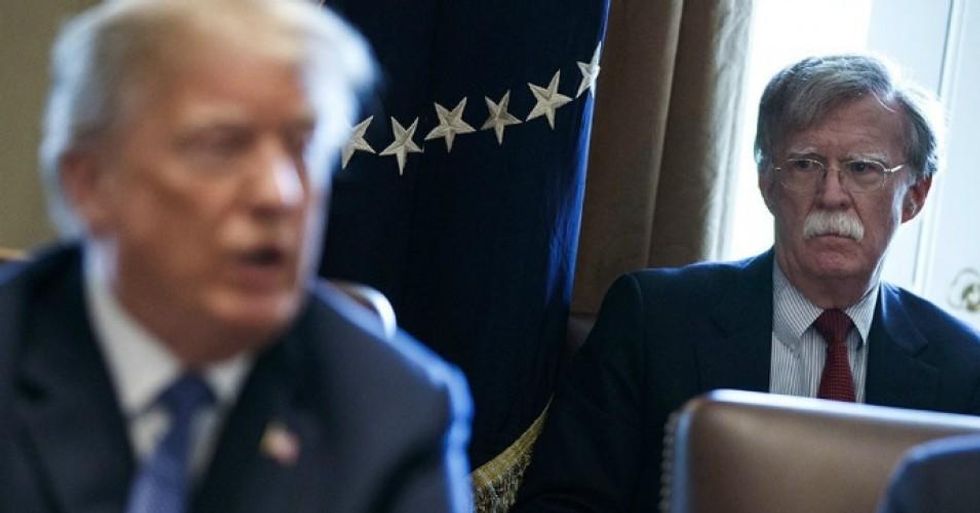
As the world scrambles to make sense of U.S. President Donald Trump's bizarre and potentially disastrous letter announcing the cancellation of his planned meeting with North Korean leader Kim Jong-un on Thursday, lawmakers and anti-war advocates argued that the Trump White House's repeated regime change threats and national security adviser John Bolton's belligerent rhetoric are to blame for the summit's collapse.
"Bolton must have known his rhetoric would go over badly with Kim Jong-un. One needn't be too cynical to ask whether his goal was to imperil the summit." --Kevin Martin, Peace Action
"We can't forget that many in Trump's administration, including his national security adviser and secretary of state, are thirsty for war," Win Without War said in a statement on Thursday. "The American public and Congress must prevent the Trump administration from using this self-inflicted setback to justify a catastrophic U.S. war of choice on the Korean peninsula."
In a Twitter thread responding to the president's letter, Sen. Brian Schatz (D-Hawaii) wrote simply: "John Bolton must be stoked...This is what happens when amateurs are combined with warmongers."
While Trump insisted that "open hostility" from Pyongyang in recent days was what ultimately led him to call off the summit, Korea experts were quick to point out that White House officials' repeated references to the so-called "Libya model" provoked angry responses from North Korean officials, who have warned constantly over the past several weeks that it views such comments as explicit regime change threats.
"Congratulations to John Bolton and Mike Pence on their success making the deaths of millions more likely."
--Jon Schwartz, The Intercept
Bolton, who Trump hired as national security adviser in March, was the first administration official to invoke America's approach to the Libyan nuclear program as a possible guide to negotiations with North Korea. Vice President Mike Pence also invoked the "Libya model" in a recent Fox News interview.
In 2011, the U.S. and NATO invaded Libya, overthrew and killed then-leader Muammar Gaddafi, and transformed the country into a "terrorist haven."
"Trump and his war cabinet, with no record of achievement in international peace and diplomacy, couldn't resist provoking North Korea with talk of a 'Libyan model' of denuclearization and muscular military exercises at a time when the U.S. should be doing all it can to build trust ahead of the planned summit," Kevin Martin, president of Peace Action, said in a statement.
"In particular, national security adviser John Bolton, who helped scuttle an earlier deal with North Korea while in the George W. Bush regime, must have known his inflammatory rhetoric would go over badly with North Korean leader Kim Jong-un," Martin added. "One needn't be too cynical to ask whether his goal was to imperil the summit."
As foreign policy analysts across the globe sought to interpret Trump's letter--in which he once again bragged about America's "massive and powerful" nuclear arsenal--South Korean officials appeared to be particularly blindsided by Trump's announcement, which came just days after South Korean President Moon Jae-in visited the White House in an effort to build on diplomatic progress he has spearheaded over the past several months.
"We are attempting to make sense of what, precisely, President Trump means," Kim Eui-kyeom, a spokesperson for Moon, said after Trump's letter was released.
During a meeting with top security officials following Trump's announcement, Moon said, "I am very perplexed and it is very regrettable that the North Korea-U.S. summit will not be held on June 12 when it was scheduled to be held."
As the world scrambles to make sense of U.S. President Donald Trump's bizarre and potentially disastrous letter announcing the cancellation of his planned meeting with North Korean leader Kim Jong-un on Thursday, lawmakers and anti-war advocates argued that the Trump White House's repeated regime change threats and national security adviser John Bolton's belligerent rhetoric are to blame for the summit's collapse.
"Bolton must have known his rhetoric would go over badly with Kim Jong-un. One needn't be too cynical to ask whether his goal was to imperil the summit." --Kevin Martin, Peace Action
"We can't forget that many in Trump's administration, including his national security adviser and secretary of state, are thirsty for war," Win Without War said in a statement on Thursday. "The American public and Congress must prevent the Trump administration from using this self-inflicted setback to justify a catastrophic U.S. war of choice on the Korean peninsula."
In a Twitter thread responding to the president's letter, Sen. Brian Schatz (D-Hawaii) wrote simply: "John Bolton must be stoked...This is what happens when amateurs are combined with warmongers."
While Trump insisted that "open hostility" from Pyongyang in recent days was what ultimately led him to call off the summit, Korea experts were quick to point out that White House officials' repeated references to the so-called "Libya model" provoked angry responses from North Korean officials, who have warned constantly over the past several weeks that it views such comments as explicit regime change threats.
"Congratulations to John Bolton and Mike Pence on their success making the deaths of millions more likely."
--Jon Schwartz, The Intercept
Bolton, who Trump hired as national security adviser in March, was the first administration official to invoke America's approach to the Libyan nuclear program as a possible guide to negotiations with North Korea. Vice President Mike Pence also invoked the "Libya model" in a recent Fox News interview.
In 2011, the U.S. and NATO invaded Libya, overthrew and killed then-leader Muammar Gaddafi, and transformed the country into a "terrorist haven."
"Trump and his war cabinet, with no record of achievement in international peace and diplomacy, couldn't resist provoking North Korea with talk of a 'Libyan model' of denuclearization and muscular military exercises at a time when the U.S. should be doing all it can to build trust ahead of the planned summit," Kevin Martin, president of Peace Action, said in a statement.
"In particular, national security adviser John Bolton, who helped scuttle an earlier deal with North Korea while in the George W. Bush regime, must have known his inflammatory rhetoric would go over badly with North Korean leader Kim Jong-un," Martin added. "One needn't be too cynical to ask whether his goal was to imperil the summit."
As foreign policy analysts across the globe sought to interpret Trump's letter--in which he once again bragged about America's "massive and powerful" nuclear arsenal--South Korean officials appeared to be particularly blindsided by Trump's announcement, which came just days after South Korean President Moon Jae-in visited the White House in an effort to build on diplomatic progress he has spearheaded over the past several months.
"We are attempting to make sense of what, precisely, President Trump means," Kim Eui-kyeom, a spokesperson for Moon, said after Trump's letter was released.
During a meeting with top security officials following Trump's announcement, Moon said, "I am very perplexed and it is very regrettable that the North Korea-U.S. summit will not be held on June 12 when it was scheduled to be held."
As the world scrambles to make sense of U.S. President Donald Trump's bizarre and potentially disastrous letter announcing the cancellation of his planned meeting with North Korean leader Kim Jong-un on Thursday, lawmakers and anti-war advocates argued that the Trump White House's repeated regime change threats and national security adviser John Bolton's belligerent rhetoric are to blame for the summit's collapse.
"Bolton must have known his rhetoric would go over badly with Kim Jong-un. One needn't be too cynical to ask whether his goal was to imperil the summit." --Kevin Martin, Peace Action
"We can't forget that many in Trump's administration, including his national security adviser and secretary of state, are thirsty for war," Win Without War said in a statement on Thursday. "The American public and Congress must prevent the Trump administration from using this self-inflicted setback to justify a catastrophic U.S. war of choice on the Korean peninsula."
In a Twitter thread responding to the president's letter, Sen. Brian Schatz (D-Hawaii) wrote simply: "John Bolton must be stoked...This is what happens when amateurs are combined with warmongers."
While Trump insisted that "open hostility" from Pyongyang in recent days was what ultimately led him to call off the summit, Korea experts were quick to point out that White House officials' repeated references to the so-called "Libya model" provoked angry responses from North Korean officials, who have warned constantly over the past several weeks that it views such comments as explicit regime change threats.
"Congratulations to John Bolton and Mike Pence on their success making the deaths of millions more likely."
--Jon Schwartz, The Intercept
Bolton, who Trump hired as national security adviser in March, was the first administration official to invoke America's approach to the Libyan nuclear program as a possible guide to negotiations with North Korea. Vice President Mike Pence also invoked the "Libya model" in a recent Fox News interview.
In 2011, the U.S. and NATO invaded Libya, overthrew and killed then-leader Muammar Gaddafi, and transformed the country into a "terrorist haven."
"Trump and his war cabinet, with no record of achievement in international peace and diplomacy, couldn't resist provoking North Korea with talk of a 'Libyan model' of denuclearization and muscular military exercises at a time when the U.S. should be doing all it can to build trust ahead of the planned summit," Kevin Martin, president of Peace Action, said in a statement.
"In particular, national security adviser John Bolton, who helped scuttle an earlier deal with North Korea while in the George W. Bush regime, must have known his inflammatory rhetoric would go over badly with North Korean leader Kim Jong-un," Martin added. "One needn't be too cynical to ask whether his goal was to imperil the summit."
As foreign policy analysts across the globe sought to interpret Trump's letter--in which he once again bragged about America's "massive and powerful" nuclear arsenal--South Korean officials appeared to be particularly blindsided by Trump's announcement, which came just days after South Korean President Moon Jae-in visited the White House in an effort to build on diplomatic progress he has spearheaded over the past several months.
"We are attempting to make sense of what, precisely, President Trump means," Kim Eui-kyeom, a spokesperson for Moon, said after Trump's letter was released.
During a meeting with top security officials following Trump's announcement, Moon said, "I am very perplexed and it is very regrettable that the North Korea-U.S. summit will not be held on June 12 when it was scheduled to be held."