SUBSCRIBE TO OUR FREE NEWSLETTER
Daily news & progressive opinion—funded by the people, not the corporations—delivered straight to your inbox.
5
#000000
#FFFFFF
To donate by check, phone, or other method, see our More Ways to Give page.
Daily news & progressive opinion—funded by the people, not the corporations—delivered straight to your inbox.
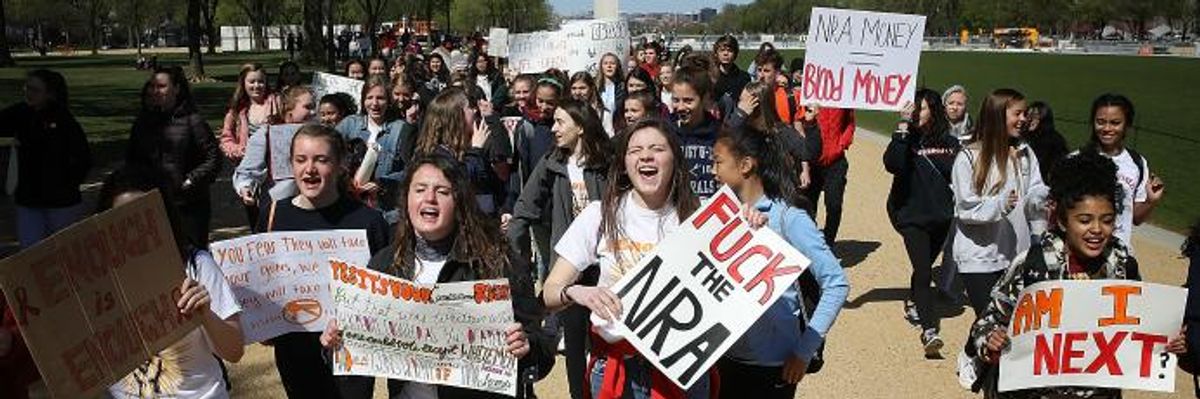
Students from Washington-Lee High School in Arlington, Virginia joined the National School Walkout on April 20, 2018 and marched to the U.S. Capitol in Washington, D.C. (Photo: Win McNamee/Getty Images)
Students walked out of classrooms across the country at 10am local time on Friday--the 19th anniversary of the Columbine school massacre--for the latest in a series of recent youth-led demonstrations to demand stricter gun laws.
Student protesters and their supporters shared updates from walkouts throughout the country with the hashtag #NationalSchoolWalkout.
Mounting calls to enhance gun control through state and federal legislation have come in response to a series of mass school shootings--most recently in February, when a gunman killed 17 people at Marjory Stoneman Douglas High School in the Parkland, Florida. Parkland survivors have played key roles in driving this national movement to end gun violence.
In solidarity with students from more than 2,000 U.S. high schools who planned to protest on Friday, students from Chapel Hill, North Carolina walked out while chanting, "Guns don't die. Children do."
Students in Washington, D.C. gathered outside the U.S. Capitol and the White House to remember victims of gun violence, including those killed at Columbine High School in Colorado in 1999. On Thursday, students from Columbine High School hosted a "Vote For Our Lives" rally to register local teens ahead of the November midterm elections.
"This movement is the next step in the series of pressure points placed on politicians to take action," the event organizers said in a statement. Referencing another nationwide walkout last month, they added, "We walked out, then we marched, and now we vote."
Speaking at a rally outside Plantation High School in Florida, junior Romy Giler reminded her peers that the movement's demands for legislative action are also motivated by mass shootings at a movie theater in Aurora, Colorado; Pulse night club in Orlando, Florida; and a country music concert in Las Vegas, Nevada--the deadliest shooting in U.S. history.
"We can't just stop at schools," she said. "Concerts, night clubs, and movie theaters are, sadly, places we have to consider as well--places we regularly go to with our friends to have fun."
Acknowledging the walkouts, marches, and town halls that have swept the nation since February, Giley concluded, "We have changed opinions on gun control but there is nothing stopping these senseless acts of violence until legislators do something."
Another district in Florida canceled its planned walkouts after a 17-year-old male student was shot at Forest High School in Ocala. Police said Friday that the victim sustained nonlife-threatening injuries and the 19-year-old suspect--who is not a student--was taken into custody.
Dear Common Dreams reader, It’s been nearly 30 years since I co-founded Common Dreams with my late wife, Lina Newhouser. We had the radical notion that journalism should serve the public good, not corporate profits. It was clear to us from the outset what it would take to build such a project. No paid advertisements. No corporate sponsors. No millionaire publisher telling us what to think or do. Many people said we wouldn't last a year, but we proved those doubters wrong. Together with a tremendous team of journalists and dedicated staff, we built an independent media outlet free from the constraints of profits and corporate control. Our mission has always been simple: To inform. To inspire. To ignite change for the common good. Building Common Dreams was not easy. Our survival was never guaranteed. When you take on the most powerful forces—Wall Street greed, fossil fuel industry destruction, Big Tech lobbyists, and uber-rich oligarchs who have spent billions upon billions rigging the economy and democracy in their favor—the only bulwark you have is supporters who believe in your work. But here’s the urgent message from me today. It's never been this bad out there. And it's never been this hard to keep us going. At the very moment Common Dreams is most needed, the threats we face are intensifying. We need your support now more than ever. We don't accept corporate advertising and never will. We don't have a paywall because we don't think people should be blocked from critical news based on their ability to pay. Everything we do is funded by the donations of readers like you. When everyone does the little they can afford, we are strong. But if that support retreats or dries up, so do we. Will you donate now to make sure Common Dreams not only survives but thrives? —Craig Brown, Co-founder |
Students walked out of classrooms across the country at 10am local time on Friday--the 19th anniversary of the Columbine school massacre--for the latest in a series of recent youth-led demonstrations to demand stricter gun laws.
Student protesters and their supporters shared updates from walkouts throughout the country with the hashtag #NationalSchoolWalkout.
Mounting calls to enhance gun control through state and federal legislation have come in response to a series of mass school shootings--most recently in February, when a gunman killed 17 people at Marjory Stoneman Douglas High School in the Parkland, Florida. Parkland survivors have played key roles in driving this national movement to end gun violence.
In solidarity with students from more than 2,000 U.S. high schools who planned to protest on Friday, students from Chapel Hill, North Carolina walked out while chanting, "Guns don't die. Children do."
Students in Washington, D.C. gathered outside the U.S. Capitol and the White House to remember victims of gun violence, including those killed at Columbine High School in Colorado in 1999. On Thursday, students from Columbine High School hosted a "Vote For Our Lives" rally to register local teens ahead of the November midterm elections.
"This movement is the next step in the series of pressure points placed on politicians to take action," the event organizers said in a statement. Referencing another nationwide walkout last month, they added, "We walked out, then we marched, and now we vote."
Speaking at a rally outside Plantation High School in Florida, junior Romy Giler reminded her peers that the movement's demands for legislative action are also motivated by mass shootings at a movie theater in Aurora, Colorado; Pulse night club in Orlando, Florida; and a country music concert in Las Vegas, Nevada--the deadliest shooting in U.S. history.
"We can't just stop at schools," she said. "Concerts, night clubs, and movie theaters are, sadly, places we have to consider as well--places we regularly go to with our friends to have fun."
Acknowledging the walkouts, marches, and town halls that have swept the nation since February, Giley concluded, "We have changed opinions on gun control but there is nothing stopping these senseless acts of violence until legislators do something."
Another district in Florida canceled its planned walkouts after a 17-year-old male student was shot at Forest High School in Ocala. Police said Friday that the victim sustained nonlife-threatening injuries and the 19-year-old suspect--who is not a student--was taken into custody.
Students walked out of classrooms across the country at 10am local time on Friday--the 19th anniversary of the Columbine school massacre--for the latest in a series of recent youth-led demonstrations to demand stricter gun laws.
Student protesters and their supporters shared updates from walkouts throughout the country with the hashtag #NationalSchoolWalkout.
Mounting calls to enhance gun control through state and federal legislation have come in response to a series of mass school shootings--most recently in February, when a gunman killed 17 people at Marjory Stoneman Douglas High School in the Parkland, Florida. Parkland survivors have played key roles in driving this national movement to end gun violence.
In solidarity with students from more than 2,000 U.S. high schools who planned to protest on Friday, students from Chapel Hill, North Carolina walked out while chanting, "Guns don't die. Children do."
Students in Washington, D.C. gathered outside the U.S. Capitol and the White House to remember victims of gun violence, including those killed at Columbine High School in Colorado in 1999. On Thursday, students from Columbine High School hosted a "Vote For Our Lives" rally to register local teens ahead of the November midterm elections.
"This movement is the next step in the series of pressure points placed on politicians to take action," the event organizers said in a statement. Referencing another nationwide walkout last month, they added, "We walked out, then we marched, and now we vote."
Speaking at a rally outside Plantation High School in Florida, junior Romy Giler reminded her peers that the movement's demands for legislative action are also motivated by mass shootings at a movie theater in Aurora, Colorado; Pulse night club in Orlando, Florida; and a country music concert in Las Vegas, Nevada--the deadliest shooting in U.S. history.
"We can't just stop at schools," she said. "Concerts, night clubs, and movie theaters are, sadly, places we have to consider as well--places we regularly go to with our friends to have fun."
Acknowledging the walkouts, marches, and town halls that have swept the nation since February, Giley concluded, "We have changed opinions on gun control but there is nothing stopping these senseless acts of violence until legislators do something."
Another district in Florida canceled its planned walkouts after a 17-year-old male student was shot at Forest High School in Ocala. Police said Friday that the victim sustained nonlife-threatening injuries and the 19-year-old suspect--who is not a student--was taken into custody.