
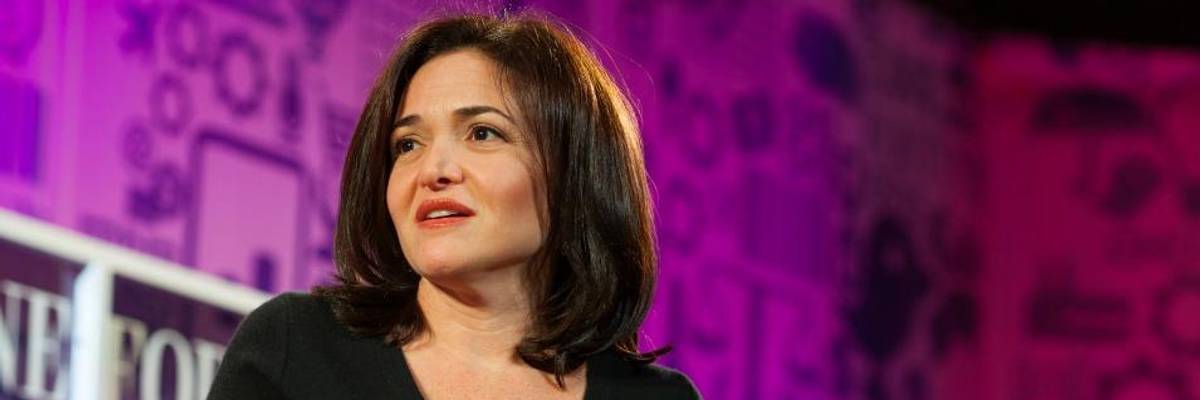
Facebook's chief operating officer, Sheryl Sandberg, said Friday that the company would have to charge users for its service without its data-driven advertising model. (Photo: Fortune Live Media/Flickr/cc)
Facebook's Sheryl Sandberg: If You Want Privacy, You're Going to Have to Pay for It
"Facebook is really good at making money. But I wonder if your problems could be somewhat mitigated if the company didn't try to make so much."
Statements from Facebook's chief operating officer regarding concerns over the company's collection of users' data this week left some critics wondering why Facebook--already one of the richest tech companies in Silicon Valley--still appears intensely focused on accumulating vast profits even as its monetization methods have proven controversial.
Speaking with NBC News on Thursday, Chief Operating Officer Sheryl Sandberg said that if people want to use Facebook without seeing advertisements--targeted at the company's two billion users based on their personal data--they will have to pay.
"We don't sell data ever, we do not give personal data to advertisers," said Sandberg.
However, Sandberg said, the company still relies on users' personal information to keep its advertising service afloat.
"We don't have an opt-out at the highest level," she said. "That would be a paid product."
Watch:
The company's constant collection of data made it vulnerable to a data breach that affected at least 87 million of its two billion users--and likely more.
CEO Mark Zuckerberg will appear before a congressional committee next week to testify about the breach that made it possible for Cambridge Analytica, a firm that worked with President Donald Trump's 2016 campaign, to collect users' data through a third-party app without the users' knowledge.
Facebook knew about the data breach two years ago, Sandberg admitted, but has only begun to address security concerns recently, after a former Cambridge Analytica employee publicized the firm's actions.
"We could've done this two and a half years ago," Sandberg told NBC. "We thought the data had been deleted and we should have checked. They gave us assurances and it wasn't until other people told us it wasn't true...We had legal assurances from them that they deleted it. What we didn't do is the next step of an audit and we're trying to do that now."
As the controversy grew this week, Buzzfeed's Alex Kantrowitz asked Zuckerberg about Facebook's profit-making endeavors at a press meeting on Thursday.
"Facebook is really good at making money," said Kantrowitz. "But I wonder if your problems could be somewhat mitigated if the company didn't try to make so much. So, you can still run Facebook as a free service and collect significantly less data and offer significantly less ad targeting criteria. So, I wonder if you think that would put you and society at less risk and if it's something you'd consider doing?"
Zuckerberg suggested in his reply that an ad-free Facebook is not possible, telling Kantrowitz, "People tell us that if they're going to see ads, they want the ads to be good. And the way to make the ads good, is by making it so that when someone tells us they have an interest...that the ads are actually tailored to what they care about."
Meanwhile, new details of Facebook's data-gathering activities caused outcry, as CNBC reported that the company sought patients' personal data from hospitals.
An Urgent Message From Our Co-Founder
Dear Common Dreams reader, It’s been nearly 30 years since I co-founded Common Dreams with my late wife, Lina Newhouser. We had the radical notion that journalism should serve the public good, not corporate profits. It was clear to us from the outset what it would take to build such a project. No paid advertisements. No corporate sponsors. No millionaire publisher telling us what to think or do. Many people said we wouldn't last a year, but we proved those doubters wrong. Together with a tremendous team of journalists and dedicated staff, we built an independent media outlet free from the constraints of profits and corporate control. Our mission has always been simple: To inform. To inspire. To ignite change for the common good. Building Common Dreams was not easy. Our survival was never guaranteed. When you take on the most powerful forces—Wall Street greed, fossil fuel industry destruction, Big Tech lobbyists, and uber-rich oligarchs who have spent billions upon billions rigging the economy and democracy in their favor—the only bulwark you have is supporters who believe in your work. But here’s the urgent message from me today. It's never been this bad out there. And it's never been this hard to keep us going. At the very moment Common Dreams is most needed, the threats we face are intensifying. We need your support now more than ever. We don't accept corporate advertising and never will. We don't have a paywall because we don't think people should be blocked from critical news based on their ability to pay. Everything we do is funded by the donations of readers like you. When everyone does the little they can afford, we are strong. But if that support retreats or dries up, so do we. Will you donate now to make sure Common Dreams not only survives but thrives? —Craig Brown, Co-founder |
Statements from Facebook's chief operating officer regarding concerns over the company's collection of users' data this week left some critics wondering why Facebook--already one of the richest tech companies in Silicon Valley--still appears intensely focused on accumulating vast profits even as its monetization methods have proven controversial.
Speaking with NBC News on Thursday, Chief Operating Officer Sheryl Sandberg said that if people want to use Facebook without seeing advertisements--targeted at the company's two billion users based on their personal data--they will have to pay.
"We don't sell data ever, we do not give personal data to advertisers," said Sandberg.
However, Sandberg said, the company still relies on users' personal information to keep its advertising service afloat.
"We don't have an opt-out at the highest level," she said. "That would be a paid product."
Watch:
The company's constant collection of data made it vulnerable to a data breach that affected at least 87 million of its two billion users--and likely more.
CEO Mark Zuckerberg will appear before a congressional committee next week to testify about the breach that made it possible for Cambridge Analytica, a firm that worked with President Donald Trump's 2016 campaign, to collect users' data through a third-party app without the users' knowledge.
Facebook knew about the data breach two years ago, Sandberg admitted, but has only begun to address security concerns recently, after a former Cambridge Analytica employee publicized the firm's actions.
"We could've done this two and a half years ago," Sandberg told NBC. "We thought the data had been deleted and we should have checked. They gave us assurances and it wasn't until other people told us it wasn't true...We had legal assurances from them that they deleted it. What we didn't do is the next step of an audit and we're trying to do that now."
As the controversy grew this week, Buzzfeed's Alex Kantrowitz asked Zuckerberg about Facebook's profit-making endeavors at a press meeting on Thursday.
"Facebook is really good at making money," said Kantrowitz. "But I wonder if your problems could be somewhat mitigated if the company didn't try to make so much. So, you can still run Facebook as a free service and collect significantly less data and offer significantly less ad targeting criteria. So, I wonder if you think that would put you and society at less risk and if it's something you'd consider doing?"
Zuckerberg suggested in his reply that an ad-free Facebook is not possible, telling Kantrowitz, "People tell us that if they're going to see ads, they want the ads to be good. And the way to make the ads good, is by making it so that when someone tells us they have an interest...that the ads are actually tailored to what they care about."
Meanwhile, new details of Facebook's data-gathering activities caused outcry, as CNBC reported that the company sought patients' personal data from hospitals.
Statements from Facebook's chief operating officer regarding concerns over the company's collection of users' data this week left some critics wondering why Facebook--already one of the richest tech companies in Silicon Valley--still appears intensely focused on accumulating vast profits even as its monetization methods have proven controversial.
Speaking with NBC News on Thursday, Chief Operating Officer Sheryl Sandberg said that if people want to use Facebook without seeing advertisements--targeted at the company's two billion users based on their personal data--they will have to pay.
"We don't sell data ever, we do not give personal data to advertisers," said Sandberg.
However, Sandberg said, the company still relies on users' personal information to keep its advertising service afloat.
"We don't have an opt-out at the highest level," she said. "That would be a paid product."
Watch:
The company's constant collection of data made it vulnerable to a data breach that affected at least 87 million of its two billion users--and likely more.
CEO Mark Zuckerberg will appear before a congressional committee next week to testify about the breach that made it possible for Cambridge Analytica, a firm that worked with President Donald Trump's 2016 campaign, to collect users' data through a third-party app without the users' knowledge.
Facebook knew about the data breach two years ago, Sandberg admitted, but has only begun to address security concerns recently, after a former Cambridge Analytica employee publicized the firm's actions.
"We could've done this two and a half years ago," Sandberg told NBC. "We thought the data had been deleted and we should have checked. They gave us assurances and it wasn't until other people told us it wasn't true...We had legal assurances from them that they deleted it. What we didn't do is the next step of an audit and we're trying to do that now."
As the controversy grew this week, Buzzfeed's Alex Kantrowitz asked Zuckerberg about Facebook's profit-making endeavors at a press meeting on Thursday.
"Facebook is really good at making money," said Kantrowitz. "But I wonder if your problems could be somewhat mitigated if the company didn't try to make so much. So, you can still run Facebook as a free service and collect significantly less data and offer significantly less ad targeting criteria. So, I wonder if you think that would put you and society at less risk and if it's something you'd consider doing?"
Zuckerberg suggested in his reply that an ad-free Facebook is not possible, telling Kantrowitz, "People tell us that if they're going to see ads, they want the ads to be good. And the way to make the ads good, is by making it so that when someone tells us they have an interest...that the ads are actually tailored to what they care about."
Meanwhile, new details of Facebook's data-gathering activities caused outcry, as CNBC reported that the company sought patients' personal data from hospitals.