
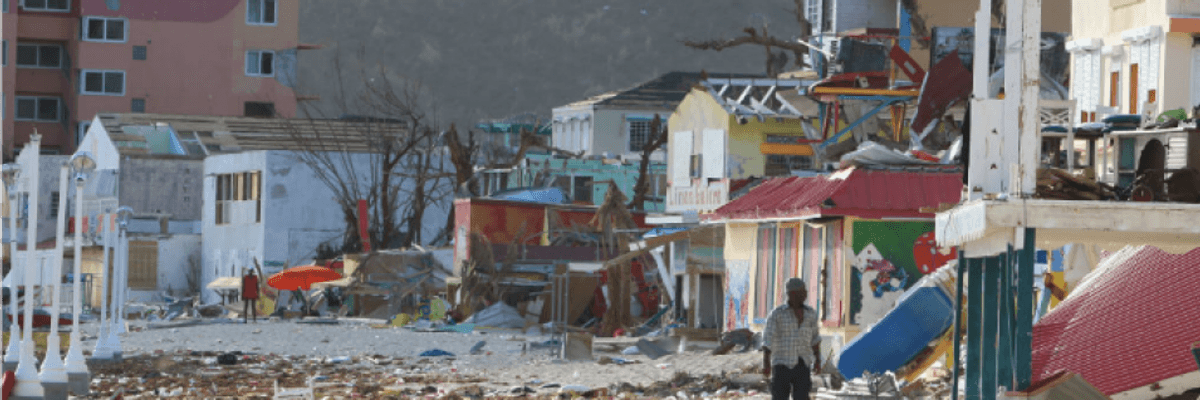
A man walks among the destruction left by Hurricane Irma at the Phillipsburg Town Beach on September 11, 2017 in Philipsburg, St. Maarten. (Photo: Jose Jimenez/Getty Images)
In Midst of 'Immense Suffering' Caused by Climate Crisis, Caribbean Religious Leaders Call for Debt Relief
"We in the Caribbean, like some other nations elsewhere in the global south, are least responsible for but most affected by climate change."
Citing the destruction wrought by last year's uniquely devastating Atlantic hurricane season and other natural disasters, a group of Caribbean religious leaders issued a letter (pdf) on Friday calling on governments and international financial institutions to relieve the debt of island nations and allow them to devote their resources to meeting the needs of their citizens.
"Islands that are struggling to recover after natural disasters and meet basic needs of their people should not be making debt payments."
--Eric LeCompte, Jubilee USA"Across the Caribbean, we still see immense suffering from the hurricanes that landed last year," Jubilee USA executive director Eric LeCompte said in a statement endorsing the Caribbean leaders' call. "Islands that are struggling to recover after natural disasters and meet basic needs of their people should not be making debt payments."
Signed by 22 faith leaders from several Caribbean islands, the letter notes that research "points to the fact that the growing severity of hurricanes in the Caribbean is related to man-made climate change."
"We in the Caribbean, like some other nations elsewhere in the global south, are least responsible for but most affected by climate change," the letter continues. "The few dozen small Island States across the world, for example, have neither the size nor developmental history to have been major contributors to current climate change. Yet these small Island States are the most easily devastated by rising seas and harsher storms. Our brothers and sisters who inhabit these places are in peril, through no fault of their own."
In order to be prepared for the next hurricane season and future disasters caused or made worse by the climate crisis, the faith leaders made three demands:
- Our own heads of state and government must unite and collectively demand the creation of an efficient debt relief option ahead of the next hurricane season through all available means, including the United Nations system and the Bretton Woods institutions.
- The IMF must use its rule-setting power to endorse a full debt moratorium once a hurricane or any other serious disaster brings destruction beyond a predefined level and make sure that a serious debt restructuring of all external commitments shall be possible under due consideration of our peoples' human rights.
- The Eastern Caribbean Central Bank and the Caribbean Development Bank must act as supporters of a comprehensive debt restructuring process once it is needed.
"As churches in the Caribbean we have witnessed the grief and despair of our people last September, and we are not prepared to enter the next hurricane season without at least being able to tell them that our authorities shall be able to use scarce resources for immediate relief and midterm reconstruction rather than debt service," the statement concludes.
We are at a crossroads
This country and this world are at a monumental crossroads. US voters have an opportunity to beat back the forces of fascism and confront the billionaires who are rigging the economy, our media system, and our democracy, making it increasingly impossible for ordinary people to get by. We’re not just talking about the election. We’re talking about what must be done once these fascist elements are vanquished from power. We need a bolder set of solutions than what either major party has so far been willing to offer and a working-class movement ready to fight like hell for it. Trump didn't emerge from nowhere. The conditions that fueled MAGA authoritarianism were created by decades of radical neoliberal economic policies and a corrupt political system dominated by corporate interests. They slashed taxes on the super-rich, promising that the benefits would trickle down. They said giveaways to the corporate titans would make life more affordable for the rest of us. It was all bullshit. And when a bitter, betrayed populace searches for someone to blame, right-wing demagogues have little trouble finding scapegoats. People know when they're being lied to, but you won't hear any of this from the corporate media. Only independent journalism—powered and funded by people who believe in building a better world—can deliver truly trustworthy daily news. Our Fall Campaign is underway, and we need your help. To power our newsroom through the rest of the year, we need to raise $125,000 by midnight on October 31. So if you share our vision, please contribute whatever you can to sustain our work. |
Citing the destruction wrought by last year's uniquely devastating Atlantic hurricane season and other natural disasters, a group of Caribbean religious leaders issued a letter (pdf) on Friday calling on governments and international financial institutions to relieve the debt of island nations and allow them to devote their resources to meeting the needs of their citizens.
"Islands that are struggling to recover after natural disasters and meet basic needs of their people should not be making debt payments."
--Eric LeCompte, Jubilee USA"Across the Caribbean, we still see immense suffering from the hurricanes that landed last year," Jubilee USA executive director Eric LeCompte said in a statement endorsing the Caribbean leaders' call. "Islands that are struggling to recover after natural disasters and meet basic needs of their people should not be making debt payments."
Signed by 22 faith leaders from several Caribbean islands, the letter notes that research "points to the fact that the growing severity of hurricanes in the Caribbean is related to man-made climate change."
"We in the Caribbean, like some other nations elsewhere in the global south, are least responsible for but most affected by climate change," the letter continues. "The few dozen small Island States across the world, for example, have neither the size nor developmental history to have been major contributors to current climate change. Yet these small Island States are the most easily devastated by rising seas and harsher storms. Our brothers and sisters who inhabit these places are in peril, through no fault of their own."
In order to be prepared for the next hurricane season and future disasters caused or made worse by the climate crisis, the faith leaders made three demands:
- Our own heads of state and government must unite and collectively demand the creation of an efficient debt relief option ahead of the next hurricane season through all available means, including the United Nations system and the Bretton Woods institutions.
- The IMF must use its rule-setting power to endorse a full debt moratorium once a hurricane or any other serious disaster brings destruction beyond a predefined level and make sure that a serious debt restructuring of all external commitments shall be possible under due consideration of our peoples' human rights.
- The Eastern Caribbean Central Bank and the Caribbean Development Bank must act as supporters of a comprehensive debt restructuring process once it is needed.
"As churches in the Caribbean we have witnessed the grief and despair of our people last September, and we are not prepared to enter the next hurricane season without at least being able to tell them that our authorities shall be able to use scarce resources for immediate relief and midterm reconstruction rather than debt service," the statement concludes.