SUBSCRIBE TO OUR FREE NEWSLETTER
Daily news & progressive opinion—funded by the people, not the corporations—delivered straight to your inbox.
5
#000000
#FFFFFF
To donate by check, phone, or other method, see our More Ways to Give page.
Daily news & progressive opinion—funded by the people, not the corporations—delivered straight to your inbox.
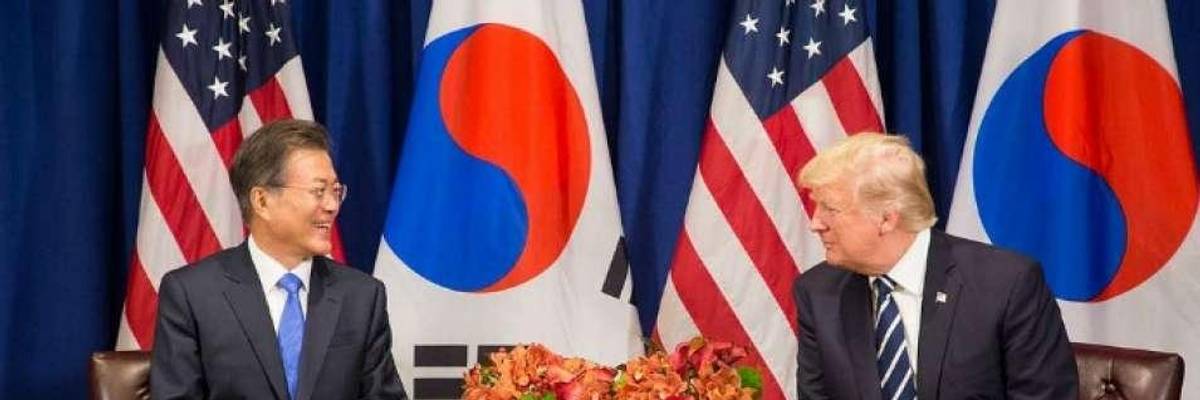
South Korean President Moon Jae-in and U.S. President Donald Trump met at the United Nations General Assembly in October. (Photo: Shealah Craighead/White House)
After the Olympic Winter Games came to a close in PyeongChang on Sunday, South Korean President Moon Jae-in urged the Trump administration to "lower the threshold" for diplomatic talks to ease rising nuclear tensions with North Korea, and called on the North to demonstrate its commitment to ending its blossoming nuclear weapons program.
"It's important the United States and North Korea sit down together quickly."
--Moon Jae-in, South Korean President
"Recently, North Korea has shown it is open to actively engaging the United States in talks and the United States is talking about the importance of dialogue," Moon said Monday, while meeting with Chinese Vice Premier Liu Yandong in Seoul, according to Reuters.
"There is a need for the United States to lower the threshold for talks with North Korea, and North Korea should show it is willing to denuclearize," Moon added. "It's important the United States and North Korea sit down together quickly."
Those comments built upon statements released during the Games' closing ceremony. Moon's office had said the North has "ample intentions of holding talks with the United States," while North Korea said that "South-North relations and U.S.-North Korean relations should be improved together," according to the Associated Press.
Peace advocates and world leaders have for months demanded that the Trump administration agree to talks with South Korea, a U.S. ally, and North Korea.
South Korea has held multiple meetings with North Korean officials in recent weeks, with the aim of reducing regional tensions. North Korean leader Kim Jong Un took Moon up on his offer to welcome North Korean athletes at the Olympics, and during the opening ceremony, competitors from the North and South marched in together, provoking ample applause.
Meanwhile, on Friday, the United States unveiled the largest sanctions ever imposed on North Korea, which the Washington Post reported "target 56 vessels, shipping companies, and other entities that U.S. officials say are used by North Korea to conduct trade prohibited under previous sanctions."
"Instead of doubling down on threats and the so-called 'maximum pressure' campaign, the Trump administration needs to pivot to diplomacy now."
--Jon Rainwater,
Peace Action
Jon Rainwater, executive director of Peace Action, said in response to the new sanctions that "with this blunt military threat--and let's not be coy, that is what this is-- [President Donald] Trump is ratcheting up tensions and making diplomatic solutions more difficult."
"It's particularly harmful that he is beating the drums for war while both North and South Korea are working to build on the diplomatic opening created by the Olympic Truce," Rainwater added. "Instead of doubling down on threats and the so-called 'maximum pressure' campaign, the Trump administration needs to pivot to diplomacy now."
This latest round of sanctions had been teased by Vice President Mike Pence ahead of the Olympics. There had been high hopes that Pence, who led the U.S. delegation during the Games' opening ceremony, would use the trip to meet with representatives from North Korea, and he came under fire both for his refusal to stand for other countries' athletes, including the joint Korean team, as well as his refusal to engage with the North Korean delegation, which was seated behind him.
The vice president's office told the Post last week that Pence had been scheduled to meet with North Korean officials on Feb. 10, but North Korea canceled the meeting a few hours beforehand, and "when canceling the meeting, the North Koreans expressed dissatisfaction with Pence's announcement of new sanctions as well as his meeting with North Korean defectors."
Dear Common Dreams reader, It’s been nearly 30 years since I co-founded Common Dreams with my late wife, Lina Newhouser. We had the radical notion that journalism should serve the public good, not corporate profits. It was clear to us from the outset what it would take to build such a project. No paid advertisements. No corporate sponsors. No millionaire publisher telling us what to think or do. Many people said we wouldn't last a year, but we proved those doubters wrong. Together with a tremendous team of journalists and dedicated staff, we built an independent media outlet free from the constraints of profits and corporate control. Our mission has always been simple: To inform. To inspire. To ignite change for the common good. Building Common Dreams was not easy. Our survival was never guaranteed. When you take on the most powerful forces—Wall Street greed, fossil fuel industry destruction, Big Tech lobbyists, and uber-rich oligarchs who have spent billions upon billions rigging the economy and democracy in their favor—the only bulwark you have is supporters who believe in your work. But here’s the urgent message from me today. It's never been this bad out there. And it's never been this hard to keep us going. At the very moment Common Dreams is most needed, the threats we face are intensifying. We need your support now more than ever. We don't accept corporate advertising and never will. We don't have a paywall because we don't think people should be blocked from critical news based on their ability to pay. Everything we do is funded by the donations of readers like you. When everyone does the little they can afford, we are strong. But if that support retreats or dries up, so do we. Will you donate now to make sure Common Dreams not only survives but thrives? —Craig Brown, Co-founder |
After the Olympic Winter Games came to a close in PyeongChang on Sunday, South Korean President Moon Jae-in urged the Trump administration to "lower the threshold" for diplomatic talks to ease rising nuclear tensions with North Korea, and called on the North to demonstrate its commitment to ending its blossoming nuclear weapons program.
"It's important the United States and North Korea sit down together quickly."
--Moon Jae-in, South Korean President
"Recently, North Korea has shown it is open to actively engaging the United States in talks and the United States is talking about the importance of dialogue," Moon said Monday, while meeting with Chinese Vice Premier Liu Yandong in Seoul, according to Reuters.
"There is a need for the United States to lower the threshold for talks with North Korea, and North Korea should show it is willing to denuclearize," Moon added. "It's important the United States and North Korea sit down together quickly."
Those comments built upon statements released during the Games' closing ceremony. Moon's office had said the North has "ample intentions of holding talks with the United States," while North Korea said that "South-North relations and U.S.-North Korean relations should be improved together," according to the Associated Press.
Peace advocates and world leaders have for months demanded that the Trump administration agree to talks with South Korea, a U.S. ally, and North Korea.
South Korea has held multiple meetings with North Korean officials in recent weeks, with the aim of reducing regional tensions. North Korean leader Kim Jong Un took Moon up on his offer to welcome North Korean athletes at the Olympics, and during the opening ceremony, competitors from the North and South marched in together, provoking ample applause.
Meanwhile, on Friday, the United States unveiled the largest sanctions ever imposed on North Korea, which the Washington Post reported "target 56 vessels, shipping companies, and other entities that U.S. officials say are used by North Korea to conduct trade prohibited under previous sanctions."
"Instead of doubling down on threats and the so-called 'maximum pressure' campaign, the Trump administration needs to pivot to diplomacy now."
--Jon Rainwater,
Peace Action
Jon Rainwater, executive director of Peace Action, said in response to the new sanctions that "with this blunt military threat--and let's not be coy, that is what this is-- [President Donald] Trump is ratcheting up tensions and making diplomatic solutions more difficult."
"It's particularly harmful that he is beating the drums for war while both North and South Korea are working to build on the diplomatic opening created by the Olympic Truce," Rainwater added. "Instead of doubling down on threats and the so-called 'maximum pressure' campaign, the Trump administration needs to pivot to diplomacy now."
This latest round of sanctions had been teased by Vice President Mike Pence ahead of the Olympics. There had been high hopes that Pence, who led the U.S. delegation during the Games' opening ceremony, would use the trip to meet with representatives from North Korea, and he came under fire both for his refusal to stand for other countries' athletes, including the joint Korean team, as well as his refusal to engage with the North Korean delegation, which was seated behind him.
The vice president's office told the Post last week that Pence had been scheduled to meet with North Korean officials on Feb. 10, but North Korea canceled the meeting a few hours beforehand, and "when canceling the meeting, the North Koreans expressed dissatisfaction with Pence's announcement of new sanctions as well as his meeting with North Korean defectors."
After the Olympic Winter Games came to a close in PyeongChang on Sunday, South Korean President Moon Jae-in urged the Trump administration to "lower the threshold" for diplomatic talks to ease rising nuclear tensions with North Korea, and called on the North to demonstrate its commitment to ending its blossoming nuclear weapons program.
"It's important the United States and North Korea sit down together quickly."
--Moon Jae-in, South Korean President
"Recently, North Korea has shown it is open to actively engaging the United States in talks and the United States is talking about the importance of dialogue," Moon said Monday, while meeting with Chinese Vice Premier Liu Yandong in Seoul, according to Reuters.
"There is a need for the United States to lower the threshold for talks with North Korea, and North Korea should show it is willing to denuclearize," Moon added. "It's important the United States and North Korea sit down together quickly."
Those comments built upon statements released during the Games' closing ceremony. Moon's office had said the North has "ample intentions of holding talks with the United States," while North Korea said that "South-North relations and U.S.-North Korean relations should be improved together," according to the Associated Press.
Peace advocates and world leaders have for months demanded that the Trump administration agree to talks with South Korea, a U.S. ally, and North Korea.
South Korea has held multiple meetings with North Korean officials in recent weeks, with the aim of reducing regional tensions. North Korean leader Kim Jong Un took Moon up on his offer to welcome North Korean athletes at the Olympics, and during the opening ceremony, competitors from the North and South marched in together, provoking ample applause.
Meanwhile, on Friday, the United States unveiled the largest sanctions ever imposed on North Korea, which the Washington Post reported "target 56 vessels, shipping companies, and other entities that U.S. officials say are used by North Korea to conduct trade prohibited under previous sanctions."
"Instead of doubling down on threats and the so-called 'maximum pressure' campaign, the Trump administration needs to pivot to diplomacy now."
--Jon Rainwater,
Peace Action
Jon Rainwater, executive director of Peace Action, said in response to the new sanctions that "with this blunt military threat--and let's not be coy, that is what this is-- [President Donald] Trump is ratcheting up tensions and making diplomatic solutions more difficult."
"It's particularly harmful that he is beating the drums for war while both North and South Korea are working to build on the diplomatic opening created by the Olympic Truce," Rainwater added. "Instead of doubling down on threats and the so-called 'maximum pressure' campaign, the Trump administration needs to pivot to diplomacy now."
This latest round of sanctions had been teased by Vice President Mike Pence ahead of the Olympics. There had been high hopes that Pence, who led the U.S. delegation during the Games' opening ceremony, would use the trip to meet with representatives from North Korea, and he came under fire both for his refusal to stand for other countries' athletes, including the joint Korean team, as well as his refusal to engage with the North Korean delegation, which was seated behind him.
The vice president's office told the Post last week that Pence had been scheduled to meet with North Korean officials on Feb. 10, but North Korea canceled the meeting a few hours beforehand, and "when canceling the meeting, the North Koreans expressed dissatisfaction with Pence's announcement of new sanctions as well as his meeting with North Korean defectors."