

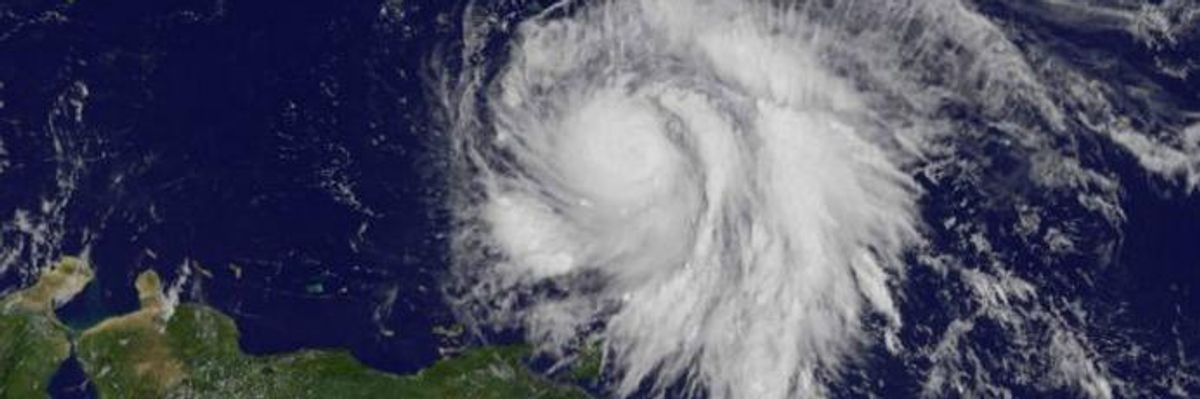
This visible image of Hurricane Maria was taken from NOAA's GOES East satellite on Sept. 18, 2017. (Photo: NASA/NOAA GOES Project)
Threatening the 'Warnings Upon Which the Country Depends,' Trump Budget Would Axe Nearly 250 Weather Forecasters
"We can't take any more cuts and still do the job that the American public needs us to do," says Dan Sobien, president of the National Weather Service Employees Organization
Among the agencies slated for deep cuts in President Donald Trump's "morally bankrupt" budget proposal is the National Oceanic and Atmospheric Administration (NOAA).
The National Weather Service (NWS), which is part of the NOAA, faces a proposed 8 percent cut compared to 2017 levels, which would mean slashing 355 jobs, including those of 248 forecasters.
"The proposed NWS cuts are especially troubling given that the nation just saw its most expensive year for weather disasters on record." The proposal suggests (pdf) that the staff reduction will make "the agency more effective and efficient to protect lives and property," though it also notes that "Every day, NWS forecasters issue public, aviation, marine, fire weather, climate, space weather, river, and flood forecasts and warnings for the protection of life, property, and the enhancement of the national economy."
According to Dan Sobien, president of the National Weather Service Employees Organization, "We can't take any more cuts and still do the job that the American public needs us to do--there simply will not be the staff available on duty to issue the forecasts and warnings upon which the country depends."
The budget proposal comes shortly after the NOAA said 2017 broke the record for costliest weather-related disasters.
"The proposed NWS cuts are especially troubling given that the nation just saw its most expensive year for weather disasters on record," said Bob Henson of Weather Underground. "The NWS forecasters I know are passionate about their jobs and dedicated to serving the public. They've also been stretched thin by understaffing. If we want a world-class weather service, we ought to fully fund it."
Among the other cuts the NWS are an $11 million hit to the agency's tsunami warning program and a $15 million cut in its surface and marine observations program.
Overall, the NOAA faces a 37 percent cut compared to 2017 levels--a level Ocean Conservancy's Addie Haughey described as "shocking."
An Urgent Message From Our Co-Founder
Dear Common Dreams reader, It’s been nearly 30 years since I co-founded Common Dreams with my late wife, Lina Newhouser. We had the radical notion that journalism should serve the public good, not corporate profits. It was clear to us from the outset what it would take to build such a project. No paid advertisements. No corporate sponsors. No millionaire publisher telling us what to think or do. Many people said we wouldn't last a year, but we proved those doubters wrong. Together with a tremendous team of journalists and dedicated staff, we built an independent media outlet free from the constraints of profits and corporate control. Our mission has always been simple: To inform. To inspire. To ignite change for the common good. Building Common Dreams was not easy. Our survival was never guaranteed. When you take on the most powerful forces—Wall Street greed, fossil fuel industry destruction, Big Tech lobbyists, and uber-rich oligarchs who have spent billions upon billions rigging the economy and democracy in their favor—the only bulwark you have is supporters who believe in your work. But here’s the urgent message from me today. It's never been this bad out there. And it's never been this hard to keep us going. At the very moment Common Dreams is most needed, the threats we face are intensifying. We need your support now more than ever. We don't accept corporate advertising and never will. We don't have a paywall because we don't think people should be blocked from critical news based on their ability to pay. Everything we do is funded by the donations of readers like you. When everyone does the little they can afford, we are strong. But if that support retreats or dries up, so do we. Will you donate now to make sure Common Dreams not only survives but thrives? —Craig Brown, Co-founder |
Among the agencies slated for deep cuts in President Donald Trump's "morally bankrupt" budget proposal is the National Oceanic and Atmospheric Administration (NOAA).
The National Weather Service (NWS), which is part of the NOAA, faces a proposed 8 percent cut compared to 2017 levels, which would mean slashing 355 jobs, including those of 248 forecasters.
"The proposed NWS cuts are especially troubling given that the nation just saw its most expensive year for weather disasters on record." The proposal suggests (pdf) that the staff reduction will make "the agency more effective and efficient to protect lives and property," though it also notes that "Every day, NWS forecasters issue public, aviation, marine, fire weather, climate, space weather, river, and flood forecasts and warnings for the protection of life, property, and the enhancement of the national economy."
According to Dan Sobien, president of the National Weather Service Employees Organization, "We can't take any more cuts and still do the job that the American public needs us to do--there simply will not be the staff available on duty to issue the forecasts and warnings upon which the country depends."
The budget proposal comes shortly after the NOAA said 2017 broke the record for costliest weather-related disasters.
"The proposed NWS cuts are especially troubling given that the nation just saw its most expensive year for weather disasters on record," said Bob Henson of Weather Underground. "The NWS forecasters I know are passionate about their jobs and dedicated to serving the public. They've also been stretched thin by understaffing. If we want a world-class weather service, we ought to fully fund it."
Among the other cuts the NWS are an $11 million hit to the agency's tsunami warning program and a $15 million cut in its surface and marine observations program.
Overall, the NOAA faces a 37 percent cut compared to 2017 levels--a level Ocean Conservancy's Addie Haughey described as "shocking."
Among the agencies slated for deep cuts in President Donald Trump's "morally bankrupt" budget proposal is the National Oceanic and Atmospheric Administration (NOAA).
The National Weather Service (NWS), which is part of the NOAA, faces a proposed 8 percent cut compared to 2017 levels, which would mean slashing 355 jobs, including those of 248 forecasters.
"The proposed NWS cuts are especially troubling given that the nation just saw its most expensive year for weather disasters on record." The proposal suggests (pdf) that the staff reduction will make "the agency more effective and efficient to protect lives and property," though it also notes that "Every day, NWS forecasters issue public, aviation, marine, fire weather, climate, space weather, river, and flood forecasts and warnings for the protection of life, property, and the enhancement of the national economy."
According to Dan Sobien, president of the National Weather Service Employees Organization, "We can't take any more cuts and still do the job that the American public needs us to do--there simply will not be the staff available on duty to issue the forecasts and warnings upon which the country depends."
The budget proposal comes shortly after the NOAA said 2017 broke the record for costliest weather-related disasters.
"The proposed NWS cuts are especially troubling given that the nation just saw its most expensive year for weather disasters on record," said Bob Henson of Weather Underground. "The NWS forecasters I know are passionate about their jobs and dedicated to serving the public. They've also been stretched thin by understaffing. If we want a world-class weather service, we ought to fully fund it."
Among the other cuts the NWS are an $11 million hit to the agency's tsunami warning program and a $15 million cut in its surface and marine observations program.
Overall, the NOAA faces a 37 percent cut compared to 2017 levels--a level Ocean Conservancy's Addie Haughey described as "shocking."