SUBSCRIBE TO OUR FREE NEWSLETTER
Daily news & progressive opinion—funded by the people, not the corporations—delivered straight to your inbox.
5
#000000
#FFFFFF
To donate by check, phone, or other method, see our More Ways to Give page.
Daily news & progressive opinion—funded by the people, not the corporations—delivered straight to your inbox.
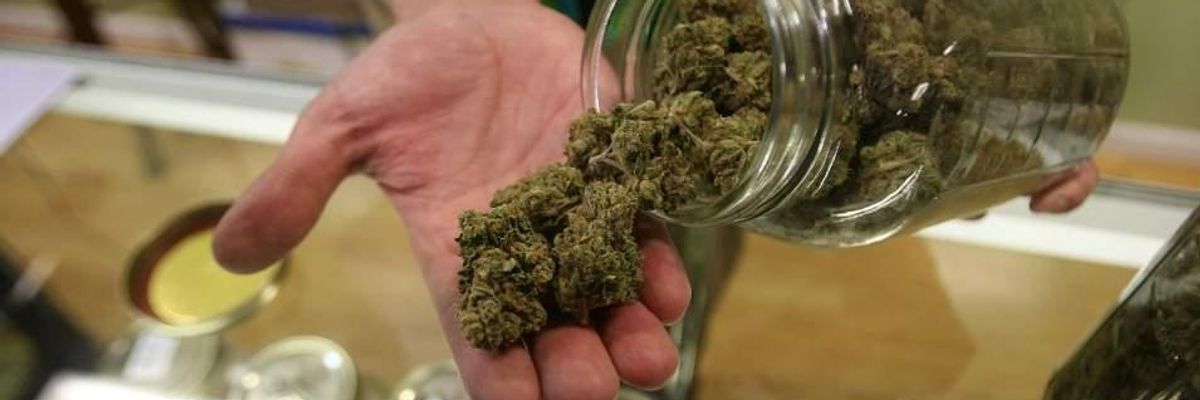
Dave Warden, a bud tender at Private Organic Therapy (P.O.T.), a non-profit co-operative medical marijuana dispensary, displays various types of marijuana available to patients on October 19, 2009 in Los Angeles, California. (Photo: David McNew/Getty Images)
Just weeks after a California measure legalizing the use of recreational marijuana went into effect, San Francisco District Attorney George Gascon announced on Wednesday that the city will wipe clean the records of thousands of individuals who have been charged with marijuana-related misdemeanors and felonies over the past several decades.
"There are millions of Californians with marijuana convictions on their record. Automatic expungement is neeeded to truly repair the drug war's harms."
--Jag Davis, Drug Policy Alliance
"While drug policy on the federal level is going backwards, San Francisco is once again taking the lead to undo the damage that this country's disastrous, failed drug war has had on our nation and on communities of color in particular," Gascon said in a statement on Wednesday, alluding to the Trump administration's recent announcement that it will rescind federal policy that allows Americans grow, sell, and use marijuana in states where it's legal.
Noting that California's new marijuana law allows citizens to petition courts to have their convictions tossed or reduced, Gascon notes that the process can be expensive and time-consuming.
"A criminal conviction can be a barrier to employment, housing, and other benefits, so instead of waiting for the community to take action, we're taking action for the community," Gascon said.
San Francisco's decision to retroactively apply Proposition 64, which was approved by voters in November 2016, was immediately applauded as a massive "step forward"--one that must be replicated throughout California and in other states that have legalized marijuana in order to "truly repair the drug war's harms."
Dear Common Dreams reader, It’s been nearly 30 years since I co-founded Common Dreams with my late wife, Lina Newhouser. We had the radical notion that journalism should serve the public good, not corporate profits. It was clear to us from the outset what it would take to build such a project. No paid advertisements. No corporate sponsors. No millionaire publisher telling us what to think or do. Many people said we wouldn't last a year, but we proved those doubters wrong. Together with a tremendous team of journalists and dedicated staff, we built an independent media outlet free from the constraints of profits and corporate control. Our mission has always been simple: To inform. To inspire. To ignite change for the common good. Building Common Dreams was not easy. Our survival was never guaranteed. When you take on the most powerful forces—Wall Street greed, fossil fuel industry destruction, Big Tech lobbyists, and uber-rich oligarchs who have spent billions upon billions rigging the economy and democracy in their favor—the only bulwark you have is supporters who believe in your work. But here’s the urgent message from me today. It's never been this bad out there. And it's never been this hard to keep us going. At the very moment Common Dreams is most needed, the threats we face are intensifying. We need your support now more than ever. We don't accept corporate advertising and never will. We don't have a paywall because we don't think people should be blocked from critical news based on their ability to pay. Everything we do is funded by the donations of readers like you. When everyone does the little they can afford, we are strong. But if that support retreats or dries up, so do we. Will you donate now to make sure Common Dreams not only survives but thrives? —Craig Brown, Co-founder |
Just weeks after a California measure legalizing the use of recreational marijuana went into effect, San Francisco District Attorney George Gascon announced on Wednesday that the city will wipe clean the records of thousands of individuals who have been charged with marijuana-related misdemeanors and felonies over the past several decades.
"There are millions of Californians with marijuana convictions on their record. Automatic expungement is neeeded to truly repair the drug war's harms."
--Jag Davis, Drug Policy Alliance
"While drug policy on the federal level is going backwards, San Francisco is once again taking the lead to undo the damage that this country's disastrous, failed drug war has had on our nation and on communities of color in particular," Gascon said in a statement on Wednesday, alluding to the Trump administration's recent announcement that it will rescind federal policy that allows Americans grow, sell, and use marijuana in states where it's legal.
Noting that California's new marijuana law allows citizens to petition courts to have their convictions tossed or reduced, Gascon notes that the process can be expensive and time-consuming.
"A criminal conviction can be a barrier to employment, housing, and other benefits, so instead of waiting for the community to take action, we're taking action for the community," Gascon said.
San Francisco's decision to retroactively apply Proposition 64, which was approved by voters in November 2016, was immediately applauded as a massive "step forward"--one that must be replicated throughout California and in other states that have legalized marijuana in order to "truly repair the drug war's harms."
Just weeks after a California measure legalizing the use of recreational marijuana went into effect, San Francisco District Attorney George Gascon announced on Wednesday that the city will wipe clean the records of thousands of individuals who have been charged with marijuana-related misdemeanors and felonies over the past several decades.
"There are millions of Californians with marijuana convictions on their record. Automatic expungement is neeeded to truly repair the drug war's harms."
--Jag Davis, Drug Policy Alliance
"While drug policy on the federal level is going backwards, San Francisco is once again taking the lead to undo the damage that this country's disastrous, failed drug war has had on our nation and on communities of color in particular," Gascon said in a statement on Wednesday, alluding to the Trump administration's recent announcement that it will rescind federal policy that allows Americans grow, sell, and use marijuana in states where it's legal.
Noting that California's new marijuana law allows citizens to petition courts to have their convictions tossed or reduced, Gascon notes that the process can be expensive and time-consuming.
"A criminal conviction can be a barrier to employment, housing, and other benefits, so instead of waiting for the community to take action, we're taking action for the community," Gascon said.
San Francisco's decision to retroactively apply Proposition 64, which was approved by voters in November 2016, was immediately applauded as a massive "step forward"--one that must be replicated throughout California and in other states that have legalized marijuana in order to "truly repair the drug war's harms."