SUBSCRIBE TO OUR FREE NEWSLETTER
Daily news & progressive opinion—funded by the people, not the corporations—delivered straight to your inbox.
5
#000000
#FFFFFF
To donate by check, phone, or other method, see our More Ways to Give page.
Daily news & progressive opinion—funded by the people, not the corporations—delivered straight to your inbox.
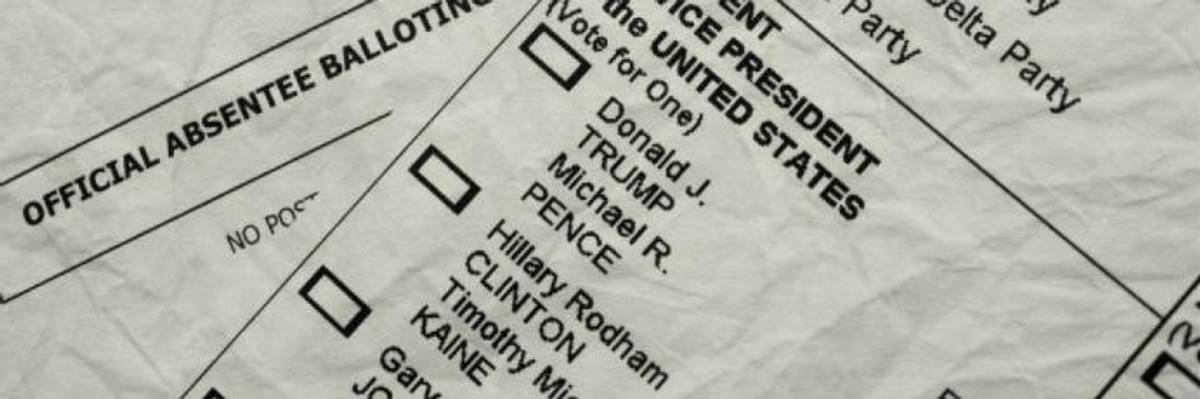
Documents from President Donald Trump's defunct election commission reveal that a researcher requested that Texas records identify voters with Hispanic surnames. (Photo: Frankie Leon/cc/flickr)
Raising fresh concerns about the intentions behind President Donald Trump's now-defunct "Commission on Election Integrity," newly released documents reveal a "deeply disturbing" request that Texas officials flag records for all voters with Hispanic surnames, according to the Washington Post.
The commission--which was launched following Trump's unsubstantiated claims about rampant fraud and faced challenges from several states and advocacy groups--paid Texas $3,500 in September for nearly 50 million state voter records. The Post reports a commission researcher "checked a box on two Texas public voter data request forms explicitly asking for the 'Hispanic surname flag notation,' to be included in information sent to the voting commission."
Although the commission disbanded following several legal challenges and the state's records were never sent, Texas was expected to provide "lists of voters who were active, those with canceled registrations, and those with an outdated or incorrect address on file; and a list of those who voted in the past six general elections from 2006 through 2016," and "flags for the Hispanic surnames would be in the lists."
Justin Levitt, a professor and election law expert who oversaw voting rights for the Obama administration's Department of Justice, told the Associated Press the "deeply disturbing" request could suggest the commission was searching for non-citizens on Texas' voter rolls, and noted "that--I cannot say more emphatically--is the sort of discriminatory racial profiling that the constitution forbids in official government action."
Texas has one of the largest Hispanic populations in the country, second only to California. About a quarter of Texas' more than 15 million voters have Hispanic surnames, and the state identifies Hispanic voters in order to provide them with bilingual election notices, according to a spokesman for Texas Secretary of State Rolando Pablos.
Myrna Perez, a lawyer for the Brennan Center for Justice, said, "Texas voters would have been subject to unreasonable and unlawful privacy risks" had the commission continued its work. "The request from the commission was inappropriate to begin with," she added, "and it was inappropriate for Texas to have contemplated giving the data given their state privacy laws and the inability of the commission to protect voters' privacy."
The commission was led by Vice President Mike Pence as well as "notorious vote suppressor" Kansas Secretary of State Kris Kobach, who told the Post that the researcher who filed the request for Texas records "did not ask any member of the commission whether he should check that box or not" and "at no time did the commission request any state to flag surnames by ethnicity or race."
An anonymous White House official, meanwhile, claimed the commission "asked to identify Hispanic surnames to resolve data discrepancies or confusion caused by the traditional Spanish naming convention that uses the surnames of both parents."
The documents (pdf) detailing the Texas purchase were made public in response to a request by Sen. Claire McCaskill (D-Mo.) that the U.S. General Service Administration release records of its communications with Trump's election commission.
Dear Common Dreams reader, It’s been nearly 30 years since I co-founded Common Dreams with my late wife, Lina Newhouser. We had the radical notion that journalism should serve the public good, not corporate profits. It was clear to us from the outset what it would take to build such a project. No paid advertisements. No corporate sponsors. No millionaire publisher telling us what to think or do. Many people said we wouldn't last a year, but we proved those doubters wrong. Together with a tremendous team of journalists and dedicated staff, we built an independent media outlet free from the constraints of profits and corporate control. Our mission has always been simple: To inform. To inspire. To ignite change for the common good. Building Common Dreams was not easy. Our survival was never guaranteed. When you take on the most powerful forces—Wall Street greed, fossil fuel industry destruction, Big Tech lobbyists, and uber-rich oligarchs who have spent billions upon billions rigging the economy and democracy in their favor—the only bulwark you have is supporters who believe in your work. But here’s the urgent message from me today. It's never been this bad out there. And it's never been this hard to keep us going. At the very moment Common Dreams is most needed, the threats we face are intensifying. We need your support now more than ever. We don't accept corporate advertising and never will. We don't have a paywall because we don't think people should be blocked from critical news based on their ability to pay. Everything we do is funded by the donations of readers like you. When everyone does the little they can afford, we are strong. But if that support retreats or dries up, so do we. Will you donate now to make sure Common Dreams not only survives but thrives? —Craig Brown, Co-founder |
Raising fresh concerns about the intentions behind President Donald Trump's now-defunct "Commission on Election Integrity," newly released documents reveal a "deeply disturbing" request that Texas officials flag records for all voters with Hispanic surnames, according to the Washington Post.
The commission--which was launched following Trump's unsubstantiated claims about rampant fraud and faced challenges from several states and advocacy groups--paid Texas $3,500 in September for nearly 50 million state voter records. The Post reports a commission researcher "checked a box on two Texas public voter data request forms explicitly asking for the 'Hispanic surname flag notation,' to be included in information sent to the voting commission."
Although the commission disbanded following several legal challenges and the state's records were never sent, Texas was expected to provide "lists of voters who were active, those with canceled registrations, and those with an outdated or incorrect address on file; and a list of those who voted in the past six general elections from 2006 through 2016," and "flags for the Hispanic surnames would be in the lists."
Justin Levitt, a professor and election law expert who oversaw voting rights for the Obama administration's Department of Justice, told the Associated Press the "deeply disturbing" request could suggest the commission was searching for non-citizens on Texas' voter rolls, and noted "that--I cannot say more emphatically--is the sort of discriminatory racial profiling that the constitution forbids in official government action."
Texas has one of the largest Hispanic populations in the country, second only to California. About a quarter of Texas' more than 15 million voters have Hispanic surnames, and the state identifies Hispanic voters in order to provide them with bilingual election notices, according to a spokesman for Texas Secretary of State Rolando Pablos.
Myrna Perez, a lawyer for the Brennan Center for Justice, said, "Texas voters would have been subject to unreasonable and unlawful privacy risks" had the commission continued its work. "The request from the commission was inappropriate to begin with," she added, "and it was inappropriate for Texas to have contemplated giving the data given their state privacy laws and the inability of the commission to protect voters' privacy."
The commission was led by Vice President Mike Pence as well as "notorious vote suppressor" Kansas Secretary of State Kris Kobach, who told the Post that the researcher who filed the request for Texas records "did not ask any member of the commission whether he should check that box or not" and "at no time did the commission request any state to flag surnames by ethnicity or race."
An anonymous White House official, meanwhile, claimed the commission "asked to identify Hispanic surnames to resolve data discrepancies or confusion caused by the traditional Spanish naming convention that uses the surnames of both parents."
The documents (pdf) detailing the Texas purchase were made public in response to a request by Sen. Claire McCaskill (D-Mo.) that the U.S. General Service Administration release records of its communications with Trump's election commission.
Raising fresh concerns about the intentions behind President Donald Trump's now-defunct "Commission on Election Integrity," newly released documents reveal a "deeply disturbing" request that Texas officials flag records for all voters with Hispanic surnames, according to the Washington Post.
The commission--which was launched following Trump's unsubstantiated claims about rampant fraud and faced challenges from several states and advocacy groups--paid Texas $3,500 in September for nearly 50 million state voter records. The Post reports a commission researcher "checked a box on two Texas public voter data request forms explicitly asking for the 'Hispanic surname flag notation,' to be included in information sent to the voting commission."
Although the commission disbanded following several legal challenges and the state's records were never sent, Texas was expected to provide "lists of voters who were active, those with canceled registrations, and those with an outdated or incorrect address on file; and a list of those who voted in the past six general elections from 2006 through 2016," and "flags for the Hispanic surnames would be in the lists."
Justin Levitt, a professor and election law expert who oversaw voting rights for the Obama administration's Department of Justice, told the Associated Press the "deeply disturbing" request could suggest the commission was searching for non-citizens on Texas' voter rolls, and noted "that--I cannot say more emphatically--is the sort of discriminatory racial profiling that the constitution forbids in official government action."
Texas has one of the largest Hispanic populations in the country, second only to California. About a quarter of Texas' more than 15 million voters have Hispanic surnames, and the state identifies Hispanic voters in order to provide them with bilingual election notices, according to a spokesman for Texas Secretary of State Rolando Pablos.
Myrna Perez, a lawyer for the Brennan Center for Justice, said, "Texas voters would have been subject to unreasonable and unlawful privacy risks" had the commission continued its work. "The request from the commission was inappropriate to begin with," she added, "and it was inappropriate for Texas to have contemplated giving the data given their state privacy laws and the inability of the commission to protect voters' privacy."
The commission was led by Vice President Mike Pence as well as "notorious vote suppressor" Kansas Secretary of State Kris Kobach, who told the Post that the researcher who filed the request for Texas records "did not ask any member of the commission whether he should check that box or not" and "at no time did the commission request any state to flag surnames by ethnicity or race."
An anonymous White House official, meanwhile, claimed the commission "asked to identify Hispanic surnames to resolve data discrepancies or confusion caused by the traditional Spanish naming convention that uses the surnames of both parents."
The documents (pdf) detailing the Texas purchase were made public in response to a request by Sen. Claire McCaskill (D-Mo.) that the U.S. General Service Administration release records of its communications with Trump's election commission.