SUBSCRIBE TO OUR FREE NEWSLETTER
Daily news & progressive opinion—funded by the people, not the corporations—delivered straight to your inbox.
5
#000000
#FFFFFF
To donate by check, phone, or other method, see our More Ways to Give page.
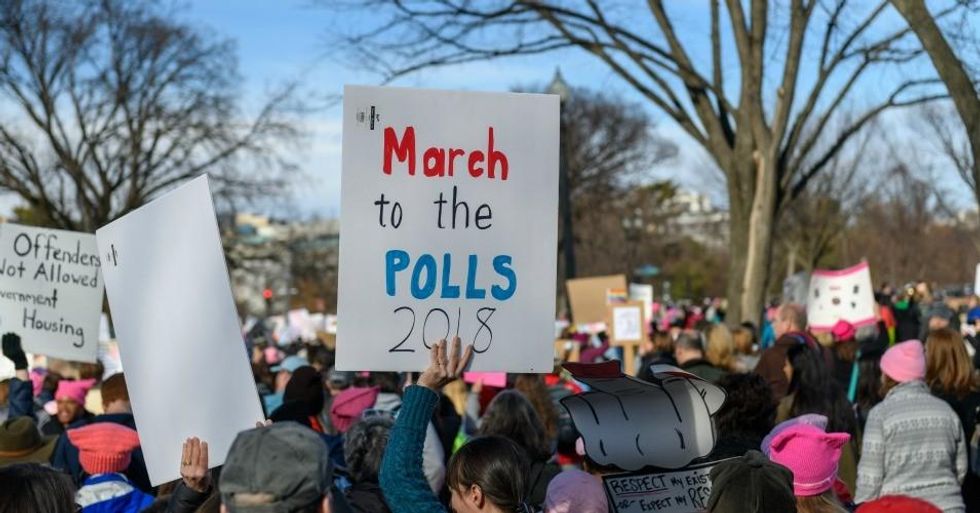
The second annual Women's March generated widespread enthusiasm on Saturday and Sunday, after a year in which sexual harassment and assault dominated many headlines along with President Donald Trump's policies, many of which threatened women's rights. Rallies, marches, and anniversary events drew an estimated one-to-two million men, women, and children in cities across the country and around the world.
High-profile speakers were scheduled to speak at the coalition's main event on Sunday, held in Las Vegas under the name #PowertothePolls and focusing largely on voter mobilization ahead of the 2018 midterm elections.
Attendees came from all over the country, many arriving at Sam Boyd Stadium for the rally by 5:30am, nearly five hours before the event was set to begin.
Nevada was reportedly chosen as the site of this year's main event due to its history as a swing state in elections and the high number of women who hold public office there.
The state also has a large immigrant population and has been at the center of the national debate over gun control legislation in recent months due to the October shooting at a Las Vegas concert that killed 58 people--both issues that the Women's March and its partners argue have strong correlations to women's rights.
Other cities drew large crowds as well, with an estimated 200,000 marchers in New York on Saturday. Many of the protesters left the signs they carried at Trump Tower.
The #MeToo and #TimesUp movements also informed much of the conversation at the second annual Women's March, with actress and activist Viola Davis speaking about women across industries and socioeconomic backgrounds who have been impacted by sexual harassment and assault, at the Los Angeles rally.
Six hundred thousand marchers attended the Los Angeles event, according to Mayor Eric Garcetti.
According to a map of planned events on the official website of the Women's March, hundreds of smaller marches were planned for the weekend in smaller cities and towns, as well as on every continent in the world except Antarctica.
The second annual Women's March generated widespread enthusiasm on Saturday and Sunday, after a year in which sexual harassment and assault dominated many headlines along with President Donald Trump's policies, many of which threatened women's rights. Rallies, marches, and anniversary events drew an estimated one-to-two million men, women, and children in cities across the country and around the world.
High-profile speakers were scheduled to speak at the coalition's main event on Sunday, held in Las Vegas under the name #PowertothePolls and focusing largely on voter mobilization ahead of the 2018 midterm elections.
Attendees came from all over the country, many arriving at Sam Boyd Stadium for the rally by 5:30am, nearly five hours before the event was set to begin.
Nevada was reportedly chosen as the site of this year's main event due to its history as a swing state in elections and the high number of women who hold public office there.
The state also has a large immigrant population and has been at the center of the national debate over gun control legislation in recent months due to the October shooting at a Las Vegas concert that killed 58 people--both issues that the Women's March and its partners argue have strong correlations to women's rights.
Other cities drew large crowds as well, with an estimated 200,000 marchers in New York on Saturday. Many of the protesters left the signs they carried at Trump Tower.
The #MeToo and #TimesUp movements also informed much of the conversation at the second annual Women's March, with actress and activist Viola Davis speaking about women across industries and socioeconomic backgrounds who have been impacted by sexual harassment and assault, at the Los Angeles rally.
Six hundred thousand marchers attended the Los Angeles event, according to Mayor Eric Garcetti.
According to a map of planned events on the official website of the Women's March, hundreds of smaller marches were planned for the weekend in smaller cities and towns, as well as on every continent in the world except Antarctica.
The second annual Women's March generated widespread enthusiasm on Saturday and Sunday, after a year in which sexual harassment and assault dominated many headlines along with President Donald Trump's policies, many of which threatened women's rights. Rallies, marches, and anniversary events drew an estimated one-to-two million men, women, and children in cities across the country and around the world.
High-profile speakers were scheduled to speak at the coalition's main event on Sunday, held in Las Vegas under the name #PowertothePolls and focusing largely on voter mobilization ahead of the 2018 midterm elections.
Attendees came from all over the country, many arriving at Sam Boyd Stadium for the rally by 5:30am, nearly five hours before the event was set to begin.
Nevada was reportedly chosen as the site of this year's main event due to its history as a swing state in elections and the high number of women who hold public office there.
The state also has a large immigrant population and has been at the center of the national debate over gun control legislation in recent months due to the October shooting at a Las Vegas concert that killed 58 people--both issues that the Women's March and its partners argue have strong correlations to women's rights.
Other cities drew large crowds as well, with an estimated 200,000 marchers in New York on Saturday. Many of the protesters left the signs they carried at Trump Tower.
The #MeToo and #TimesUp movements also informed much of the conversation at the second annual Women's March, with actress and activist Viola Davis speaking about women across industries and socioeconomic backgrounds who have been impacted by sexual harassment and assault, at the Los Angeles rally.
Six hundred thousand marchers attended the Los Angeles event, according to Mayor Eric Garcetti.
According to a map of planned events on the official website of the Women's March, hundreds of smaller marches were planned for the weekend in smaller cities and towns, as well as on every continent in the world except Antarctica.