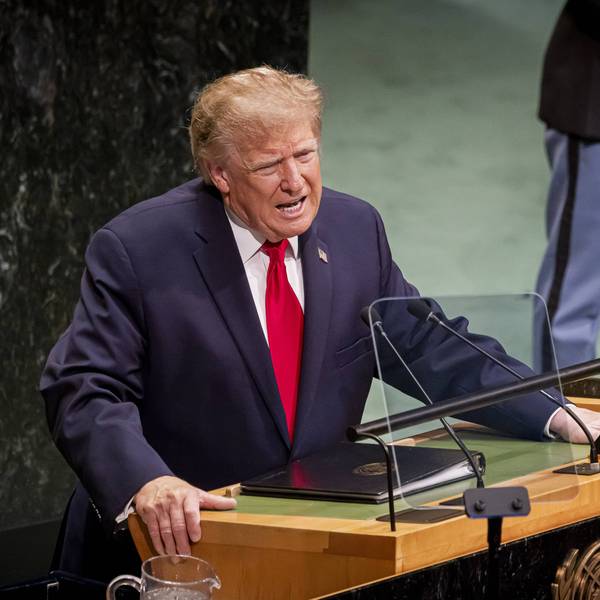

US President Donald Trump makes opening remarks as he holds a Cabinet meeting in the Cabinet Room of the White House on January 10, 2018 in Washington, DC. Looking on from right is US Secretary of Defense Jim Mattis. (Photo by Ron Sachs-Pool/Getty Images)
Prominent Birther Conspiracy Theorist Trump Says 'Look at Libel Laws' on Top of 2018 Agenda
"This from the birther guy!"
During comments to the press at the opening of a cabinet meeting on Wednesday, President Donald Trump announced that among his administration's top priorities in the coming year would be taking a closer look at the nation's libel laws, a suggestion that drew immediate howls from critics and legal experts who say the president has no business trying to silence those who criticize or speak out against elected government officials.
"We're going to be taking a look at our nation's libel laws," Trump said, "so that when someone says something that is false and defamatory about someone that person will have meaningful recourse in our courts."
Last week, after the excerpts from an explosive book by journalist Michael Wolff were released, Trump's attorneys sent cease-and-desist letters to individuals quoted in the book and also tried to block the publisher from releasing it. "The libel laws are very weak in this country," Trump said Wednesday. "If they were strong, it would be very helpful. You wouldn't have things like that happen where you can say whatever comes to your head."
Social media was quick to point out the president's hypocrisy, lack of self-awareness, and the troubling implications of a president--especially one known for being a serial liar--who thinks it should be a national priority to clamp down on the rights of people who may say things that he personally finds unpleasant:
We are at a crossroads
This country and this world are at a monumental crossroads. US voters have an opportunity to beat back the forces of fascism and confront the billionaires who are rigging the economy, our media system, and our democracy, making it increasingly impossible for ordinary people to get by. We’re not just talking about the election. We’re talking about what must be done once these fascist elements are vanquished from power. We need a bolder set of solutions than what either major party has so far been willing to offer and a working-class movement ready to fight like hell for it. Trump didn't emerge from nowhere. The conditions that fueled MAGA authoritarianism were created by decades of radical neoliberal economic policies and a corrupt political system dominated by corporate interests. They slashed taxes on the super-rich, promising that the benefits would trickle down. They said giveaways to the corporate titans would make life more affordable for the rest of us. It was all bullshit. And when a bitter, betrayed populace searches for someone to blame, right-wing demagogues have little trouble finding scapegoats. People know when they're being lied to, but you won't hear any of this from the corporate media. Only independent journalism—powered and funded by people who believe in building a better world—can deliver truly trustworthy daily news. Our Fall Campaign is underway, and we need your help. To power our newsroom through the rest of the year, we need to raise $125,000 by midnight on October 31. So if you share our vision, please contribute whatever you can to sustain our work. |
During comments to the press at the opening of a cabinet meeting on Wednesday, President Donald Trump announced that among his administration's top priorities in the coming year would be taking a closer look at the nation's libel laws, a suggestion that drew immediate howls from critics and legal experts who say the president has no business trying to silence those who criticize or speak out against elected government officials.
"We're going to be taking a look at our nation's libel laws," Trump said, "so that when someone says something that is false and defamatory about someone that person will have meaningful recourse in our courts."
Last week, after the excerpts from an explosive book by journalist Michael Wolff were released, Trump's attorneys sent cease-and-desist letters to individuals quoted in the book and also tried to block the publisher from releasing it. "The libel laws are very weak in this country," Trump said Wednesday. "If they were strong, it would be very helpful. You wouldn't have things like that happen where you can say whatever comes to your head."
Social media was quick to point out the president's hypocrisy, lack of self-awareness, and the troubling implications of a president--especially one known for being a serial liar--who thinks it should be a national priority to clamp down on the rights of people who may say things that he personally finds unpleasant: