SUBSCRIBE TO OUR FREE NEWSLETTER
Daily news & progressive opinion—funded by the people, not the corporations—delivered straight to your inbox.
5
#000000
#FFFFFF
To donate by check, phone, or other method, see our More Ways to Give page.
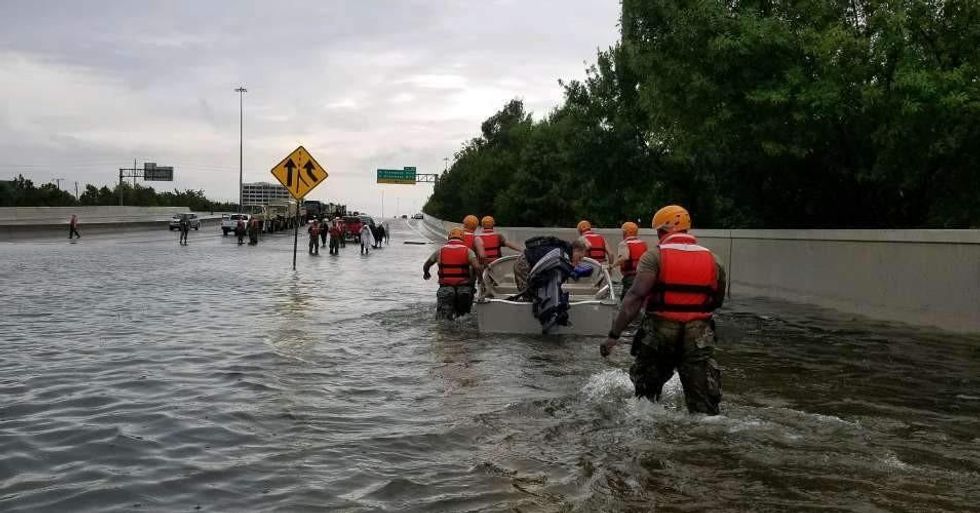
Devastating hurricanes and wildfires--fueled in part by anthropogenic climate change--contributed to more than $300 billion in disaster-related damage across the United States last year, making 2017 the costliest year on record for extreme weather events, according to a government report released Monday.
"We can expect extreme weather events and economic losses and costs associated with them to continue increasing unless we make dramatic reductions in greenhouse gas emissions."
--James McCarthy, climate expert
"During 2017, the U.S. experienced a historic year of weather and climate disasters," according to the National Oceanic and Atmospheric Administration's (NOAA) National Climatic Data Center. "In total, the U.S. was impacted by 16 separate billion-dollar disaster events."
"The cumulative damage of these 16 U.S. events during 2017 is $306.2 billion, which shatters the previous U.S. annual record cost of $214.8 billion," NOAA notes. The previous record--adjusted for inflation--was set in 2005, following Hurricanes Dennis, Katrina, Rita, and Wilma. Last year saw Hurricanes Harvey, Maria, and Irma produce the most expensive hurricane season ever recorded, at $265 billion, while the raging wildfires in California contributed to a record $18 billion in fire damage.
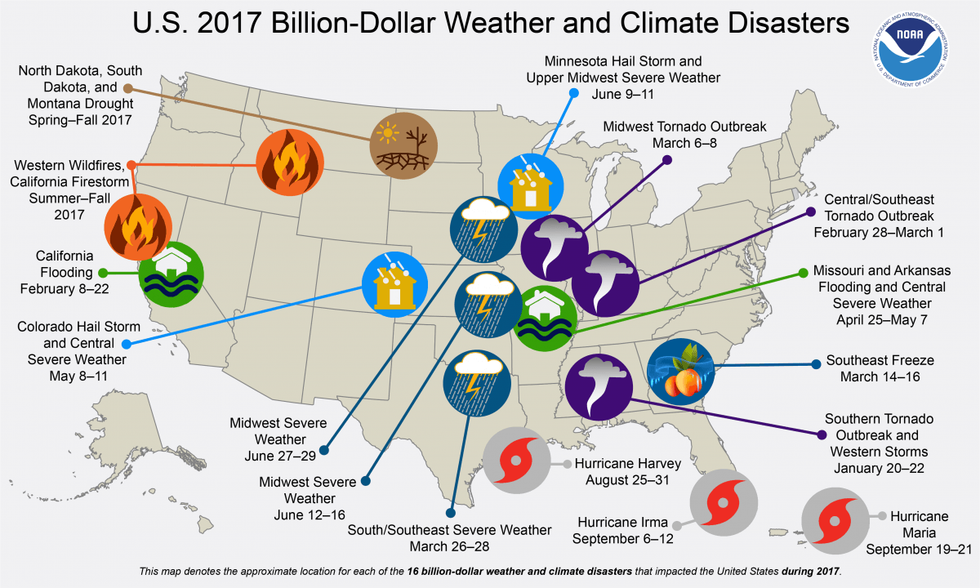
NOAA mapped 2017's billion-dollar disasters, which included not only fires and hurricanes, but also flooding, a freeze, a drought, tornadoes, and general severe weather:
The human cost may not be fully recognized in the NOAA report, which claims, "overall, these events resulted in the deaths of 362 people." In contrast, news reports from Puerto Rico--a U.S. territory devastated by the 2017 hurricane season--indicate the post-hurricane death toll on the island alone could exceed 1,000 Americans.
Though alarming on its own, Ashley Siefert, communications director for the Union of Concerned Scientists (UCS), said NOAA's new report "is even more staggering when reviewed alongside recent reports from the insurance industry, as well as the latest attribution studies examining the connection between climate change and specific extreme weather events."
Rachel Cleetus, UCS's lead economist and climate policy manager, outlined in a blog post how the NOAA report echoes reports from the insurance industry.
"Last week, Munich Re, one of the world's leading reinsurers, stated that the costs to the insurance industry from Harvey, Irma, and Maria, and other 2017 disasters, are expected to reach $135 billion globally, the highest ever, with the U.S. share dominating at 50 percent of these costs. Overall economic losses, including uninsured losses, will amount to $330 billion, the second highest ever for a single year," she writes. "Last month, Swiss Re released a similar report stating that global insured losses for 2017 were $136 billion, and total economic losses are estimated to be $306 billion."
"First and foremost, we must do more to prepare and protect communities ahead of time by investing in risk reduction and disaster preparedness, and by ensuring that our federal, state, and local policies are guided by the best available science."
--Rachel Cleetus, Union of Concerned Scientists
This "historic and unprecedented year of disastrous extremes" reinforces "the fact that climate change is a threat to our health, and also a threat to our economy," Cleetus concludes, emphasizing that in order to mitigate the impacts, "first and foremost, we must do more to prepare and protect communities ahead of time by investing in risk reduction and disaster preparedness, and by ensuring that our federal, state, and local policies are guided by the best available science."
Although NOAA experts who held a media call to discuss the report declined to comment on the extent to which they believe climate change is impacting natural disasters, according to the Washington Post, climate experts were quick to weigh in.
"Hurricanes, wildfires, floods, and severe weather events occur naturally. However, the data shows an overall increased frequency in these events, and an associated increase in intensity," said Robert Watson, the former chairman of the United Nations' Intergovernmental Panel on Climate Change, who co-authored a recent report on the economic consequences of extreme weather disasters influenced by climate change.
"The precautionary principle would suggest," Watson added, "that we should assume a significant contribution from human activities, and prepare to adapt and mitigate."
Harvard oceanographer and climate expert James McCarthy, who co-authored the report with Watson, warned, "We can expect extreme weather events and economic losses and costs associated with them to continue increasing unless we make dramatic reductions in greenhouse gas emissions."
Devastating hurricanes and wildfires--fueled in part by anthropogenic climate change--contributed to more than $300 billion in disaster-related damage across the United States last year, making 2017 the costliest year on record for extreme weather events, according to a government report released Monday.
"We can expect extreme weather events and economic losses and costs associated with them to continue increasing unless we make dramatic reductions in greenhouse gas emissions."
--James McCarthy, climate expert
"During 2017, the U.S. experienced a historic year of weather and climate disasters," according to the National Oceanic and Atmospheric Administration's (NOAA) National Climatic Data Center. "In total, the U.S. was impacted by 16 separate billion-dollar disaster events."
"The cumulative damage of these 16 U.S. events during 2017 is $306.2 billion, which shatters the previous U.S. annual record cost of $214.8 billion," NOAA notes. The previous record--adjusted for inflation--was set in 2005, following Hurricanes Dennis, Katrina, Rita, and Wilma. Last year saw Hurricanes Harvey, Maria, and Irma produce the most expensive hurricane season ever recorded, at $265 billion, while the raging wildfires in California contributed to a record $18 billion in fire damage.
NOAA mapped 2017's billion-dollar disasters, which included not only fires and hurricanes, but also flooding, a freeze, a drought, tornadoes, and general severe weather:
The human cost may not be fully recognized in the NOAA report, which claims, "overall, these events resulted in the deaths of 362 people." In contrast, news reports from Puerto Rico--a U.S. territory devastated by the 2017 hurricane season--indicate the post-hurricane death toll on the island alone could exceed 1,000 Americans.
Though alarming on its own, Ashley Siefert, communications director for the Union of Concerned Scientists (UCS), said NOAA's new report "is even more staggering when reviewed alongside recent reports from the insurance industry, as well as the latest attribution studies examining the connection between climate change and specific extreme weather events."
Rachel Cleetus, UCS's lead economist and climate policy manager, outlined in a blog post how the NOAA report echoes reports from the insurance industry.
"Last week, Munich Re, one of the world's leading reinsurers, stated that the costs to the insurance industry from Harvey, Irma, and Maria, and other 2017 disasters, are expected to reach $135 billion globally, the highest ever, with the U.S. share dominating at 50 percent of these costs. Overall economic losses, including uninsured losses, will amount to $330 billion, the second highest ever for a single year," she writes. "Last month, Swiss Re released a similar report stating that global insured losses for 2017 were $136 billion, and total economic losses are estimated to be $306 billion."
"First and foremost, we must do more to prepare and protect communities ahead of time by investing in risk reduction and disaster preparedness, and by ensuring that our federal, state, and local policies are guided by the best available science."
--Rachel Cleetus, Union of Concerned Scientists
This "historic and unprecedented year of disastrous extremes" reinforces "the fact that climate change is a threat to our health, and also a threat to our economy," Cleetus concludes, emphasizing that in order to mitigate the impacts, "first and foremost, we must do more to prepare and protect communities ahead of time by investing in risk reduction and disaster preparedness, and by ensuring that our federal, state, and local policies are guided by the best available science."
Although NOAA experts who held a media call to discuss the report declined to comment on the extent to which they believe climate change is impacting natural disasters, according to the Washington Post, climate experts were quick to weigh in.
"Hurricanes, wildfires, floods, and severe weather events occur naturally. However, the data shows an overall increased frequency in these events, and an associated increase in intensity," said Robert Watson, the former chairman of the United Nations' Intergovernmental Panel on Climate Change, who co-authored a recent report on the economic consequences of extreme weather disasters influenced by climate change.
"The precautionary principle would suggest," Watson added, "that we should assume a significant contribution from human activities, and prepare to adapt and mitigate."
Harvard oceanographer and climate expert James McCarthy, who co-authored the report with Watson, warned, "We can expect extreme weather events and economic losses and costs associated with them to continue increasing unless we make dramatic reductions in greenhouse gas emissions."
Devastating hurricanes and wildfires--fueled in part by anthropogenic climate change--contributed to more than $300 billion in disaster-related damage across the United States last year, making 2017 the costliest year on record for extreme weather events, according to a government report released Monday.
"We can expect extreme weather events and economic losses and costs associated with them to continue increasing unless we make dramatic reductions in greenhouse gas emissions."
--James McCarthy, climate expert
"During 2017, the U.S. experienced a historic year of weather and climate disasters," according to the National Oceanic and Atmospheric Administration's (NOAA) National Climatic Data Center. "In total, the U.S. was impacted by 16 separate billion-dollar disaster events."
"The cumulative damage of these 16 U.S. events during 2017 is $306.2 billion, which shatters the previous U.S. annual record cost of $214.8 billion," NOAA notes. The previous record--adjusted for inflation--was set in 2005, following Hurricanes Dennis, Katrina, Rita, and Wilma. Last year saw Hurricanes Harvey, Maria, and Irma produce the most expensive hurricane season ever recorded, at $265 billion, while the raging wildfires in California contributed to a record $18 billion in fire damage.
NOAA mapped 2017's billion-dollar disasters, which included not only fires and hurricanes, but also flooding, a freeze, a drought, tornadoes, and general severe weather:
The human cost may not be fully recognized in the NOAA report, which claims, "overall, these events resulted in the deaths of 362 people." In contrast, news reports from Puerto Rico--a U.S. territory devastated by the 2017 hurricane season--indicate the post-hurricane death toll on the island alone could exceed 1,000 Americans.
Though alarming on its own, Ashley Siefert, communications director for the Union of Concerned Scientists (UCS), said NOAA's new report "is even more staggering when reviewed alongside recent reports from the insurance industry, as well as the latest attribution studies examining the connection between climate change and specific extreme weather events."
Rachel Cleetus, UCS's lead economist and climate policy manager, outlined in a blog post how the NOAA report echoes reports from the insurance industry.
"Last week, Munich Re, one of the world's leading reinsurers, stated that the costs to the insurance industry from Harvey, Irma, and Maria, and other 2017 disasters, are expected to reach $135 billion globally, the highest ever, with the U.S. share dominating at 50 percent of these costs. Overall economic losses, including uninsured losses, will amount to $330 billion, the second highest ever for a single year," she writes. "Last month, Swiss Re released a similar report stating that global insured losses for 2017 were $136 billion, and total economic losses are estimated to be $306 billion."
"First and foremost, we must do more to prepare and protect communities ahead of time by investing in risk reduction and disaster preparedness, and by ensuring that our federal, state, and local policies are guided by the best available science."
--Rachel Cleetus, Union of Concerned Scientists
This "historic and unprecedented year of disastrous extremes" reinforces "the fact that climate change is a threat to our health, and also a threat to our economy," Cleetus concludes, emphasizing that in order to mitigate the impacts, "first and foremost, we must do more to prepare and protect communities ahead of time by investing in risk reduction and disaster preparedness, and by ensuring that our federal, state, and local policies are guided by the best available science."
Although NOAA experts who held a media call to discuss the report declined to comment on the extent to which they believe climate change is impacting natural disasters, according to the Washington Post, climate experts were quick to weigh in.
"Hurricanes, wildfires, floods, and severe weather events occur naturally. However, the data shows an overall increased frequency in these events, and an associated increase in intensity," said Robert Watson, the former chairman of the United Nations' Intergovernmental Panel on Climate Change, who co-authored a recent report on the economic consequences of extreme weather disasters influenced by climate change.
"The precautionary principle would suggest," Watson added, "that we should assume a significant contribution from human activities, and prepare to adapt and mitigate."
Harvard oceanographer and climate expert James McCarthy, who co-authored the report with Watson, warned, "We can expect extreme weather events and economic losses and costs associated with them to continue increasing unless we make dramatic reductions in greenhouse gas emissions."