SUBSCRIBE TO OUR FREE NEWSLETTER
Daily news & progressive opinion—funded by the people, not the corporations—delivered straight to your inbox.
5
#000000
#FFFFFF
To donate by check, phone, or other method, see our More Ways to Give page.
Daily news & progressive opinion—funded by the people, not the corporations—delivered straight to your inbox.
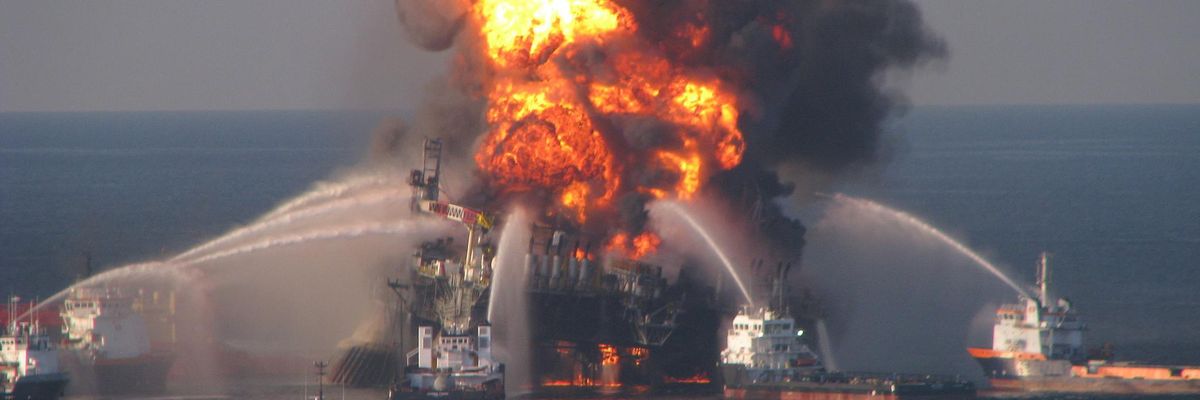
The Deepwater Horizon oil spill, found to be partially caused by lax safety regulations, killed 11 people and injured 16. (Photo: Florida Sea Grant/Flickr/cc)
The oil and gas industry is poised to save hundreds of millions of dollars over the next decade thanks to a rollback of offshore drilling safety regulations that have been proposed by the Trump administration--including the elimination of the word "safe" from one rule.
The rules in question were put in place following the Deepwater Horizon explosion in 2010, which killed 11 people, injured 16, and caused the worst oil spill in U.S. history.
Siding with the fossil fuel industry, which has complained safety regulations are overly broad, the Bureau of Safety and Environmental Enforcement (BSEE) has proposed scrapping or changing some major requirements, according to the Wall Street Journal. The rules to be changed include one that orders companies to take steps to prevent oil-well blowouts, part of what caused British Petroleum's (BP) Deepwater Horizon disaster.
The BSEE argued that the word "safe" should be taken out of the rule, to stop regulators from "interpreting the term in a way to withhold certain drilling permits."
The bureau also proposed eliminating a rule that requires a third party to inspect drilling equipment, like the blowout preventor which failed just before the BP explosion.
The rollback "is literally going back to business as usual," a former federal official told the Journal, which obtained the BSEE's proposal.
The oil and gas industry is expected to save about $900 million over the next decade if the proposal is adopted. Fossil fuel companies rake in more than $100 billion in revenue per year, making the annual savings comparatively minor--but as critics and politicians pointed out on social media, the elimination of the Obama-era safety regulations could cost lives as the BP disaster did.
Dear Common Dreams reader, It’s been nearly 30 years since I co-founded Common Dreams with my late wife, Lina Newhouser. We had the radical notion that journalism should serve the public good, not corporate profits. It was clear to us from the outset what it would take to build such a project. No paid advertisements. No corporate sponsors. No millionaire publisher telling us what to think or do. Many people said we wouldn't last a year, but we proved those doubters wrong. Together with a tremendous team of journalists and dedicated staff, we built an independent media outlet free from the constraints of profits and corporate control. Our mission has always been simple: To inform. To inspire. To ignite change for the common good. Building Common Dreams was not easy. Our survival was never guaranteed. When you take on the most powerful forces—Wall Street greed, fossil fuel industry destruction, Big Tech lobbyists, and uber-rich oligarchs who have spent billions upon billions rigging the economy and democracy in their favor—the only bulwark you have is supporters who believe in your work. But here’s the urgent message from me today. It's never been this bad out there. And it's never been this hard to keep us going. At the very moment Common Dreams is most needed, the threats we face are intensifying. We need your support now more than ever. We don't accept corporate advertising and never will. We don't have a paywall because we don't think people should be blocked from critical news based on their ability to pay. Everything we do is funded by the donations of readers like you. When everyone does the little they can afford, we are strong. But if that support retreats or dries up, so do we. Will you donate now to make sure Common Dreams not only survives but thrives? —Craig Brown, Co-founder |
The oil and gas industry is poised to save hundreds of millions of dollars over the next decade thanks to a rollback of offshore drilling safety regulations that have been proposed by the Trump administration--including the elimination of the word "safe" from one rule.
The rules in question were put in place following the Deepwater Horizon explosion in 2010, which killed 11 people, injured 16, and caused the worst oil spill in U.S. history.
Siding with the fossil fuel industry, which has complained safety regulations are overly broad, the Bureau of Safety and Environmental Enforcement (BSEE) has proposed scrapping or changing some major requirements, according to the Wall Street Journal. The rules to be changed include one that orders companies to take steps to prevent oil-well blowouts, part of what caused British Petroleum's (BP) Deepwater Horizon disaster.
The BSEE argued that the word "safe" should be taken out of the rule, to stop regulators from "interpreting the term in a way to withhold certain drilling permits."
The bureau also proposed eliminating a rule that requires a third party to inspect drilling equipment, like the blowout preventor which failed just before the BP explosion.
The rollback "is literally going back to business as usual," a former federal official told the Journal, which obtained the BSEE's proposal.
The oil and gas industry is expected to save about $900 million over the next decade if the proposal is adopted. Fossil fuel companies rake in more than $100 billion in revenue per year, making the annual savings comparatively minor--but as critics and politicians pointed out on social media, the elimination of the Obama-era safety regulations could cost lives as the BP disaster did.
The oil and gas industry is poised to save hundreds of millions of dollars over the next decade thanks to a rollback of offshore drilling safety regulations that have been proposed by the Trump administration--including the elimination of the word "safe" from one rule.
The rules in question were put in place following the Deepwater Horizon explosion in 2010, which killed 11 people, injured 16, and caused the worst oil spill in U.S. history.
Siding with the fossil fuel industry, which has complained safety regulations are overly broad, the Bureau of Safety and Environmental Enforcement (BSEE) has proposed scrapping or changing some major requirements, according to the Wall Street Journal. The rules to be changed include one that orders companies to take steps to prevent oil-well blowouts, part of what caused British Petroleum's (BP) Deepwater Horizon disaster.
The BSEE argued that the word "safe" should be taken out of the rule, to stop regulators from "interpreting the term in a way to withhold certain drilling permits."
The bureau also proposed eliminating a rule that requires a third party to inspect drilling equipment, like the blowout preventor which failed just before the BP explosion.
The rollback "is literally going back to business as usual," a former federal official told the Journal, which obtained the BSEE's proposal.
The oil and gas industry is expected to save about $900 million over the next decade if the proposal is adopted. Fossil fuel companies rake in more than $100 billion in revenue per year, making the annual savings comparatively minor--but as critics and politicians pointed out on social media, the elimination of the Obama-era safety regulations could cost lives as the BP disaster did.