SUBSCRIBE TO OUR FREE NEWSLETTER
Daily news & progressive opinion—funded by the people, not the corporations—delivered straight to your inbox.
5
#000000
#FFFFFF
To donate by check, phone, or other method, see our More Ways to Give page.
Daily news & progressive opinion—funded by the people, not the corporations—delivered straight to your inbox.
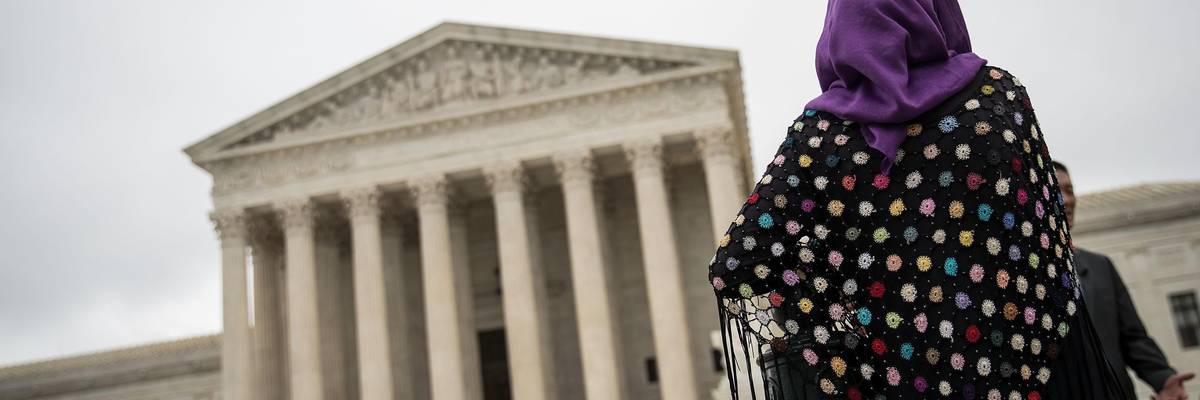
A woman wearing a hijab stands outside the U.S. Supreme Court, October 11, 2017 in Washington, DC. On Monday, the U.S. Supreme Court issued an order allowing the Trump administration to fully enforce a ban on travel to the United States by residents of six mostly Muslim countries by lifting injunctions imposed by lower courts. (Photo by Drew Angerer/Getty Images)
This a breaking news development and will be updated...
"Shameful... Another stain added to our nation's history." --Faiza N. Ali, social justice activist
In 7-2 ruling handed down Monday afternoon, the U.S. Supreme Court will allow full enforcement of a ban on travel to the United States by residents of six mostly Muslim countries by lifting injunctions imposed by lower courts.
As the Associated Press reports, "The ban applies to travelers from Chad, Iran, Libya, Somalia, Syria and Yemen. Lower courts had said people from those nations with a claim of a 'bona fide' relationship with someone in the United States could not be kept out of the country. Grandparents, cousins and other relatives were among those courts said could not be excluded."
As the ALCU notes, the ruling does not mean the court has sided with the Trump administration on the merits of the "Muslim Ban" itself--a policy that sparked fierce protests when it was first announced earlier this year and which civil liberties advocates have widely condemned--but instead stayed orders from lower courts which said that enforcement of the ban should be on hold while the various challenges to the policy made their way through the system.
Justices Ruth Bader Ginsburg and Sonia Sotomayor were the two dissenting voices on the bench.
Omar Jadwat, director of the ACLU's Immigrants' Rights Project, had this reaction:
"President Trump's anti-Muslim prejudice is no secret -- he has repeatedly confirmed it, including just last week on Twitter. It's unfortunate that the full ban can move forward for now, but this order does not address the merits of our claims. We continue to stand for freedom, equality, and for those who are unfairly being separated from their loved ones. We will be arguing Friday in the Fourth Circuit that the ban should ultimately be struck down."
Others critics of the ban were swift in expressing their disappointment, but also explained that the order does not contain anything about the court's overall assessment of the case:
Dear Common Dreams reader, It’s been nearly 30 years since I co-founded Common Dreams with my late wife, Lina Newhouser. We had the radical notion that journalism should serve the public good, not corporate profits. It was clear to us from the outset what it would take to build such a project. No paid advertisements. No corporate sponsors. No millionaire publisher telling us what to think or do. Many people said we wouldn't last a year, but we proved those doubters wrong. Together with a tremendous team of journalists and dedicated staff, we built an independent media outlet free from the constraints of profits and corporate control. Our mission has always been simple: To inform. To inspire. To ignite change for the common good. Building Common Dreams was not easy. Our survival was never guaranteed. When you take on the most powerful forces—Wall Street greed, fossil fuel industry destruction, Big Tech lobbyists, and uber-rich oligarchs who have spent billions upon billions rigging the economy and democracy in their favor—the only bulwark you have is supporters who believe in your work. But here’s the urgent message from me today. It's never been this bad out there. And it's never been this hard to keep us going. At the very moment Common Dreams is most needed, the threats we face are intensifying. We need your support now more than ever. We don't accept corporate advertising and never will. We don't have a paywall because we don't think people should be blocked from critical news based on their ability to pay. Everything we do is funded by the donations of readers like you. When everyone does the little they can afford, we are strong. But if that support retreats or dries up, so do we. Will you donate now to make sure Common Dreams not only survives but thrives? —Craig Brown, Co-founder |
This a breaking news development and will be updated...
"Shameful... Another stain added to our nation's history." --Faiza N. Ali, social justice activist
In 7-2 ruling handed down Monday afternoon, the U.S. Supreme Court will allow full enforcement of a ban on travel to the United States by residents of six mostly Muslim countries by lifting injunctions imposed by lower courts.
As the Associated Press reports, "The ban applies to travelers from Chad, Iran, Libya, Somalia, Syria and Yemen. Lower courts had said people from those nations with a claim of a 'bona fide' relationship with someone in the United States could not be kept out of the country. Grandparents, cousins and other relatives were among those courts said could not be excluded."
As the ALCU notes, the ruling does not mean the court has sided with the Trump administration on the merits of the "Muslim Ban" itself--a policy that sparked fierce protests when it was first announced earlier this year and which civil liberties advocates have widely condemned--but instead stayed orders from lower courts which said that enforcement of the ban should be on hold while the various challenges to the policy made their way through the system.
Justices Ruth Bader Ginsburg and Sonia Sotomayor were the two dissenting voices on the bench.
Omar Jadwat, director of the ACLU's Immigrants' Rights Project, had this reaction:
"President Trump's anti-Muslim prejudice is no secret -- he has repeatedly confirmed it, including just last week on Twitter. It's unfortunate that the full ban can move forward for now, but this order does not address the merits of our claims. We continue to stand for freedom, equality, and for those who are unfairly being separated from their loved ones. We will be arguing Friday in the Fourth Circuit that the ban should ultimately be struck down."
Others critics of the ban were swift in expressing their disappointment, but also explained that the order does not contain anything about the court's overall assessment of the case:
This a breaking news development and will be updated...
"Shameful... Another stain added to our nation's history." --Faiza N. Ali, social justice activist
In 7-2 ruling handed down Monday afternoon, the U.S. Supreme Court will allow full enforcement of a ban on travel to the United States by residents of six mostly Muslim countries by lifting injunctions imposed by lower courts.
As the Associated Press reports, "The ban applies to travelers from Chad, Iran, Libya, Somalia, Syria and Yemen. Lower courts had said people from those nations with a claim of a 'bona fide' relationship with someone in the United States could not be kept out of the country. Grandparents, cousins and other relatives were among those courts said could not be excluded."
As the ALCU notes, the ruling does not mean the court has sided with the Trump administration on the merits of the "Muslim Ban" itself--a policy that sparked fierce protests when it was first announced earlier this year and which civil liberties advocates have widely condemned--but instead stayed orders from lower courts which said that enforcement of the ban should be on hold while the various challenges to the policy made their way through the system.
Justices Ruth Bader Ginsburg and Sonia Sotomayor were the two dissenting voices on the bench.
Omar Jadwat, director of the ACLU's Immigrants' Rights Project, had this reaction:
"President Trump's anti-Muslim prejudice is no secret -- he has repeatedly confirmed it, including just last week on Twitter. It's unfortunate that the full ban can move forward for now, but this order does not address the merits of our claims. We continue to stand for freedom, equality, and for those who are unfairly being separated from their loved ones. We will be arguing Friday in the Fourth Circuit that the ban should ultimately be struck down."
Others critics of the ban were swift in expressing their disappointment, but also explained that the order does not contain anything about the court's overall assessment of the case: