SUBSCRIBE TO OUR FREE NEWSLETTER
Daily news & progressive opinion—funded by the people, not the corporations—delivered straight to your inbox.
5
#000000
#FFFFFF
To donate by check, phone, or other method, see our More Ways to Give page.
Daily news & progressive opinion—funded by the people, not the corporations—delivered straight to your inbox.
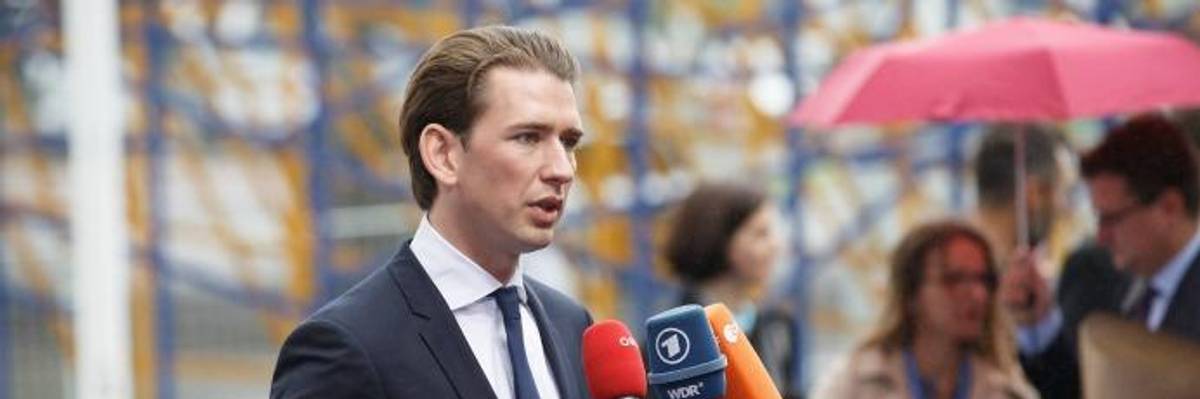
Sebastian Kurz, seen here on Sept. 7, 2017, led his People's Party to apparent victory in Sunday's election. (Photo: Raul Mee (EU2017EE)/flickr/cc)
Preliminary results from Sunday's parliamentary elections in Austria point towards a 31-year-old immigration hardliner becoming the country's next leader and his conservative party forming a coalition with the neo-Nazi linked Freedom Party.
Millennial Sebastian Kurz's People's Party (OVP)--which he's moved further to the right--took in 31.6 percent of the vote, while the Social Democrats and the far-right Freedom Party (FPO) each received about 26 percent of the vote.
Newsweek writes that Kurz "achieved electoral success partly by adopting some of the Freedom Party's positioning on" immigration. That fact was noted by FPO head Heinz-Christian Strache. "I'm feeling somewhat vindicated by the fact that way more than 55 percent have voted for the Freedom Party's platform, because big parts of our program were copied by other parties," he said on a television panel. "We're now the mainstream of society."
The results, the New York Times writes, reflect "the new normal in Europe, where anti-immigration populism and nationalism are challenging the European Union's commitment to open borders for trade and immigration." According to Social Democratic Chancellor Christian Kern, the results reflect "a push to the right."
Kurz, who's been serving as foreign minister since 2013, "appealed to conservative and right-wing voters with pledges to shut down migrant routes to Europe, cap benefit payments to refugees, and bar immigrants from receiving benefits until they have lived in Austria for five years," BBC News reports.
Reuters adds:
For the Freedom Party, forming a coalition with the conservatives would be a milestone in Europe where its sister parties, Germany's AfD and France's National Front, can only dream of joining the cabinet.
When the Freedom Party last entered government in 2000, also with the conservatives, the EU imposed sanctions on Austria.
"I hope that many (in the European parliament) will understand that the topics we are running with have strong support among the population," said Harald Vilimsky, the FPO's most prominent EU parliamentarian.
"But in a measure of how far Europe has shifted to the right," the Washington Post notes, "no one is contemplating sanctions today."
According to democracy advocate and Munich-based engineer Bogdan Gradinaru, Austria "plays a very important role in mirroring emerging trends in Europe," and the election outcome should serve as "a wake-up call for progressive movements... to push harder and stronger for their positions."
A final tally of the votes is expected Thursday.
Dear Common Dreams reader, It’s been nearly 30 years since I co-founded Common Dreams with my late wife, Lina Newhouser. We had the radical notion that journalism should serve the public good, not corporate profits. It was clear to us from the outset what it would take to build such a project. No paid advertisements. No corporate sponsors. No millionaire publisher telling us what to think or do. Many people said we wouldn't last a year, but we proved those doubters wrong. Together with a tremendous team of journalists and dedicated staff, we built an independent media outlet free from the constraints of profits and corporate control. Our mission has always been simple: To inform. To inspire. To ignite change for the common good. Building Common Dreams was not easy. Our survival was never guaranteed. When you take on the most powerful forces—Wall Street greed, fossil fuel industry destruction, Big Tech lobbyists, and uber-rich oligarchs who have spent billions upon billions rigging the economy and democracy in their favor—the only bulwark you have is supporters who believe in your work. But here’s the urgent message from me today. It's never been this bad out there. And it's never been this hard to keep us going. At the very moment Common Dreams is most needed, the threats we face are intensifying. We need your support now more than ever. We don't accept corporate advertising and never will. We don't have a paywall because we don't think people should be blocked from critical news based on their ability to pay. Everything we do is funded by the donations of readers like you. When everyone does the little they can afford, we are strong. But if that support retreats or dries up, so do we. Will you donate now to make sure Common Dreams not only survives but thrives? —Craig Brown, Co-founder |
Preliminary results from Sunday's parliamentary elections in Austria point towards a 31-year-old immigration hardliner becoming the country's next leader and his conservative party forming a coalition with the neo-Nazi linked Freedom Party.
Millennial Sebastian Kurz's People's Party (OVP)--which he's moved further to the right--took in 31.6 percent of the vote, while the Social Democrats and the far-right Freedom Party (FPO) each received about 26 percent of the vote.
Newsweek writes that Kurz "achieved electoral success partly by adopting some of the Freedom Party's positioning on" immigration. That fact was noted by FPO head Heinz-Christian Strache. "I'm feeling somewhat vindicated by the fact that way more than 55 percent have voted for the Freedom Party's platform, because big parts of our program were copied by other parties," he said on a television panel. "We're now the mainstream of society."
The results, the New York Times writes, reflect "the new normal in Europe, where anti-immigration populism and nationalism are challenging the European Union's commitment to open borders for trade and immigration." According to Social Democratic Chancellor Christian Kern, the results reflect "a push to the right."
Kurz, who's been serving as foreign minister since 2013, "appealed to conservative and right-wing voters with pledges to shut down migrant routes to Europe, cap benefit payments to refugees, and bar immigrants from receiving benefits until they have lived in Austria for five years," BBC News reports.
Reuters adds:
For the Freedom Party, forming a coalition with the conservatives would be a milestone in Europe where its sister parties, Germany's AfD and France's National Front, can only dream of joining the cabinet.
When the Freedom Party last entered government in 2000, also with the conservatives, the EU imposed sanctions on Austria.
"I hope that many (in the European parliament) will understand that the topics we are running with have strong support among the population," said Harald Vilimsky, the FPO's most prominent EU parliamentarian.
"But in a measure of how far Europe has shifted to the right," the Washington Post notes, "no one is contemplating sanctions today."
According to democracy advocate and Munich-based engineer Bogdan Gradinaru, Austria "plays a very important role in mirroring emerging trends in Europe," and the election outcome should serve as "a wake-up call for progressive movements... to push harder and stronger for their positions."
A final tally of the votes is expected Thursday.
Preliminary results from Sunday's parliamentary elections in Austria point towards a 31-year-old immigration hardliner becoming the country's next leader and his conservative party forming a coalition with the neo-Nazi linked Freedom Party.
Millennial Sebastian Kurz's People's Party (OVP)--which he's moved further to the right--took in 31.6 percent of the vote, while the Social Democrats and the far-right Freedom Party (FPO) each received about 26 percent of the vote.
Newsweek writes that Kurz "achieved electoral success partly by adopting some of the Freedom Party's positioning on" immigration. That fact was noted by FPO head Heinz-Christian Strache. "I'm feeling somewhat vindicated by the fact that way more than 55 percent have voted for the Freedom Party's platform, because big parts of our program were copied by other parties," he said on a television panel. "We're now the mainstream of society."
The results, the New York Times writes, reflect "the new normal in Europe, where anti-immigration populism and nationalism are challenging the European Union's commitment to open borders for trade and immigration." According to Social Democratic Chancellor Christian Kern, the results reflect "a push to the right."
Kurz, who's been serving as foreign minister since 2013, "appealed to conservative and right-wing voters with pledges to shut down migrant routes to Europe, cap benefit payments to refugees, and bar immigrants from receiving benefits until they have lived in Austria for five years," BBC News reports.
Reuters adds:
For the Freedom Party, forming a coalition with the conservatives would be a milestone in Europe where its sister parties, Germany's AfD and France's National Front, can only dream of joining the cabinet.
When the Freedom Party last entered government in 2000, also with the conservatives, the EU imposed sanctions on Austria.
"I hope that many (in the European parliament) will understand that the topics we are running with have strong support among the population," said Harald Vilimsky, the FPO's most prominent EU parliamentarian.
"But in a measure of how far Europe has shifted to the right," the Washington Post notes, "no one is contemplating sanctions today."
According to democracy advocate and Munich-based engineer Bogdan Gradinaru, Austria "plays a very important role in mirroring emerging trends in Europe," and the election outcome should serve as "a wake-up call for progressive movements... to push harder and stronger for their positions."
A final tally of the votes is expected Thursday.