

SUBSCRIBE TO OUR FREE NEWSLETTER
Daily news & progressive opinion—funded by the people, not the corporations—delivered straight to your inbox.
5
#000000
#FFFFFF
To donate by check, phone, or other method, see our More Ways to Give page.
Daily news & progressive opinion—funded by the people, not the corporations—delivered straight to your inbox.
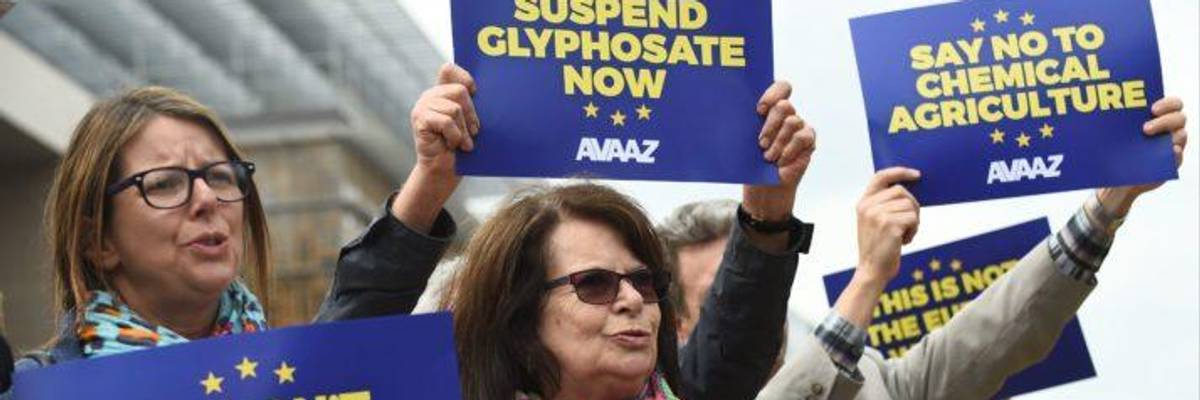
Members of Avaaz civic organization hold up protest signs at the Schuman roundabout in Brussels, in a demonstration against the European Commission's plans to relicense glyphosate. (Photo: John Thys/AFP via Getty Images)
Monsanto lobbyists were officially barred by the European Parliament on Thursday after refusing requests to participate in hearings about the U.S. corporation's efforts to influence regulations of its controversial glyphosate within the 28-nation bloc.
The ban was announced by the parliament's presidential council under rules designed to combat misbehavior by those lobbying the EU's lawmaking body. It is the first time, the Guardian notes, that "MEPs have used new rules to withdraw parliamentary access for firms that ignore a summons to attend parliamentary inquiries or hearings."
The Greens/EFA Group in the parliament, which had requested Monsanto's removal after the biotech giant's refusal, welcomed the decision.
"This is strong democracy. Those who escape democratic accountability must be excluded from access to lobbying," said MEP Sven Giegold, financial and economic policy spokesperson for the Greens/EFA and parliament's rapporteur for Transparency, Accountability and Integrity. "If Monsanto does business in Europe, it must also face up to its responsibilities before the European Parliament."
The Guardian reports:
The lobby ban will be a bitter blow to Monsanto's advocacy campaign ahead of a decision later this year about the relicensing of glyphosate, which has been linked to cancer by one expert WHO panel.
Another deemed it safe for public use, but Monsanto's outreach to regulatory agencies in the US and Europe sparked controversy and prompted the parliamentary hearing.
Philippe Lamberts, president of the Greens/EFA, added, "Those who ignore the rules of democracy also lose their rights as a lobbyist in the European Parliament. US corporations must also accept the democratic control function of the parliament. Monsanto cannot escape this. There remain many uncertainties in the assessment of the pesticide glyphosate. Monsanto has to face the questions of parliamentarians and should not hinder the clarification process."
In response to the decision in Brussels, critics of the powerful company wondered if the U.S. would ever take such measures:
Dear Common Dreams reader, It’s been nearly 30 years since I co-founded Common Dreams with my late wife, Lina Newhouser. We had the radical notion that journalism should serve the public good, not corporate profits. It was clear to us from the outset what it would take to build such a project. No paid advertisements. No corporate sponsors. No millionaire publisher telling us what to think or do. Many people said we wouldn't last a year, but we proved those doubters wrong. Together with a tremendous team of journalists and dedicated staff, we built an independent media outlet free from the constraints of profits and corporate control. Our mission has always been simple: To inform. To inspire. To ignite change for the common good. Building Common Dreams was not easy. Our survival was never guaranteed. When you take on the most powerful forces—Wall Street greed, fossil fuel industry destruction, Big Tech lobbyists, and uber-rich oligarchs who have spent billions upon billions rigging the economy and democracy in their favor—the only bulwark you have is supporters who believe in your work. But here’s the urgent message from me today. It's never been this bad out there. And it's never been this hard to keep us going. At the very moment Common Dreams is most needed, the threats we face are intensifying. We need your support now more than ever. We don't accept corporate advertising and never will. We don't have a paywall because we don't think people should be blocked from critical news based on their ability to pay. Everything we do is funded by the donations of readers like you. When everyone does the little they can afford, we are strong. But if that support retreats or dries up, so do we. Will you donate now to make sure Common Dreams not only survives but thrives? —Craig Brown, Co-founder |
Monsanto lobbyists were officially barred by the European Parliament on Thursday after refusing requests to participate in hearings about the U.S. corporation's efforts to influence regulations of its controversial glyphosate within the 28-nation bloc.
The ban was announced by the parliament's presidential council under rules designed to combat misbehavior by those lobbying the EU's lawmaking body. It is the first time, the Guardian notes, that "MEPs have used new rules to withdraw parliamentary access for firms that ignore a summons to attend parliamentary inquiries or hearings."
The Greens/EFA Group in the parliament, which had requested Monsanto's removal after the biotech giant's refusal, welcomed the decision.
"This is strong democracy. Those who escape democratic accountability must be excluded from access to lobbying," said MEP Sven Giegold, financial and economic policy spokesperson for the Greens/EFA and parliament's rapporteur for Transparency, Accountability and Integrity. "If Monsanto does business in Europe, it must also face up to its responsibilities before the European Parliament."
The Guardian reports:
The lobby ban will be a bitter blow to Monsanto's advocacy campaign ahead of a decision later this year about the relicensing of glyphosate, which has been linked to cancer by one expert WHO panel.
Another deemed it safe for public use, but Monsanto's outreach to regulatory agencies in the US and Europe sparked controversy and prompted the parliamentary hearing.
Philippe Lamberts, president of the Greens/EFA, added, "Those who ignore the rules of democracy also lose their rights as a lobbyist in the European Parliament. US corporations must also accept the democratic control function of the parliament. Monsanto cannot escape this. There remain many uncertainties in the assessment of the pesticide glyphosate. Monsanto has to face the questions of parliamentarians and should not hinder the clarification process."
In response to the decision in Brussels, critics of the powerful company wondered if the U.S. would ever take such measures:
Monsanto lobbyists were officially barred by the European Parliament on Thursday after refusing requests to participate in hearings about the U.S. corporation's efforts to influence regulations of its controversial glyphosate within the 28-nation bloc.
The ban was announced by the parliament's presidential council under rules designed to combat misbehavior by those lobbying the EU's lawmaking body. It is the first time, the Guardian notes, that "MEPs have used new rules to withdraw parliamentary access for firms that ignore a summons to attend parliamentary inquiries or hearings."
The Greens/EFA Group in the parliament, which had requested Monsanto's removal after the biotech giant's refusal, welcomed the decision.
"This is strong democracy. Those who escape democratic accountability must be excluded from access to lobbying," said MEP Sven Giegold, financial and economic policy spokesperson for the Greens/EFA and parliament's rapporteur for Transparency, Accountability and Integrity. "If Monsanto does business in Europe, it must also face up to its responsibilities before the European Parliament."
The Guardian reports:
The lobby ban will be a bitter blow to Monsanto's advocacy campaign ahead of a decision later this year about the relicensing of glyphosate, which has been linked to cancer by one expert WHO panel.
Another deemed it safe for public use, but Monsanto's outreach to regulatory agencies in the US and Europe sparked controversy and prompted the parliamentary hearing.
Philippe Lamberts, president of the Greens/EFA, added, "Those who ignore the rules of democracy also lose their rights as a lobbyist in the European Parliament. US corporations must also accept the democratic control function of the parliament. Monsanto cannot escape this. There remain many uncertainties in the assessment of the pesticide glyphosate. Monsanto has to face the questions of parliamentarians and should not hinder the clarification process."
In response to the decision in Brussels, critics of the powerful company wondered if the U.S. would ever take such measures:

