SUBSCRIBE TO OUR FREE NEWSLETTER
Daily news & progressive opinion—funded by the people, not the corporations—delivered straight to your inbox.
5
#000000
#FFFFFF
To donate by check, phone, or other method, see our More Ways to Give page.
Daily news & progressive opinion—funded by the people, not the corporations—delivered straight to your inbox.
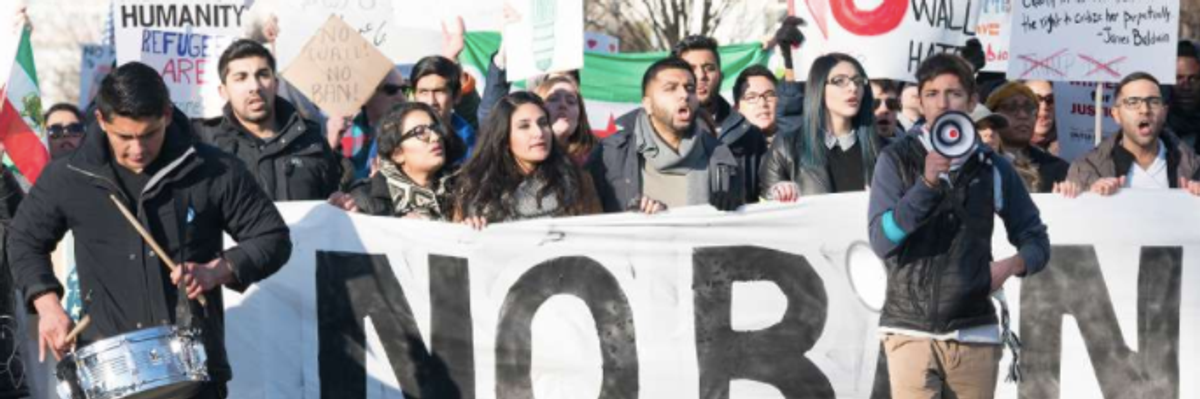
President Trump's proposed ban on travelers from six majority-Muslim nations has been met with widespread protests and legal challenges. (Photo: Victoria Pickering/Flickr/cc)
While no information has been released about the nationalities of two suspects in Friday's subway bombing in London, national security advisor H.R. McMaster indicated Sunday that the Trump administration is eager to use the attack to bolster its argument for a ban on travelers from six majority-Muslim countries.
Appearing on ABC's "This Week" Sunday morning, McMaster said the White House is examining "how to protect the American people better, how to ensure that we know who these people are who are moving."
His comments came two says after Trump tweeted about imposing a "larger, tougher, and more specific" ban on travelers to the U.S. than the one he proposed in January. Trump made his comments as authorities were investigating Friday morning's attack and was chastised by British officials for the "unhelpful" remarks.
ISIS claimed responsibility for the attack on Friday but no evidence or proof of its connection has been found.
The travel ban has come up against widespread protests as well as legal challenges, with federal courts blocking the executive order and states filing lawsuits. The Supreme Court allowed a suspension of travel from the six countries in question --Syria, Yemen, Libya, Somalia, Iran, and Sudan--for 90 days, making exceptions for certain family members. Last week, the high court ruled that the travel suspension can apply even to refugees who have connections with resettlement agencies in the United States.
The court will hear arguments next month regarding the constitutionality of President Trump's original ban.
Dear Common Dreams reader, It’s been nearly 30 years since I co-founded Common Dreams with my late wife, Lina Newhouser. We had the radical notion that journalism should serve the public good, not corporate profits. It was clear to us from the outset what it would take to build such a project. No paid advertisements. No corporate sponsors. No millionaire publisher telling us what to think or do. Many people said we wouldn't last a year, but we proved those doubters wrong. Together with a tremendous team of journalists and dedicated staff, we built an independent media outlet free from the constraints of profits and corporate control. Our mission has always been simple: To inform. To inspire. To ignite change for the common good. Building Common Dreams was not easy. Our survival was never guaranteed. When you take on the most powerful forces—Wall Street greed, fossil fuel industry destruction, Big Tech lobbyists, and uber-rich oligarchs who have spent billions upon billions rigging the economy and democracy in their favor—the only bulwark you have is supporters who believe in your work. But here’s the urgent message from me today. It's never been this bad out there. And it's never been this hard to keep us going. At the very moment Common Dreams is most needed, the threats we face are intensifying. We need your support now more than ever. We don't accept corporate advertising and never will. We don't have a paywall because we don't think people should be blocked from critical news based on their ability to pay. Everything we do is funded by the donations of readers like you. When everyone does the little they can afford, we are strong. But if that support retreats or dries up, so do we. Will you donate now to make sure Common Dreams not only survives but thrives? —Craig Brown, Co-founder |
While no information has been released about the nationalities of two suspects in Friday's subway bombing in London, national security advisor H.R. McMaster indicated Sunday that the Trump administration is eager to use the attack to bolster its argument for a ban on travelers from six majority-Muslim countries.
Appearing on ABC's "This Week" Sunday morning, McMaster said the White House is examining "how to protect the American people better, how to ensure that we know who these people are who are moving."
His comments came two says after Trump tweeted about imposing a "larger, tougher, and more specific" ban on travelers to the U.S. than the one he proposed in January. Trump made his comments as authorities were investigating Friday morning's attack and was chastised by British officials for the "unhelpful" remarks.
ISIS claimed responsibility for the attack on Friday but no evidence or proof of its connection has been found.
The travel ban has come up against widespread protests as well as legal challenges, with federal courts blocking the executive order and states filing lawsuits. The Supreme Court allowed a suspension of travel from the six countries in question --Syria, Yemen, Libya, Somalia, Iran, and Sudan--for 90 days, making exceptions for certain family members. Last week, the high court ruled that the travel suspension can apply even to refugees who have connections with resettlement agencies in the United States.
The court will hear arguments next month regarding the constitutionality of President Trump's original ban.
While no information has been released about the nationalities of two suspects in Friday's subway bombing in London, national security advisor H.R. McMaster indicated Sunday that the Trump administration is eager to use the attack to bolster its argument for a ban on travelers from six majority-Muslim countries.
Appearing on ABC's "This Week" Sunday morning, McMaster said the White House is examining "how to protect the American people better, how to ensure that we know who these people are who are moving."
His comments came two says after Trump tweeted about imposing a "larger, tougher, and more specific" ban on travelers to the U.S. than the one he proposed in January. Trump made his comments as authorities were investigating Friday morning's attack and was chastised by British officials for the "unhelpful" remarks.
ISIS claimed responsibility for the attack on Friday but no evidence or proof of its connection has been found.
The travel ban has come up against widespread protests as well as legal challenges, with federal courts blocking the executive order and states filing lawsuits. The Supreme Court allowed a suspension of travel from the six countries in question --Syria, Yemen, Libya, Somalia, Iran, and Sudan--for 90 days, making exceptions for certain family members. Last week, the high court ruled that the travel suspension can apply even to refugees who have connections with resettlement agencies in the United States.
The court will hear arguments next month regarding the constitutionality of President Trump's original ban.