

SUBSCRIBE TO OUR FREE NEWSLETTER
Daily news & progressive opinion—funded by the people, not the corporations—delivered straight to your inbox.
5
#000000
#FFFFFF
To donate by check, phone, or other method, see our More Ways to Give page.
Daily news & progressive opinion—funded by the people, not the corporations—delivered straight to your inbox.
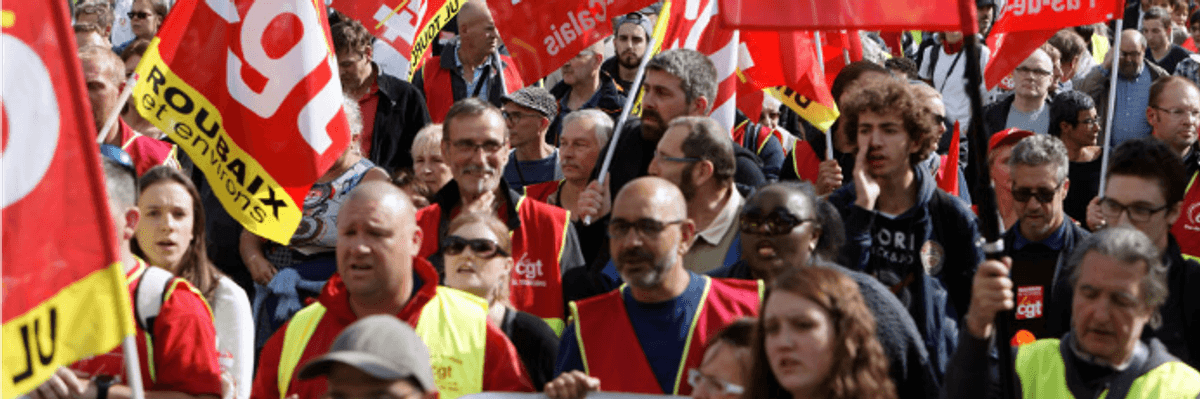
Demonstrators walk during a protest against the labor reform on September 12, 2017 in Paris, France. (Photo: Sylvain Lefevre/Getty Images)
As French President Emmanuel Macron seeks to ram through pro-business labor reforms that would weaken the bargaining power of workers and make it easier for companies to fire employees, tens of thousands of workers and students took to the streets across France Tuesday to express their opposition to Macron's agenda.
"We're not expecting the 12th to be a tidal wave, we see it more as a starting point."
--Stephane Enjarlan, Solidaires
Led by the General Confederation of Labor (CGT), France's second largest trade union, demonstrators flooded Paris and other major cities chanting: "Macron you're screwed, the slackers are in the streets."
The "slackers" label came from Macron himself, who in a recent speech vowed to not "give any ground [on his labor reforms], not to slackers, nor cynics, nor hardliners."
Union leaders and France's left opposition seized upon Macron's comments and used them to rally workers ahead of Tuesday's planned actions, which included around 180 protests and 4,000 strikes--the first nationwide demonstrations of Macron's young presidency.
In an interview on Monday, former Socialist Party presidential candidate Benoit Hamon slammed Macron's "slacker" remarks as "insulting" to French workers.
"Lazy people are the independently wealthy, who don't need to work for a living," Hamon retorted. "And a lot of independently wealthy picked Emmanuel Macron as their champion."
Many have criticized Macron's "fast-track" approach to passing the deeply unpopular reforms, which are expected to be finalized later this month. As the Guardian noted on Tuesday, the labor law changes are being "pushed through parliament with record speed using executive orders."
Jean-Luc Melenchon, former presidential candidate and leader of the left party La France Insoumise (France Unbowed), likened Macron's reforms to "a social coup d'etat," and predicted Macron will ultimately "give way" to the opposition.
"My grandparents and great-grandparents fought to have social security, to get rights which are now being stripped away."
--Valerie
"France isn't England," Melenchon concluded.
Protestors also called attention to other pro-business elements of Macron's agenda, including tax cuts for the wealthy, changes to unemployment insurance, and pension reform.
"We don't want protections stripped away so people are forced into precarious, low-wage jobs like they are in Britain or Germany," Valerie, a health assistant from outside Paris, told the Guardian. "My grandparents and great-grandparents fought to have social security, to get rights which are now being stripped away. This is about protecting the French social model."
Overall, the demonstrations and strikes brought as many as 100,000 people into the streets in provincial France and over 60,000 in Paris, leading the CGT to declare the day of action a success.
But as Stephane Enjarlan, national secretary and spokesperson for Solidaires, a group of unions that backed Tuesday's demonstrations, said in an interview with Jacobin, the protests are only the beginning of a long struggle.
"We're not expecting the 12th to be a tidal wave, we see it more as a starting point," Enjarlan concluded. "And we know that this needs to continue in the long-term."
Watch a video of a protest that took place in Chambery, France:
Dear Common Dreams reader, It’s been nearly 30 years since I co-founded Common Dreams with my late wife, Lina Newhouser. We had the radical notion that journalism should serve the public good, not corporate profits. It was clear to us from the outset what it would take to build such a project. No paid advertisements. No corporate sponsors. No millionaire publisher telling us what to think or do. Many people said we wouldn't last a year, but we proved those doubters wrong. Together with a tremendous team of journalists and dedicated staff, we built an independent media outlet free from the constraints of profits and corporate control. Our mission has always been simple: To inform. To inspire. To ignite change for the common good. Building Common Dreams was not easy. Our survival was never guaranteed. When you take on the most powerful forces—Wall Street greed, fossil fuel industry destruction, Big Tech lobbyists, and uber-rich oligarchs who have spent billions upon billions rigging the economy and democracy in their favor—the only bulwark you have is supporters who believe in your work. But here’s the urgent message from me today. It's never been this bad out there. And it's never been this hard to keep us going. At the very moment Common Dreams is most needed, the threats we face are intensifying. We need your support now more than ever. We don't accept corporate advertising and never will. We don't have a paywall because we don't think people should be blocked from critical news based on their ability to pay. Everything we do is funded by the donations of readers like you. When everyone does the little they can afford, we are strong. But if that support retreats or dries up, so do we. Will you donate now to make sure Common Dreams not only survives but thrives? —Craig Brown, Co-founder |
As French President Emmanuel Macron seeks to ram through pro-business labor reforms that would weaken the bargaining power of workers and make it easier for companies to fire employees, tens of thousands of workers and students took to the streets across France Tuesday to express their opposition to Macron's agenda.
"We're not expecting the 12th to be a tidal wave, we see it more as a starting point."
--Stephane Enjarlan, Solidaires
Led by the General Confederation of Labor (CGT), France's second largest trade union, demonstrators flooded Paris and other major cities chanting: "Macron you're screwed, the slackers are in the streets."
The "slackers" label came from Macron himself, who in a recent speech vowed to not "give any ground [on his labor reforms], not to slackers, nor cynics, nor hardliners."
Union leaders and France's left opposition seized upon Macron's comments and used them to rally workers ahead of Tuesday's planned actions, which included around 180 protests and 4,000 strikes--the first nationwide demonstrations of Macron's young presidency.
In an interview on Monday, former Socialist Party presidential candidate Benoit Hamon slammed Macron's "slacker" remarks as "insulting" to French workers.
"Lazy people are the independently wealthy, who don't need to work for a living," Hamon retorted. "And a lot of independently wealthy picked Emmanuel Macron as their champion."
Many have criticized Macron's "fast-track" approach to passing the deeply unpopular reforms, which are expected to be finalized later this month. As the Guardian noted on Tuesday, the labor law changes are being "pushed through parliament with record speed using executive orders."
Jean-Luc Melenchon, former presidential candidate and leader of the left party La France Insoumise (France Unbowed), likened Macron's reforms to "a social coup d'etat," and predicted Macron will ultimately "give way" to the opposition.
"My grandparents and great-grandparents fought to have social security, to get rights which are now being stripped away."
--Valerie
"France isn't England," Melenchon concluded.
Protestors also called attention to other pro-business elements of Macron's agenda, including tax cuts for the wealthy, changes to unemployment insurance, and pension reform.
"We don't want protections stripped away so people are forced into precarious, low-wage jobs like they are in Britain or Germany," Valerie, a health assistant from outside Paris, told the Guardian. "My grandparents and great-grandparents fought to have social security, to get rights which are now being stripped away. This is about protecting the French social model."
Overall, the demonstrations and strikes brought as many as 100,000 people into the streets in provincial France and over 60,000 in Paris, leading the CGT to declare the day of action a success.
But as Stephane Enjarlan, national secretary and spokesperson for Solidaires, a group of unions that backed Tuesday's demonstrations, said in an interview with Jacobin, the protests are only the beginning of a long struggle.
"We're not expecting the 12th to be a tidal wave, we see it more as a starting point," Enjarlan concluded. "And we know that this needs to continue in the long-term."
Watch a video of a protest that took place in Chambery, France:
As French President Emmanuel Macron seeks to ram through pro-business labor reforms that would weaken the bargaining power of workers and make it easier for companies to fire employees, tens of thousands of workers and students took to the streets across France Tuesday to express their opposition to Macron's agenda.
"We're not expecting the 12th to be a tidal wave, we see it more as a starting point."
--Stephane Enjarlan, Solidaires
Led by the General Confederation of Labor (CGT), France's second largest trade union, demonstrators flooded Paris and other major cities chanting: "Macron you're screwed, the slackers are in the streets."
The "slackers" label came from Macron himself, who in a recent speech vowed to not "give any ground [on his labor reforms], not to slackers, nor cynics, nor hardliners."
Union leaders and France's left opposition seized upon Macron's comments and used them to rally workers ahead of Tuesday's planned actions, which included around 180 protests and 4,000 strikes--the first nationwide demonstrations of Macron's young presidency.
In an interview on Monday, former Socialist Party presidential candidate Benoit Hamon slammed Macron's "slacker" remarks as "insulting" to French workers.
"Lazy people are the independently wealthy, who don't need to work for a living," Hamon retorted. "And a lot of independently wealthy picked Emmanuel Macron as their champion."
Many have criticized Macron's "fast-track" approach to passing the deeply unpopular reforms, which are expected to be finalized later this month. As the Guardian noted on Tuesday, the labor law changes are being "pushed through parliament with record speed using executive orders."
Jean-Luc Melenchon, former presidential candidate and leader of the left party La France Insoumise (France Unbowed), likened Macron's reforms to "a social coup d'etat," and predicted Macron will ultimately "give way" to the opposition.
"My grandparents and great-grandparents fought to have social security, to get rights which are now being stripped away."
--Valerie
"France isn't England," Melenchon concluded.
Protestors also called attention to other pro-business elements of Macron's agenda, including tax cuts for the wealthy, changes to unemployment insurance, and pension reform.
"We don't want protections stripped away so people are forced into precarious, low-wage jobs like they are in Britain or Germany," Valerie, a health assistant from outside Paris, told the Guardian. "My grandparents and great-grandparents fought to have social security, to get rights which are now being stripped away. This is about protecting the French social model."
Overall, the demonstrations and strikes brought as many as 100,000 people into the streets in provincial France and over 60,000 in Paris, leading the CGT to declare the day of action a success.
But as Stephane Enjarlan, national secretary and spokesperson for Solidaires, a group of unions that backed Tuesday's demonstrations, said in an interview with Jacobin, the protests are only the beginning of a long struggle.
"We're not expecting the 12th to be a tidal wave, we see it more as a starting point," Enjarlan concluded. "And we know that this needs to continue in the long-term."
Watch a video of a protest that took place in Chambery, France:

