SUBSCRIBE TO OUR FREE NEWSLETTER
Daily news & progressive opinion—funded by the people, not the corporations—delivered straight to your inbox.
5
#000000
#FFFFFF
To donate by check, phone, or other method, see our More Ways to Give page.
Daily news & progressive opinion—funded by the people, not the corporations—delivered straight to your inbox.
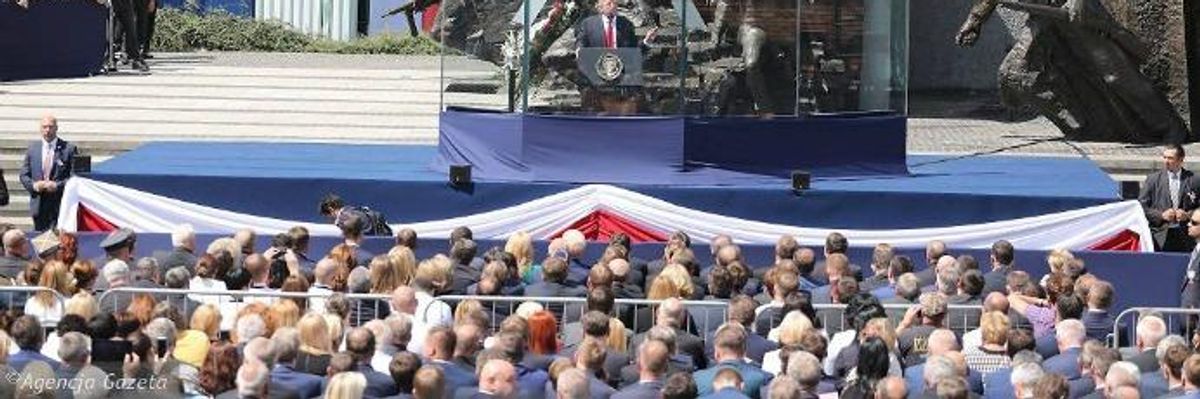
Trump returned to "the same life-or-death language as his inauguration speech, which promised a war against the 'American carnage' of urban crime," noted Julie Hirschfeld Davis of the New York Times. (Photo: Slawomir Kaminski/Agenja Gazeta)
During a speech at the site of the Warsaw Uprising Monument in Poland on Thursday, President Donald Trump proclaimed in terms some characterized as "disturbing" that "the fundamental question of our time is whether the West has the will to survive."
Speaking before an audience of close to 15,000 enthusiastic, flag-waving Poles--many of them bused in by Poland's ruling right-wing Law and Justice Party--Trump returned to "the same life-or-death language as his inauguration speech, which promised a war against the 'American carnage' of urban crime," noted Julie Hirschfeld Davis of the New York Times.
"Do we have the confidence in our values to defend them at any cost?" Trump asked. "Do we have enough respect for our citizens to protect our borders? Do we have the desire and the courage to preserve our civilization in the face of those who would subvert and destroy it?"
Many observed that the speech was noticeably "Bannonesque," with its stark good-versus-evil imagery and its invocation of a battle of civilizations. The speech, argued Vox's Sarah Wildman, "sounded like an alt-right manifesto."
Others, however, detected a more ominous current running beneath Trump's words, which were delivered in a nation governed by a fervently nationalistic party that has sparked fierce and widespread protests for what critics view as a sharp drift away from democracy.
Honing in on Trump's repeated emphasis on "the will" and his declaration that "our civilization will triumph," many made connections between the speech and an infamous 1935 Nazi propaganda film titled "Triumph of the Will," which was directed by Leni Riefenstahl and based on the 1934 Nuremberg Rally.
Though the curated crowd responded to Trump's words with raucous praise and the waving of flags, there were dissenters.
Most notable, The Guardian observed, was a "small left-wing party [that] held a protest with activists dressed as women from The Handmaid's Tale, an American TV drama series based on a novel about a future totalitarian society, in protest over Trump's treatment of women."
Dear Common Dreams reader, It’s been nearly 30 years since I co-founded Common Dreams with my late wife, Lina Newhouser. We had the radical notion that journalism should serve the public good, not corporate profits. It was clear to us from the outset what it would take to build such a project. No paid advertisements. No corporate sponsors. No millionaire publisher telling us what to think or do. Many people said we wouldn't last a year, but we proved those doubters wrong. Together with a tremendous team of journalists and dedicated staff, we built an independent media outlet free from the constraints of profits and corporate control. Our mission has always been simple: To inform. To inspire. To ignite change for the common good. Building Common Dreams was not easy. Our survival was never guaranteed. When you take on the most powerful forces—Wall Street greed, fossil fuel industry destruction, Big Tech lobbyists, and uber-rich oligarchs who have spent billions upon billions rigging the economy and democracy in their favor—the only bulwark you have is supporters who believe in your work. But here’s the urgent message from me today. It's never been this bad out there. And it's never been this hard to keep us going. At the very moment Common Dreams is most needed, the threats we face are intensifying. We need your support now more than ever. We don't accept corporate advertising and never will. We don't have a paywall because we don't think people should be blocked from critical news based on their ability to pay. Everything we do is funded by the donations of readers like you. When everyone does the little they can afford, we are strong. But if that support retreats or dries up, so do we. Will you donate now to make sure Common Dreams not only survives but thrives? —Craig Brown, Co-founder |
During a speech at the site of the Warsaw Uprising Monument in Poland on Thursday, President Donald Trump proclaimed in terms some characterized as "disturbing" that "the fundamental question of our time is whether the West has the will to survive."
Speaking before an audience of close to 15,000 enthusiastic, flag-waving Poles--many of them bused in by Poland's ruling right-wing Law and Justice Party--Trump returned to "the same life-or-death language as his inauguration speech, which promised a war against the 'American carnage' of urban crime," noted Julie Hirschfeld Davis of the New York Times.
"Do we have the confidence in our values to defend them at any cost?" Trump asked. "Do we have enough respect for our citizens to protect our borders? Do we have the desire and the courage to preserve our civilization in the face of those who would subvert and destroy it?"
Many observed that the speech was noticeably "Bannonesque," with its stark good-versus-evil imagery and its invocation of a battle of civilizations. The speech, argued Vox's Sarah Wildman, "sounded like an alt-right manifesto."
Others, however, detected a more ominous current running beneath Trump's words, which were delivered in a nation governed by a fervently nationalistic party that has sparked fierce and widespread protests for what critics view as a sharp drift away from democracy.
Honing in on Trump's repeated emphasis on "the will" and his declaration that "our civilization will triumph," many made connections between the speech and an infamous 1935 Nazi propaganda film titled "Triumph of the Will," which was directed by Leni Riefenstahl and based on the 1934 Nuremberg Rally.
Though the curated crowd responded to Trump's words with raucous praise and the waving of flags, there were dissenters.
Most notable, The Guardian observed, was a "small left-wing party [that] held a protest with activists dressed as women from The Handmaid's Tale, an American TV drama series based on a novel about a future totalitarian society, in protest over Trump's treatment of women."
During a speech at the site of the Warsaw Uprising Monument in Poland on Thursday, President Donald Trump proclaimed in terms some characterized as "disturbing" that "the fundamental question of our time is whether the West has the will to survive."
Speaking before an audience of close to 15,000 enthusiastic, flag-waving Poles--many of them bused in by Poland's ruling right-wing Law and Justice Party--Trump returned to "the same life-or-death language as his inauguration speech, which promised a war against the 'American carnage' of urban crime," noted Julie Hirschfeld Davis of the New York Times.
"Do we have the confidence in our values to defend them at any cost?" Trump asked. "Do we have enough respect for our citizens to protect our borders? Do we have the desire and the courage to preserve our civilization in the face of those who would subvert and destroy it?"
Many observed that the speech was noticeably "Bannonesque," with its stark good-versus-evil imagery and its invocation of a battle of civilizations. The speech, argued Vox's Sarah Wildman, "sounded like an alt-right manifesto."
Others, however, detected a more ominous current running beneath Trump's words, which were delivered in a nation governed by a fervently nationalistic party that has sparked fierce and widespread protests for what critics view as a sharp drift away from democracy.
Honing in on Trump's repeated emphasis on "the will" and his declaration that "our civilization will triumph," many made connections between the speech and an infamous 1935 Nazi propaganda film titled "Triumph of the Will," which was directed by Leni Riefenstahl and based on the 1934 Nuremberg Rally.
Though the curated crowd responded to Trump's words with raucous praise and the waving of flags, there were dissenters.
Most notable, The Guardian observed, was a "small left-wing party [that] held a protest with activists dressed as women from The Handmaid's Tale, an American TV drama series based on a novel about a future totalitarian society, in protest over Trump's treatment of women."