




SUBSCRIBE TO OUR FREE NEWSLETTER
Daily news & progressive opinion—funded by the people, not the corporations—delivered straight to your inbox.
5
#000000
#FFFFFF
To donate by check, phone, or other method, see our More Ways to Give page.
Daily news & progressive opinion—funded by the people, not the corporations—delivered straight to your inbox.
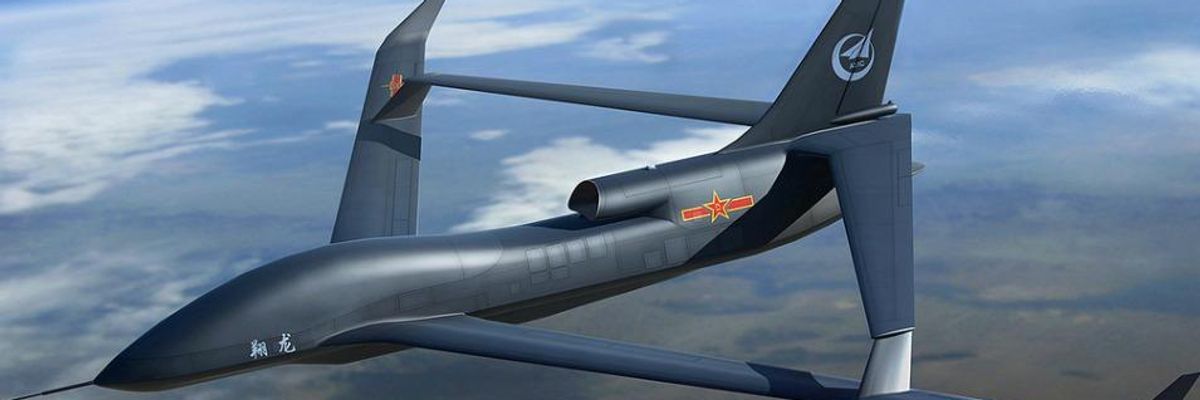
Conceptual drawing of a Chinese prototype drone. (Image: Headline Digest)
Near and far... the proliferation of drones is coming.
With the Federal Aviation Administration facing pressure from corporate interests and drone manufacturers to make room in the skies over the United States, the push for industry-friendly regulations is now in full gear.
Meanwhile, foreign governments are rapidly developing their own technology to make sure the era of the unmanned aircraft--so far dominated by the U.S. military--does not leave them stranded on the ground, both literally and strategically.
Though critics of the U.S. government's use of drones on foreign battlefields (not to mention over foreign nations with whom the U.S. is not at war) have focused on human rights violations and international law, the concern over domestic drones has been more intent on addressing privacy issues and the threat that so-called "full spectrum surveillance" could ultimately have on society. But with the FAA now considering new rules that would regulate the use of recreational and commercial drones, the corporate lobbyists are in full swing to make sure those rules conform to their vision of new profit streams.
As Bloomberg reports, some of the nation's largest companies--including Amazon, American International Group Inc., Chevron Corp. and BNSF Railway Co.--have no intention of letting the opportunity pass them by:
While Amazon works on futuristic cargo carriers, other companies are seeking less-restrictive rules as they begin to get unmanned aerial vehicles into U.S. skies.
"I don't think any of us are out to do this because it's a cool thing to do," Lynden Tennison, Union Pacific's chief information officer, said in an interview. "We're out to do it because we believe it has business benefits."
Drones' potential will be a centerpiece this week in Atlanta as manufacturers and users gather for the annual trade show for the Association for Unmanned Vehicle Systems International. The FAA will be urged to move quickly on permanent rules.
At the same time, Business Insider, journalist Jeremy Bender describes how other industrial powers--namely China, Russia and other military powerhouses--are hard at work developing their own technology to compete with the U.S.:
The US, which has been at the forefront of unmanned aerial vehicle technology, will soon have to adjust to a world in which a wide range of armed forces and potential adversaries have drones as well.
According to Ian Bremmer, president of political-risk consultancy Eurasia Group, the technological gap that allowed the US to enjoy coercive diplomatic advantages over its rivals is rapidly shrinking. Drones are no exception.
"China has moved the most quickly to develop significant drone capabilities and will start deploying them to support their national security capabilities," Bremmer wrote in a recent note provided to Business Insider.
"China will also face much the same backlash from the international community as we start to see unintended civilian casualties as a consequence of expansive Beijing-led drone use," he added. "But it will set off the strong proliferation of another disruptive technology."
Donald Trump’s attacks on democracy, justice, and a free press are escalating — putting everything we stand for at risk. We believe a better world is possible, but we can’t get there without your support. Common Dreams stands apart. We answer only to you — our readers, activists, and changemakers — not to billionaires or corporations. Our independence allows us to cover the vital stories that others won’t, spotlighting movements for peace, equality, and human rights. Right now, our work faces unprecedented challenges. Misinformation is spreading, journalists are under attack, and financial pressures are mounting. As a reader-supported, nonprofit newsroom, your support is crucial to keep this journalism alive. Whatever you can give — $10, $25, or $100 — helps us stay strong and responsive when the world needs us most. Together, we’ll continue to build the independent, courageous journalism our movement relies on. Thank you for being part of this community. |
Near and far... the proliferation of drones is coming.
With the Federal Aviation Administration facing pressure from corporate interests and drone manufacturers to make room in the skies over the United States, the push for industry-friendly regulations is now in full gear.
Meanwhile, foreign governments are rapidly developing their own technology to make sure the era of the unmanned aircraft--so far dominated by the U.S. military--does not leave them stranded on the ground, both literally and strategically.
Though critics of the U.S. government's use of drones on foreign battlefields (not to mention over foreign nations with whom the U.S. is not at war) have focused on human rights violations and international law, the concern over domestic drones has been more intent on addressing privacy issues and the threat that so-called "full spectrum surveillance" could ultimately have on society. But with the FAA now considering new rules that would regulate the use of recreational and commercial drones, the corporate lobbyists are in full swing to make sure those rules conform to their vision of new profit streams.
As Bloomberg reports, some of the nation's largest companies--including Amazon, American International Group Inc., Chevron Corp. and BNSF Railway Co.--have no intention of letting the opportunity pass them by:
While Amazon works on futuristic cargo carriers, other companies are seeking less-restrictive rules as they begin to get unmanned aerial vehicles into U.S. skies.
"I don't think any of us are out to do this because it's a cool thing to do," Lynden Tennison, Union Pacific's chief information officer, said in an interview. "We're out to do it because we believe it has business benefits."
Drones' potential will be a centerpiece this week in Atlanta as manufacturers and users gather for the annual trade show for the Association for Unmanned Vehicle Systems International. The FAA will be urged to move quickly on permanent rules.
At the same time, Business Insider, journalist Jeremy Bender describes how other industrial powers--namely China, Russia and other military powerhouses--are hard at work developing their own technology to compete with the U.S.:
The US, which has been at the forefront of unmanned aerial vehicle technology, will soon have to adjust to a world in which a wide range of armed forces and potential adversaries have drones as well.
According to Ian Bremmer, president of political-risk consultancy Eurasia Group, the technological gap that allowed the US to enjoy coercive diplomatic advantages over its rivals is rapidly shrinking. Drones are no exception.
"China has moved the most quickly to develop significant drone capabilities and will start deploying them to support their national security capabilities," Bremmer wrote in a recent note provided to Business Insider.
"China will also face much the same backlash from the international community as we start to see unintended civilian casualties as a consequence of expansive Beijing-led drone use," he added. "But it will set off the strong proliferation of another disruptive technology."
Near and far... the proliferation of drones is coming.
With the Federal Aviation Administration facing pressure from corporate interests and drone manufacturers to make room in the skies over the United States, the push for industry-friendly regulations is now in full gear.
Meanwhile, foreign governments are rapidly developing their own technology to make sure the era of the unmanned aircraft--so far dominated by the U.S. military--does not leave them stranded on the ground, both literally and strategically.
Though critics of the U.S. government's use of drones on foreign battlefields (not to mention over foreign nations with whom the U.S. is not at war) have focused on human rights violations and international law, the concern over domestic drones has been more intent on addressing privacy issues and the threat that so-called "full spectrum surveillance" could ultimately have on society. But with the FAA now considering new rules that would regulate the use of recreational and commercial drones, the corporate lobbyists are in full swing to make sure those rules conform to their vision of new profit streams.
As Bloomberg reports, some of the nation's largest companies--including Amazon, American International Group Inc., Chevron Corp. and BNSF Railway Co.--have no intention of letting the opportunity pass them by:
While Amazon works on futuristic cargo carriers, other companies are seeking less-restrictive rules as they begin to get unmanned aerial vehicles into U.S. skies.
"I don't think any of us are out to do this because it's a cool thing to do," Lynden Tennison, Union Pacific's chief information officer, said in an interview. "We're out to do it because we believe it has business benefits."
Drones' potential will be a centerpiece this week in Atlanta as manufacturers and users gather for the annual trade show for the Association for Unmanned Vehicle Systems International. The FAA will be urged to move quickly on permanent rules.
At the same time, Business Insider, journalist Jeremy Bender describes how other industrial powers--namely China, Russia and other military powerhouses--are hard at work developing their own technology to compete with the U.S.:
The US, which has been at the forefront of unmanned aerial vehicle technology, will soon have to adjust to a world in which a wide range of armed forces and potential adversaries have drones as well.
According to Ian Bremmer, president of political-risk consultancy Eurasia Group, the technological gap that allowed the US to enjoy coercive diplomatic advantages over its rivals is rapidly shrinking. Drones are no exception.
"China has moved the most quickly to develop significant drone capabilities and will start deploying them to support their national security capabilities," Bremmer wrote in a recent note provided to Business Insider.
"China will also face much the same backlash from the international community as we start to see unintended civilian casualties as a consequence of expansive Beijing-led drone use," he added. "But it will set off the strong proliferation of another disruptive technology."