

SUBSCRIBE TO OUR FREE NEWSLETTER
Daily news & progressive opinion—funded by the people, not the corporations—delivered straight to your inbox.
5
#000000
#FFFFFF
To donate by check, phone, or other method, see our More Ways to Give page.
A coalition of environmental groups is hoping you will share some Valentine's Day love with the bees.
Rounding out what they're calling a Bee Week of Action, groups including Friends of the Earth, Pesticide Action Network and the Xerces Society for Invertebrate Conservation are calling on major retailers Lowe's and Home Depot to stop selling a class of bee-harming pesticides known as neonicotinoids and plants contaminated with them.
A recent study from Friends of the Earth and Pesticide Research Institute found that plants listed as bee-friendly sold by these retail giants may actually be contaminated with neonicotinoids, also known as "neonics."
"It's unnerving that gardeners across the country, looking to grow tomatoes with the help of bees, may be poisoning them instead. It's bad for bees, bad for our food, and bad for our economy," Paul Towers, Organizing & Media Director for Pesticide Action Network, told Common Dreams in an email.
The groups point out how neonics, the most widely used class of pesticides, have been linked to global bee die-offs.
"The science shows that neonicotinoid pesticides play a significant role in the declining health of bees and other beneficial organisms. It is therefore imperative that action be taken to protect these creatures, given the lack of action at the federal regulatory level," Nichelle Harriott, staff scientist at Beyond Pesticides, a group that also joins the campaign, said in a statement.
The campaign is asking people to stand up for these essential pollinators by sending a "valentine" to the stores that urges them to "show bees some love" by stopping the sale of neonics and plants treated with them.
Friends of the Earth says it's already delivered petitions Home Depot and Lowe's this week, and plans to bring more messages to them Saturday.
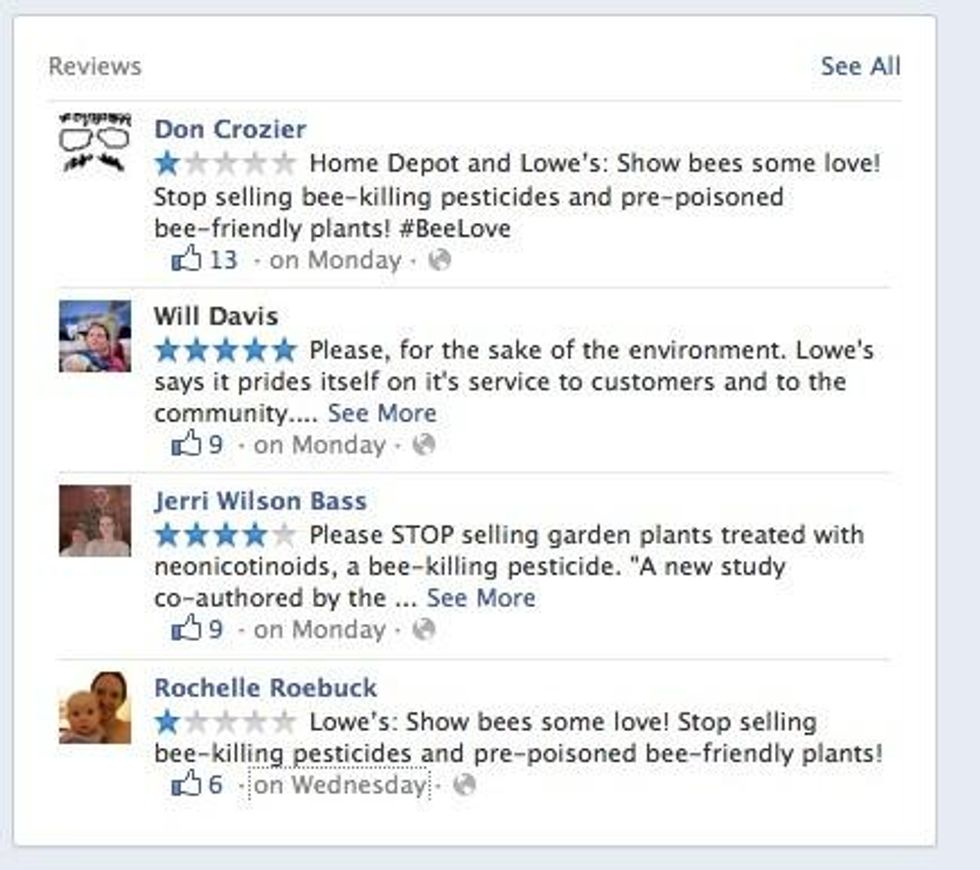
The campaign urges consumers to also call the stores' corporate offices to make their voices heard there as well. Another tactic the campaign suggests is leaving a message on the Facebook pages of the Home Depot and Lowe's with a bee-saving message. A few of the messages people have left can be seen below:
"To help solve the bee crisis," Lisa Archer, director of the food and technology program at Friends of the Earth U.S. stated, "Home Depot and Lowe's need to show bees some love and stop poisoning them with bee-killing pesticides.'
"From backyard garden to almond orchard," Towers added, "bees are critical to successful pollination and a healthy food system."
Friends of the Earth has documented some of the Bee Week of Action including delivering petitions to Home Depot, which you can see in the Flickr photos uploaded by the group below:
_________________
A coalition of environmental groups is hoping you will share some Valentine's Day love with the bees.
Rounding out what they're calling a Bee Week of Action, groups including Friends of the Earth, Pesticide Action Network and the Xerces Society for Invertebrate Conservation are calling on major retailers Lowe's and Home Depot to stop selling a class of bee-harming pesticides known as neonicotinoids and plants contaminated with them.
A recent study from Friends of the Earth and Pesticide Research Institute found that plants listed as bee-friendly sold by these retail giants may actually be contaminated with neonicotinoids, also known as "neonics."
"It's unnerving that gardeners across the country, looking to grow tomatoes with the help of bees, may be poisoning them instead. It's bad for bees, bad for our food, and bad for our economy," Paul Towers, Organizing & Media Director for Pesticide Action Network, told Common Dreams in an email.
The groups point out how neonics, the most widely used class of pesticides, have been linked to global bee die-offs.
"The science shows that neonicotinoid pesticides play a significant role in the declining health of bees and other beneficial organisms. It is therefore imperative that action be taken to protect these creatures, given the lack of action at the federal regulatory level," Nichelle Harriott, staff scientist at Beyond Pesticides, a group that also joins the campaign, said in a statement.
The campaign is asking people to stand up for these essential pollinators by sending a "valentine" to the stores that urges them to "show bees some love" by stopping the sale of neonics and plants treated with them.
Friends of the Earth says it's already delivered petitions Home Depot and Lowe's this week, and plans to bring more messages to them Saturday.
The campaign urges consumers to also call the stores' corporate offices to make their voices heard there as well. Another tactic the campaign suggests is leaving a message on the Facebook pages of the Home Depot and Lowe's with a bee-saving message. A few of the messages people have left can be seen below:
"To help solve the bee crisis," Lisa Archer, director of the food and technology program at Friends of the Earth U.S. stated, "Home Depot and Lowe's need to show bees some love and stop poisoning them with bee-killing pesticides.'
"From backyard garden to almond orchard," Towers added, "bees are critical to successful pollination and a healthy food system."
Friends of the Earth has documented some of the Bee Week of Action including delivering petitions to Home Depot, which you can see in the Flickr photos uploaded by the group below:
_________________
A coalition of environmental groups is hoping you will share some Valentine's Day love with the bees.
Rounding out what they're calling a Bee Week of Action, groups including Friends of the Earth, Pesticide Action Network and the Xerces Society for Invertebrate Conservation are calling on major retailers Lowe's and Home Depot to stop selling a class of bee-harming pesticides known as neonicotinoids and plants contaminated with them.
A recent study from Friends of the Earth and Pesticide Research Institute found that plants listed as bee-friendly sold by these retail giants may actually be contaminated with neonicotinoids, also known as "neonics."
"It's unnerving that gardeners across the country, looking to grow tomatoes with the help of bees, may be poisoning them instead. It's bad for bees, bad for our food, and bad for our economy," Paul Towers, Organizing & Media Director for Pesticide Action Network, told Common Dreams in an email.
The groups point out how neonics, the most widely used class of pesticides, have been linked to global bee die-offs.
"The science shows that neonicotinoid pesticides play a significant role in the declining health of bees and other beneficial organisms. It is therefore imperative that action be taken to protect these creatures, given the lack of action at the federal regulatory level," Nichelle Harriott, staff scientist at Beyond Pesticides, a group that also joins the campaign, said in a statement.
The campaign is asking people to stand up for these essential pollinators by sending a "valentine" to the stores that urges them to "show bees some love" by stopping the sale of neonics and plants treated with them.
Friends of the Earth says it's already delivered petitions Home Depot and Lowe's this week, and plans to bring more messages to them Saturday.
The campaign urges consumers to also call the stores' corporate offices to make their voices heard there as well. Another tactic the campaign suggests is leaving a message on the Facebook pages of the Home Depot and Lowe's with a bee-saving message. A few of the messages people have left can be seen below:
"To help solve the bee crisis," Lisa Archer, director of the food and technology program at Friends of the Earth U.S. stated, "Home Depot and Lowe's need to show bees some love and stop poisoning them with bee-killing pesticides.'
"From backyard garden to almond orchard," Towers added, "bees are critical to successful pollination and a healthy food system."
Friends of the Earth has documented some of the Bee Week of Action including delivering petitions to Home Depot, which you can see in the Flickr photos uploaded by the group below:
_________________

