

The thick smog that has blanketed major cities is not the only menace pollution has unleashed on China.
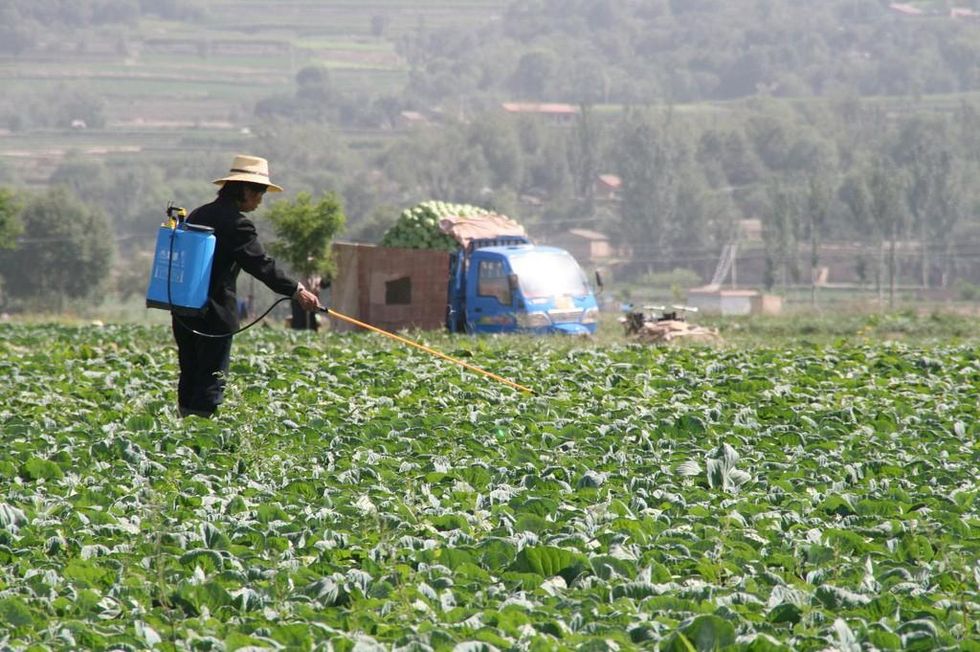
Roughly 8 million acres of the country's farmland is too polluted with heavy metals and pesticides to grow food, a government official said Monday.
Speaking at a news conference, Wang Shiyuan, a deputy minister of the Ministry of Land and Resources, stated that "moderate to severe pollution" affecting 8.3 million acres meant that those "areas cannot continue farming." That acreage represents roughly two percent of the country's acres of arable land.
According to the Associated Press, some scientists have speculated that the affected area may be closer to 60 million acres.
In February, China refused to publicly disclose the results of a national soil pollution study, saying it was a "state secret." The findings outlined Monday represent the first publicly disclosed report on land conditions since 996.
In May, public outcry followed the discovery of cadmium in rice samples above the national limits. The New York Times reported at the time:
Chinese citizens have become increasingly irate about food and beverages tainted with pesticides, illegal preservatives and additives, as well as industrial waste and heavy metals from polluted land and air. The news that this mainstay of the kitchen may also be toxic drew a vehement outcry.
"Now before every meal must we all first wonder: Does this rice have too much cadmium? Are the vegetables laced with pesticide?" one Chinese Internet user wrote on the popular Tencent microblog service. Another wondered whether he was expected to quit rice the same way he quit smoking.
As China deals with food security for its expanding population, some say that the possibility of feeding the country through organic growing methods is not only possible but can be more productive than conventional, pesticide-reliant farming.
"There is no problem to feed the Chinese through organic farming," said Xiangming Wu, General Manager of Zhikun Agricultural Development Company.
Last week China announced revised production standards in an effort to curb pollution, as Reuters reported:
China will raise standards for the production of cement, batteries, leather and heavy metals as part of its efforts to cut air, water and soil pollution, the environment ministry said on Friday. [...]
According to a notice issued by the Ministry of Environmental Protection (www.mep.gov.cn), China produced 2.21 billion tons of cement in 2012, 56 percent of the global total. Beijing aims to close around 370 million tons of outdated capacity by 2015.
_________________
The thick smog that has blanketed major cities is not the only menace pollution has unleashed on China.
Roughly 8 million acres of the country's farmland is too polluted with heavy metals and pesticides to grow food, a government official said Monday.
Speaking at a news conference, Wang Shiyuan, a deputy minister of the Ministry of Land and Resources, stated that "moderate to severe pollution" affecting 8.3 million acres meant that those "areas cannot continue farming." That acreage represents roughly two percent of the country's acres of arable land.
According to the Associated Press, some scientists have speculated that the affected area may be closer to 60 million acres.
In February, China refused to publicly disclose the results of a national soil pollution study, saying it was a "state secret." The findings outlined Monday represent the first publicly disclosed report on land conditions since 996.
In May, public outcry followed the discovery of cadmium in rice samples above the national limits. The New York Times reported at the time:
Chinese citizens have become increasingly irate about food and beverages tainted with pesticides, illegal preservatives and additives, as well as industrial waste and heavy metals from polluted land and air. The news that this mainstay of the kitchen may also be toxic drew a vehement outcry.
"Now before every meal must we all first wonder: Does this rice have too much cadmium? Are the vegetables laced with pesticide?" one Chinese Internet user wrote on the popular Tencent microblog service. Another wondered whether he was expected to quit rice the same way he quit smoking.
As China deals with food security for its expanding population, some say that the possibility of feeding the country through organic growing methods is not only possible but can be more productive than conventional, pesticide-reliant farming.
"There is no problem to feed the Chinese through organic farming," said Xiangming Wu, General Manager of Zhikun Agricultural Development Company.
Last week China announced revised production standards in an effort to curb pollution, as Reuters reported:
China will raise standards for the production of cement, batteries, leather and heavy metals as part of its efforts to cut air, water and soil pollution, the environment ministry said on Friday. [...]
According to a notice issued by the Ministry of Environmental Protection (www.mep.gov.cn), China produced 2.21 billion tons of cement in 2012, 56 percent of the global total. Beijing aims to close around 370 million tons of outdated capacity by 2015.
_________________
The thick smog that has blanketed major cities is not the only menace pollution has unleashed on China.
Roughly 8 million acres of the country's farmland is too polluted with heavy metals and pesticides to grow food, a government official said Monday.
Speaking at a news conference, Wang Shiyuan, a deputy minister of the Ministry of Land and Resources, stated that "moderate to severe pollution" affecting 8.3 million acres meant that those "areas cannot continue farming." That acreage represents roughly two percent of the country's acres of arable land.
According to the Associated Press, some scientists have speculated that the affected area may be closer to 60 million acres.
In February, China refused to publicly disclose the results of a national soil pollution study, saying it was a "state secret." The findings outlined Monday represent the first publicly disclosed report on land conditions since 996.
In May, public outcry followed the discovery of cadmium in rice samples above the national limits. The New York Times reported at the time:
Chinese citizens have become increasingly irate about food and beverages tainted with pesticides, illegal preservatives and additives, as well as industrial waste and heavy metals from polluted land and air. The news that this mainstay of the kitchen may also be toxic drew a vehement outcry.
"Now before every meal must we all first wonder: Does this rice have too much cadmium? Are the vegetables laced with pesticide?" one Chinese Internet user wrote on the popular Tencent microblog service. Another wondered whether he was expected to quit rice the same way he quit smoking.
As China deals with food security for its expanding population, some say that the possibility of feeding the country through organic growing methods is not only possible but can be more productive than conventional, pesticide-reliant farming.
"There is no problem to feed the Chinese through organic farming," said Xiangming Wu, General Manager of Zhikun Agricultural Development Company.
Last week China announced revised production standards in an effort to curb pollution, as Reuters reported:
China will raise standards for the production of cement, batteries, leather and heavy metals as part of its efforts to cut air, water and soil pollution, the environment ministry said on Friday. [...]
According to a notice issued by the Ministry of Environmental Protection (www.mep.gov.cn), China produced 2.21 billion tons of cement in 2012, 56 percent of the global total. Beijing aims to close around 370 million tons of outdated capacity by 2015.
_________________