

SUBSCRIBE TO OUR FREE NEWSLETTER
Daily news & progressive opinion—funded by the people, not the corporations—delivered straight to your inbox.
5
#000000
#FFFFFF
To donate by check, phone, or other method, see our More Ways to Give page.
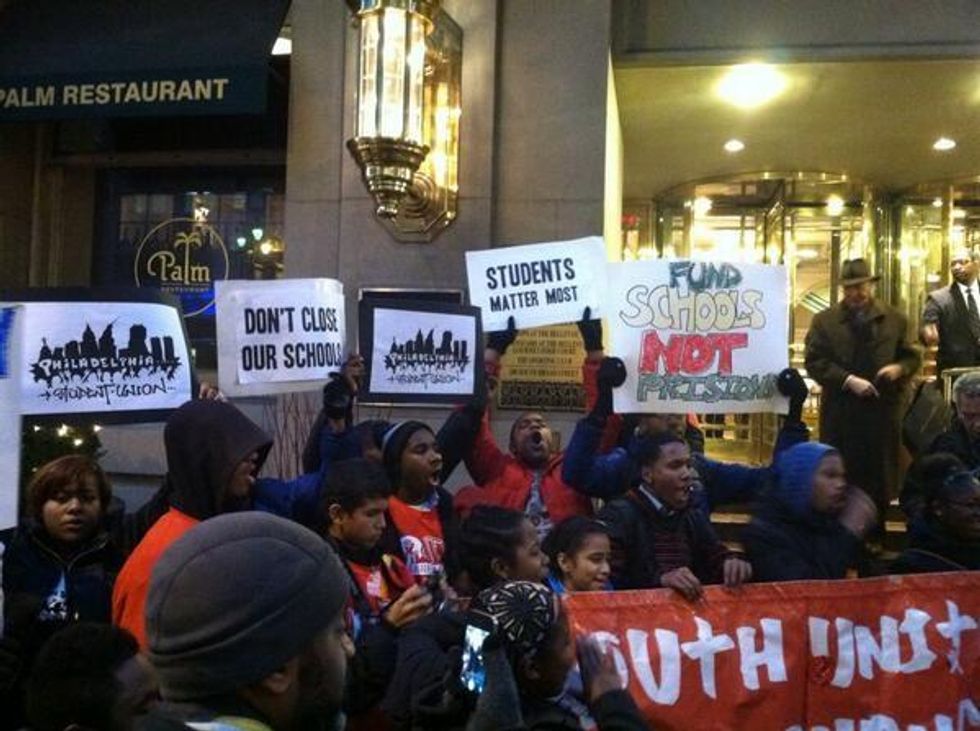
Billed as the largest yet national day of action to reclaim the promise of public education, and organized by racial and economic justice organizations and labor unions in cities across the country, the series of events aims to introduce a counter-narrative and political push-back to the corporate-backed "education reform" platform that has dominated policy throughout the presidential terms of both George W. Bush and Barack Obama.
"We need to put the public back into public education," said Kia Philpot-Hinton, Philadelphia parent and organizer with the 32,000 member organization Action United, in an interview with Common Dreams. "Corporate reform is not the way. We need to focus on the needs of the children and make sure every child has a quality education."
The coalition says Monday's show of unity is part of a growing movement against the nationally coordinated and top-down policies epitomized in high stakes, standardized testing programs like Common Core, as well as mass public school closures, privatization, and education worker lay-offs in Chicago, Philadelphia, and elsewhere. Such policies devastate all students, critics charge, hitting poor students and communities of color the hardest. According to a WBEZ Chicago report from March, at least 80 percent of the Chicago students affected by school closures and consolidations are African-American, and 87 percent of schools being shut down are majority African-American.
"We deserve better," said Sharron Snyder, Philadelphia high school senior and organizer with the Philadelphia Student Union, in an interview with Common Dreams. "I don't like how they are taking money from our education."
Philpot-Hinton explained that Philadelphia parents, workers, and students will march from the Philadelphia governor's office to the Loop Capital building, an Illinois-based bank that critics charge gave bad loans that had a hand in de-funding and shuttering Philadelphia's public schools. "We're coming together--neighbors, teachers, and students--to say 'no more.' We need to make our schools better," she said.
In Austin, Texas, community organizations and teachers' unions held a march and rally from the capitol demanding public schools invest in Texas students.
New Orleans will see a series of teach-ins aimed at mobilizing community members to reflect and take action on the loss of local control of schooling.
Chicago organizers will sing Christmas carols at City Hall about the gutting of the city's public schools that severely penalizes poor people and communities of color.
Employing Twitter, participants in the day of action are using the #ReclaimPublicEd hashtag to provide reports and photographs of protests, most of which were scheduled for after-school hours:
Tweets about "#ReclaimPublicEd"
In an October precursor to the day of action, over 100 community organizations and unions joined forces around five key principles (pdf) demanding the preservation and resourcing of public education:
According to Jeffrey Bryant, an associate fellow at Campaign for America's Future and editor of the recently launched Education Opportunity Network, "There is now widespread common understanding that top-down reforms are products of a market-based philosophy - emphasizing competition rather then collaboration, and winners and losers - in which those who are most vulnerable will become collateral damage."
"The Day of Action is important because young people are under attack when it comes to public education," said Baltimore-based Tre Murphy, an 18-year-old high school senior, in an interview with The Root. "We have found that the educational decision-makers do not value the thoughts and opinions of young people. That creates a critical gap when it comes to making decisions about our future."
"I think we have to change the narrative and mindset that parents and community members are consumers of public education, when in fact we are the owners," said Daniel del Pielago, an education organizer for Empower DC in Washington, D.C., according to an American Federation of Teachers statement. "Our voices need to be heard at all levels, and I think the Day of Action is the springboard for us to begin working together in a more deliberate way and to say to those who would divide us that this is a new day and that we're going to take back and improve our schools."
_____________________
Billed as the largest yet national day of action to reclaim the promise of public education, and organized by racial and economic justice organizations and labor unions in cities across the country, the series of events aims to introduce a counter-narrative and political push-back to the corporate-backed "education reform" platform that has dominated policy throughout the presidential terms of both George W. Bush and Barack Obama.
"We need to put the public back into public education," said Kia Philpot-Hinton, Philadelphia parent and organizer with the 32,000 member organization Action United, in an interview with Common Dreams. "Corporate reform is not the way. We need to focus on the needs of the children and make sure every child has a quality education."
The coalition says Monday's show of unity is part of a growing movement against the nationally coordinated and top-down policies epitomized in high stakes, standardized testing programs like Common Core, as well as mass public school closures, privatization, and education worker lay-offs in Chicago, Philadelphia, and elsewhere. Such policies devastate all students, critics charge, hitting poor students and communities of color the hardest. According to a WBEZ Chicago report from March, at least 80 percent of the Chicago students affected by school closures and consolidations are African-American, and 87 percent of schools being shut down are majority African-American.
"We deserve better," said Sharron Snyder, Philadelphia high school senior and organizer with the Philadelphia Student Union, in an interview with Common Dreams. "I don't like how they are taking money from our education."
Philpot-Hinton explained that Philadelphia parents, workers, and students will march from the Philadelphia governor's office to the Loop Capital building, an Illinois-based bank that critics charge gave bad loans that had a hand in de-funding and shuttering Philadelphia's public schools. "We're coming together--neighbors, teachers, and students--to say 'no more.' We need to make our schools better," she said.
In Austin, Texas, community organizations and teachers' unions held a march and rally from the capitol demanding public schools invest in Texas students.
New Orleans will see a series of teach-ins aimed at mobilizing community members to reflect and take action on the loss of local control of schooling.
Chicago organizers will sing Christmas carols at City Hall about the gutting of the city's public schools that severely penalizes poor people and communities of color.
Employing Twitter, participants in the day of action are using the #ReclaimPublicEd hashtag to provide reports and photographs of protests, most of which were scheduled for after-school hours:
Tweets about "#ReclaimPublicEd"
In an October precursor to the day of action, over 100 community organizations and unions joined forces around five key principles (pdf) demanding the preservation and resourcing of public education:
According to Jeffrey Bryant, an associate fellow at Campaign for America's Future and editor of the recently launched Education Opportunity Network, "There is now widespread common understanding that top-down reforms are products of a market-based philosophy - emphasizing competition rather then collaboration, and winners and losers - in which those who are most vulnerable will become collateral damage."
"The Day of Action is important because young people are under attack when it comes to public education," said Baltimore-based Tre Murphy, an 18-year-old high school senior, in an interview with The Root. "We have found that the educational decision-makers do not value the thoughts and opinions of young people. That creates a critical gap when it comes to making decisions about our future."
"I think we have to change the narrative and mindset that parents and community members are consumers of public education, when in fact we are the owners," said Daniel del Pielago, an education organizer for Empower DC in Washington, D.C., according to an American Federation of Teachers statement. "Our voices need to be heard at all levels, and I think the Day of Action is the springboard for us to begin working together in a more deliberate way and to say to those who would divide us that this is a new day and that we're going to take back and improve our schools."
_____________________
Billed as the largest yet national day of action to reclaim the promise of public education, and organized by racial and economic justice organizations and labor unions in cities across the country, the series of events aims to introduce a counter-narrative and political push-back to the corporate-backed "education reform" platform that has dominated policy throughout the presidential terms of both George W. Bush and Barack Obama.
"We need to put the public back into public education," said Kia Philpot-Hinton, Philadelphia parent and organizer with the 32,000 member organization Action United, in an interview with Common Dreams. "Corporate reform is not the way. We need to focus on the needs of the children and make sure every child has a quality education."
The coalition says Monday's show of unity is part of a growing movement against the nationally coordinated and top-down policies epitomized in high stakes, standardized testing programs like Common Core, as well as mass public school closures, privatization, and education worker lay-offs in Chicago, Philadelphia, and elsewhere. Such policies devastate all students, critics charge, hitting poor students and communities of color the hardest. According to a WBEZ Chicago report from March, at least 80 percent of the Chicago students affected by school closures and consolidations are African-American, and 87 percent of schools being shut down are majority African-American.
"We deserve better," said Sharron Snyder, Philadelphia high school senior and organizer with the Philadelphia Student Union, in an interview with Common Dreams. "I don't like how they are taking money from our education."
Philpot-Hinton explained that Philadelphia parents, workers, and students will march from the Philadelphia governor's office to the Loop Capital building, an Illinois-based bank that critics charge gave bad loans that had a hand in de-funding and shuttering Philadelphia's public schools. "We're coming together--neighbors, teachers, and students--to say 'no more.' We need to make our schools better," she said.
In Austin, Texas, community organizations and teachers' unions held a march and rally from the capitol demanding public schools invest in Texas students.
New Orleans will see a series of teach-ins aimed at mobilizing community members to reflect and take action on the loss of local control of schooling.
Chicago organizers will sing Christmas carols at City Hall about the gutting of the city's public schools that severely penalizes poor people and communities of color.
Employing Twitter, participants in the day of action are using the #ReclaimPublicEd hashtag to provide reports and photographs of protests, most of which were scheduled for after-school hours:
Tweets about "#ReclaimPublicEd"
In an October precursor to the day of action, over 100 community organizations and unions joined forces around five key principles (pdf) demanding the preservation and resourcing of public education:
According to Jeffrey Bryant, an associate fellow at Campaign for America's Future and editor of the recently launched Education Opportunity Network, "There is now widespread common understanding that top-down reforms are products of a market-based philosophy - emphasizing competition rather then collaboration, and winners and losers - in which those who are most vulnerable will become collateral damage."
"The Day of Action is important because young people are under attack when it comes to public education," said Baltimore-based Tre Murphy, an 18-year-old high school senior, in an interview with The Root. "We have found that the educational decision-makers do not value the thoughts and opinions of young people. That creates a critical gap when it comes to making decisions about our future."
"I think we have to change the narrative and mindset that parents and community members are consumers of public education, when in fact we are the owners," said Daniel del Pielago, an education organizer for Empower DC in Washington, D.C., according to an American Federation of Teachers statement. "Our voices need to be heard at all levels, and I think the Day of Action is the springboard for us to begin working together in a more deliberate way and to say to those who would divide us that this is a new day and that we're going to take back and improve our schools."
_____________________

