SUBSCRIBE TO OUR FREE NEWSLETTER
Daily news & progressive opinion—funded by the people, not the corporations—delivered straight to your inbox.
5
#000000
#FFFFFF
To donate by check, phone, or other method, see our More Ways to Give page.
On Tuesday in Detroit, a bankruptcy judge ruled that city pensioners can have their earned benefits cut as he approved the largest municipal bankruptcy in the state's history.
Also on Tuesday, the state of Illinois passed a measure that dramatically alters the pension formula for retired workers and diminishes those benefit programs for current and future public employees.
Both were seen by organized labor and workers advocates as an attack on those who played by the rules in order to fix the financial mess of governments that continually bow to the tax demands of corporations and the wealthy.
"It's bitterly ironic that, on the same day legislators used the state's troubled finances to justify stealing the retirement savings of public servants, they approved millions of dollars in new tax giveaways for big corporations," said the 'We Are One Illinois' union coalition following the passage of Senate Bill 1 in the state's General Assembly.
"This is no victory for Illinois, but a dark day for its citizens and public servants," the group said.
Meanwhile, in an expansive piece in the New York Times on Wednesday, titled "Americanized Labor Policy Is Spreading in Europe," Eduardo Porter explains how European governments and policy makers--by following the U.S. example of cancelling collective bargaining protections, attacking pensions, and slashing wages--are not only expanding income and wealth inequality but are "radically changing the nature of Europe's society."
According to Porter:
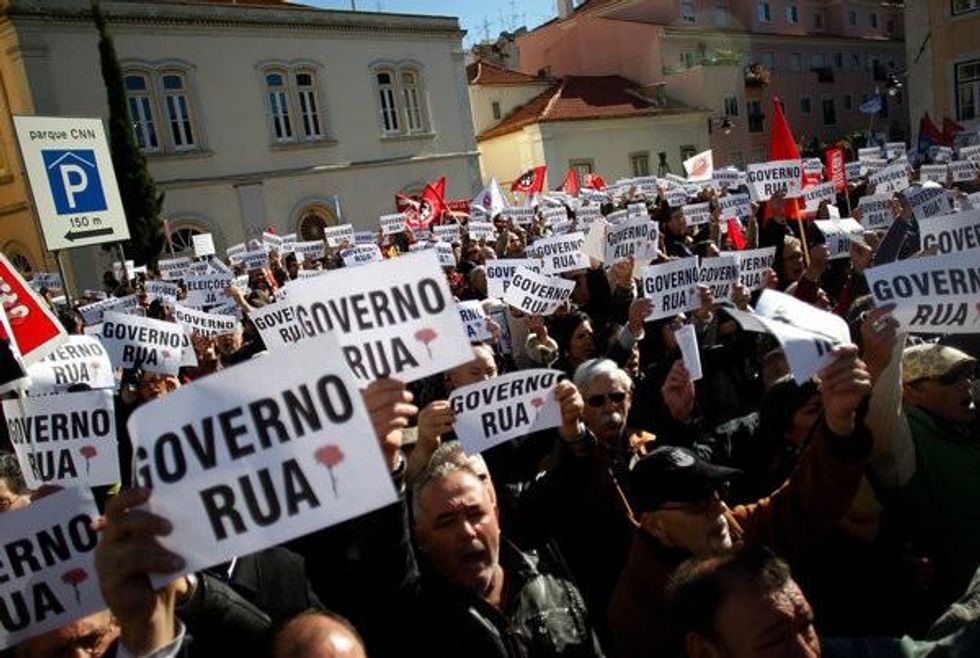
In 2008, 1.9 million Portuguese workers in the private sector were covered by collective bargaining agreements. Last year, the number was down to 300,000.
Spain has eased restrictions on collective layoffs and unfair dismissal, and softened limits on extending temporary work, allowing workers to be kept on fixed-term contracts for up to four years. Ireland and Portugal have frozen the minimum wage, while Greece has cut it by nearly a fourth. This is what is known in Europe as "internal devaluation."
Tethered to the euro and thus unable to devalue their currency to help make their goods less expensive in export markets, many European countries -- especially those along the Continent's southern rim that have been hammered by the financial crisis -- have been furiously dismantling workplace protections in a bid to reduce the cost of labor.
And the result of these developments?
Andrew Watt, an economist who heads the Macroeconomic Policy Institute in Germany, worries that the push for labor market deregulation will cascade from one weak country to the next, as all engage in a futile race to create jobs by gaining market share from one another in a world of insufficient demand. "Whichever country is weakest at the time is forced into major cutbacks. First Germany, now Spain, next France," he said.
"I am concerned about the longer-run costs," Mr. Watt added. "It is hard to rebuild collective bargaining and welfare-state structures once they have been destroyed."
Lowell Turner, who heads the Worker Institute at Cornell University, argues that there has always been a tension between the European Union's economic project -- centered on creating a vast single market -- and the Continent's deep-rooted commitment to social equity. The crisis put a thumb on the scales. "For a year or two governments protected their workers," he said. But "the balance has tipped away from social Europe."
The irony, of course, is that as a populist insurgency by low-wage workers, labor unions, and progressive activists in the U.S. tries to push for a stronger social compact--including a growing movement to significantly raise the federal the minimum wage and efforts to increase workplace protections--some of their best models for those systems remain those built by the long struggles of workers in the same European countries where workers are now under heavy attack.
As the global financial elite push their agenda on all the continents, it seems that the race to the bottom is no longer an idiom reserved for the world's least developed countries. And according to Porter's reporting, "Americanization"--especially in the context of Detroit, Illinois, and other hard hit areas--is now a phrase that stands as a warning, not a beacon, to the world's economies.
________________________________________
On Tuesday in Detroit, a bankruptcy judge ruled that city pensioners can have their earned benefits cut as he approved the largest municipal bankruptcy in the state's history.
Also on Tuesday, the state of Illinois passed a measure that dramatically alters the pension formula for retired workers and diminishes those benefit programs for current and future public employees.
Both were seen by organized labor and workers advocates as an attack on those who played by the rules in order to fix the financial mess of governments that continually bow to the tax demands of corporations and the wealthy.
"It's bitterly ironic that, on the same day legislators used the state's troubled finances to justify stealing the retirement savings of public servants, they approved millions of dollars in new tax giveaways for big corporations," said the 'We Are One Illinois' union coalition following the passage of Senate Bill 1 in the state's General Assembly.
"This is no victory for Illinois, but a dark day for its citizens and public servants," the group said.
Meanwhile, in an expansive piece in the New York Times on Wednesday, titled "Americanized Labor Policy Is Spreading in Europe," Eduardo Porter explains how European governments and policy makers--by following the U.S. example of cancelling collective bargaining protections, attacking pensions, and slashing wages--are not only expanding income and wealth inequality but are "radically changing the nature of Europe's society."
According to Porter:
In 2008, 1.9 million Portuguese workers in the private sector were covered by collective bargaining agreements. Last year, the number was down to 300,000.
Spain has eased restrictions on collective layoffs and unfair dismissal, and softened limits on extending temporary work, allowing workers to be kept on fixed-term contracts for up to four years. Ireland and Portugal have frozen the minimum wage, while Greece has cut it by nearly a fourth. This is what is known in Europe as "internal devaluation."
Tethered to the euro and thus unable to devalue their currency to help make their goods less expensive in export markets, many European countries -- especially those along the Continent's southern rim that have been hammered by the financial crisis -- have been furiously dismantling workplace protections in a bid to reduce the cost of labor.
And the result of these developments?
Andrew Watt, an economist who heads the Macroeconomic Policy Institute in Germany, worries that the push for labor market deregulation will cascade from one weak country to the next, as all engage in a futile race to create jobs by gaining market share from one another in a world of insufficient demand. "Whichever country is weakest at the time is forced into major cutbacks. First Germany, now Spain, next France," he said.
"I am concerned about the longer-run costs," Mr. Watt added. "It is hard to rebuild collective bargaining and welfare-state structures once they have been destroyed."
Lowell Turner, who heads the Worker Institute at Cornell University, argues that there has always been a tension between the European Union's economic project -- centered on creating a vast single market -- and the Continent's deep-rooted commitment to social equity. The crisis put a thumb on the scales. "For a year or two governments protected their workers," he said. But "the balance has tipped away from social Europe."
The irony, of course, is that as a populist insurgency by low-wage workers, labor unions, and progressive activists in the U.S. tries to push for a stronger social compact--including a growing movement to significantly raise the federal the minimum wage and efforts to increase workplace protections--some of their best models for those systems remain those built by the long struggles of workers in the same European countries where workers are now under heavy attack.
As the global financial elite push their agenda on all the continents, it seems that the race to the bottom is no longer an idiom reserved for the world's least developed countries. And according to Porter's reporting, "Americanization"--especially in the context of Detroit, Illinois, and other hard hit areas--is now a phrase that stands as a warning, not a beacon, to the world's economies.
________________________________________
On Tuesday in Detroit, a bankruptcy judge ruled that city pensioners can have their earned benefits cut as he approved the largest municipal bankruptcy in the state's history.
Also on Tuesday, the state of Illinois passed a measure that dramatically alters the pension formula for retired workers and diminishes those benefit programs for current and future public employees.
Both were seen by organized labor and workers advocates as an attack on those who played by the rules in order to fix the financial mess of governments that continually bow to the tax demands of corporations and the wealthy.
"It's bitterly ironic that, on the same day legislators used the state's troubled finances to justify stealing the retirement savings of public servants, they approved millions of dollars in new tax giveaways for big corporations," said the 'We Are One Illinois' union coalition following the passage of Senate Bill 1 in the state's General Assembly.
"This is no victory for Illinois, but a dark day for its citizens and public servants," the group said.
Meanwhile, in an expansive piece in the New York Times on Wednesday, titled "Americanized Labor Policy Is Spreading in Europe," Eduardo Porter explains how European governments and policy makers--by following the U.S. example of cancelling collective bargaining protections, attacking pensions, and slashing wages--are not only expanding income and wealth inequality but are "radically changing the nature of Europe's society."
According to Porter:
In 2008, 1.9 million Portuguese workers in the private sector were covered by collective bargaining agreements. Last year, the number was down to 300,000.
Spain has eased restrictions on collective layoffs and unfair dismissal, and softened limits on extending temporary work, allowing workers to be kept on fixed-term contracts for up to four years. Ireland and Portugal have frozen the minimum wage, while Greece has cut it by nearly a fourth. This is what is known in Europe as "internal devaluation."
Tethered to the euro and thus unable to devalue their currency to help make their goods less expensive in export markets, many European countries -- especially those along the Continent's southern rim that have been hammered by the financial crisis -- have been furiously dismantling workplace protections in a bid to reduce the cost of labor.
And the result of these developments?
Andrew Watt, an economist who heads the Macroeconomic Policy Institute in Germany, worries that the push for labor market deregulation will cascade from one weak country to the next, as all engage in a futile race to create jobs by gaining market share from one another in a world of insufficient demand. "Whichever country is weakest at the time is forced into major cutbacks. First Germany, now Spain, next France," he said.
"I am concerned about the longer-run costs," Mr. Watt added. "It is hard to rebuild collective bargaining and welfare-state structures once they have been destroyed."
Lowell Turner, who heads the Worker Institute at Cornell University, argues that there has always been a tension between the European Union's economic project -- centered on creating a vast single market -- and the Continent's deep-rooted commitment to social equity. The crisis put a thumb on the scales. "For a year or two governments protected their workers," he said. But "the balance has tipped away from social Europe."
The irony, of course, is that as a populist insurgency by low-wage workers, labor unions, and progressive activists in the U.S. tries to push for a stronger social compact--including a growing movement to significantly raise the federal the minimum wage and efforts to increase workplace protections--some of their best models for those systems remain those built by the long struggles of workers in the same European countries where workers are now under heavy attack.
As the global financial elite push their agenda on all the continents, it seems that the race to the bottom is no longer an idiom reserved for the world's least developed countries. And according to Porter's reporting, "Americanization"--especially in the context of Detroit, Illinois, and other hard hit areas--is now a phrase that stands as a warning, not a beacon, to the world's economies.
________________________________________