SUBSCRIBE TO OUR FREE NEWSLETTER
Daily news & progressive opinion—funded by the people, not the corporations—delivered straight to your inbox.
5
#000000
#FFFFFF
To donate by check, phone, or other method, see our More Ways to Give page.
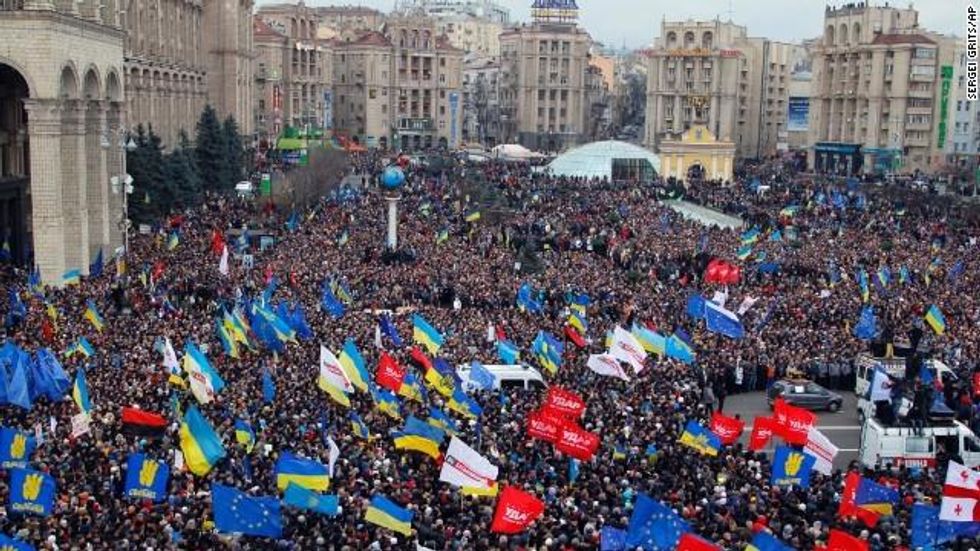
The hundreds of thousands of street demonstrators who took to the streets across Ukraine on Sunday showed no signs of letting up as their calls for 'revolution' against the government of President Viktor Yanukovych were matched with strategic seizures of ground in the nation's capital of Kiev on Monday.
Kiev's Independent Square, according to reports, is now under the full control of the protesters who have set up barricades protecting the central gathering area. Meanwhile, key government offices came under occupation overnight with protesters setting up a makeshift headquarters inside city hall and government workers have been barred from entering their workplaces.
As the Guardian reports:
On Monday morning, as Kiev began its working week, tension was high as both ordinary people and opposition leaders were left guessing how events might unfold. Hundreds of protesters took up positions blocking entrances to government buildings to stop officials from getting to work, while others blocked off whole streets. Many of the people who spent the night in the two government buildings that were seized by protesters insisted they would not leave until the government falls.
In the western city of Lviv, stronghold of pro-European forces, the regional authorities announced a general strike on Monday.
The key political opposition to Yanukovych, such as the jailed former prime minister Yulia Tymoshenko and the heavyweight boxer Vitali Klitschko, have called on their supporters to refrain from violence but not to go home.
"This government is clearly over," said Vladimir Luchishin, 60, from Donetsk, who was sleeping at city hall, having arrived on Sunday. "If they try to fight back with force, it will only make things worse for them."
Police have retreated from most of the centre of Kiev but cordons of riot police remained in position, guarding the Presidential Administration - the scene of violent clashes on Sunday in which more than 100 police were injured. On Monday morning, the interior ministry said a total of 150 riot police and other officials had been injured, while 165 protesters had been injured, 109 of which required some kind of hospital treatment.
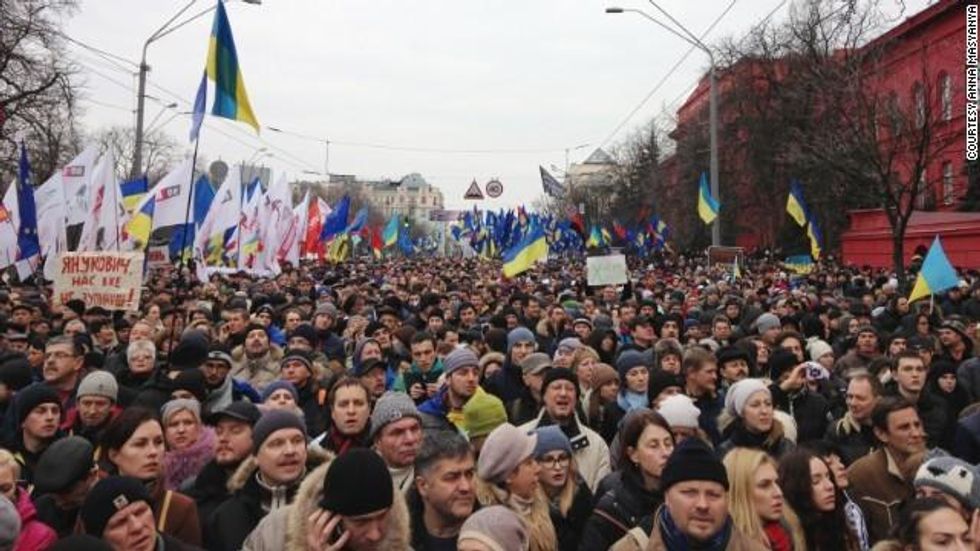
The calls for 'revolution' have mostly remained peaceful, with the majority of the large crowd speaking out against the violence that has occurred at the margins of their protests as ultra-rightwing nationalists have used the occasion of the protests to attack police, using petrol bombs, rocks, and other weapons in an effort to incite a violent response. Some peaceful anti-government protesters on Sunday put themselves between the violent, masked provocateurs and a line of riot police who had taken up a defensive position.
"We should not be provoked. There are a lot of provocateurs. We can change the power in a civilized way. Our rally in Kiev today is a peaceful protest only," said heavyweight boxer Vitali Klitchko--a member of parliament, one of the most famous people in Ukraine and a supporter of the revolution--told people during a speech in the square on Sunday.
Klitchko is only one of many of Ukrainian lawmakers siding with the protesters and as negotiations continue behind closed doors on the government response, the life of the protest movement is making progress of its own.
As the New York Times reports:
Inna Bohoslovska, a member of Parliament who has quit Mr. Yanukovich's Party of Regions in support of the demonstrators, called on Monday for the government to resign. Demonstrators also continued to occupy City Hall in Kiev, where windows had been smashed and walls covered with graffiti. Under a sign for the Kiev City Council, someone had painted in black: "Revolution Headquarters."
After a huge rally on Sunday -- a crowd estimated at a million or more that observers said exceeded even the largest gatherings of the Orange Revolution nine years ago -- the demonstrators overnight blocked city streets, using Christmas decorations and police barricades intended to stop the protest.
The result was an oddly festive, fir-trimmed encampment at the heart of the Ukrainian capital. Protest leaders, sensing that momentum had turned to their advantage, continued to add infrastructure to their operation, bringing in television monitors and erecting a small tent city that included first-aid stations and canteens.
Having occupied the nearby Trade Unions building on Sunday, they seized control of a giant screen mounted on its facade, and replaced the advertising it had carried -- first with images of the yellow-starred European Union flag, and by Monday morning with a live video feed of speakers on the protest stage outside.
The hundreds of thousands of street demonstrators who took to the streets across Ukraine on Sunday showed no signs of letting up as their calls for 'revolution' against the government of President Viktor Yanukovych were matched with strategic seizures of ground in the nation's capital of Kiev on Monday.
Kiev's Independent Square, according to reports, is now under the full control of the protesters who have set up barricades protecting the central gathering area. Meanwhile, key government offices came under occupation overnight with protesters setting up a makeshift headquarters inside city hall and government workers have been barred from entering their workplaces.
As the Guardian reports:
On Monday morning, as Kiev began its working week, tension was high as both ordinary people and opposition leaders were left guessing how events might unfold. Hundreds of protesters took up positions blocking entrances to government buildings to stop officials from getting to work, while others blocked off whole streets. Many of the people who spent the night in the two government buildings that were seized by protesters insisted they would not leave until the government falls.
In the western city of Lviv, stronghold of pro-European forces, the regional authorities announced a general strike on Monday.
The key political opposition to Yanukovych, such as the jailed former prime minister Yulia Tymoshenko and the heavyweight boxer Vitali Klitschko, have called on their supporters to refrain from violence but not to go home.
"This government is clearly over," said Vladimir Luchishin, 60, from Donetsk, who was sleeping at city hall, having arrived on Sunday. "If they try to fight back with force, it will only make things worse for them."
Police have retreated from most of the centre of Kiev but cordons of riot police remained in position, guarding the Presidential Administration - the scene of violent clashes on Sunday in which more than 100 police were injured. On Monday morning, the interior ministry said a total of 150 riot police and other officials had been injured, while 165 protesters had been injured, 109 of which required some kind of hospital treatment.
The calls for 'revolution' have mostly remained peaceful, with the majority of the large crowd speaking out against the violence that has occurred at the margins of their protests as ultra-rightwing nationalists have used the occasion of the protests to attack police, using petrol bombs, rocks, and other weapons in an effort to incite a violent response. Some peaceful anti-government protesters on Sunday put themselves between the violent, masked provocateurs and a line of riot police who had taken up a defensive position.
"We should not be provoked. There are a lot of provocateurs. We can change the power in a civilized way. Our rally in Kiev today is a peaceful protest only," said heavyweight boxer Vitali Klitchko--a member of parliament, one of the most famous people in Ukraine and a supporter of the revolution--told people during a speech in the square on Sunday.
Klitchko is only one of many of Ukrainian lawmakers siding with the protesters and as negotiations continue behind closed doors on the government response, the life of the protest movement is making progress of its own.
As the New York Times reports:
Inna Bohoslovska, a member of Parliament who has quit Mr. Yanukovich's Party of Regions in support of the demonstrators, called on Monday for the government to resign. Demonstrators also continued to occupy City Hall in Kiev, where windows had been smashed and walls covered with graffiti. Under a sign for the Kiev City Council, someone had painted in black: "Revolution Headquarters."
After a huge rally on Sunday -- a crowd estimated at a million or more that observers said exceeded even the largest gatherings of the Orange Revolution nine years ago -- the demonstrators overnight blocked city streets, using Christmas decorations and police barricades intended to stop the protest.
The result was an oddly festive, fir-trimmed encampment at the heart of the Ukrainian capital. Protest leaders, sensing that momentum had turned to their advantage, continued to add infrastructure to their operation, bringing in television monitors and erecting a small tent city that included first-aid stations and canteens.
Having occupied the nearby Trade Unions building on Sunday, they seized control of a giant screen mounted on its facade, and replaced the advertising it had carried -- first with images of the yellow-starred European Union flag, and by Monday morning with a live video feed of speakers on the protest stage outside.
The hundreds of thousands of street demonstrators who took to the streets across Ukraine on Sunday showed no signs of letting up as their calls for 'revolution' against the government of President Viktor Yanukovych were matched with strategic seizures of ground in the nation's capital of Kiev on Monday.
Kiev's Independent Square, according to reports, is now under the full control of the protesters who have set up barricades protecting the central gathering area. Meanwhile, key government offices came under occupation overnight with protesters setting up a makeshift headquarters inside city hall and government workers have been barred from entering their workplaces.
As the Guardian reports:
On Monday morning, as Kiev began its working week, tension was high as both ordinary people and opposition leaders were left guessing how events might unfold. Hundreds of protesters took up positions blocking entrances to government buildings to stop officials from getting to work, while others blocked off whole streets. Many of the people who spent the night in the two government buildings that were seized by protesters insisted they would not leave until the government falls.
In the western city of Lviv, stronghold of pro-European forces, the regional authorities announced a general strike on Monday.
The key political opposition to Yanukovych, such as the jailed former prime minister Yulia Tymoshenko and the heavyweight boxer Vitali Klitschko, have called on their supporters to refrain from violence but not to go home.
"This government is clearly over," said Vladimir Luchishin, 60, from Donetsk, who was sleeping at city hall, having arrived on Sunday. "If they try to fight back with force, it will only make things worse for them."
Police have retreated from most of the centre of Kiev but cordons of riot police remained in position, guarding the Presidential Administration - the scene of violent clashes on Sunday in which more than 100 police were injured. On Monday morning, the interior ministry said a total of 150 riot police and other officials had been injured, while 165 protesters had been injured, 109 of which required some kind of hospital treatment.
The calls for 'revolution' have mostly remained peaceful, with the majority of the large crowd speaking out against the violence that has occurred at the margins of their protests as ultra-rightwing nationalists have used the occasion of the protests to attack police, using petrol bombs, rocks, and other weapons in an effort to incite a violent response. Some peaceful anti-government protesters on Sunday put themselves between the violent, masked provocateurs and a line of riot police who had taken up a defensive position.
"We should not be provoked. There are a lot of provocateurs. We can change the power in a civilized way. Our rally in Kiev today is a peaceful protest only," said heavyweight boxer Vitali Klitchko--a member of parliament, one of the most famous people in Ukraine and a supporter of the revolution--told people during a speech in the square on Sunday.
Klitchko is only one of many of Ukrainian lawmakers siding with the protesters and as negotiations continue behind closed doors on the government response, the life of the protest movement is making progress of its own.
As the New York Times reports:
Inna Bohoslovska, a member of Parliament who has quit Mr. Yanukovich's Party of Regions in support of the demonstrators, called on Monday for the government to resign. Demonstrators also continued to occupy City Hall in Kiev, where windows had been smashed and walls covered with graffiti. Under a sign for the Kiev City Council, someone had painted in black: "Revolution Headquarters."
After a huge rally on Sunday -- a crowd estimated at a million or more that observers said exceeded even the largest gatherings of the Orange Revolution nine years ago -- the demonstrators overnight blocked city streets, using Christmas decorations and police barricades intended to stop the protest.
The result was an oddly festive, fir-trimmed encampment at the heart of the Ukrainian capital. Protest leaders, sensing that momentum had turned to their advantage, continued to add infrastructure to their operation, bringing in television monitors and erecting a small tent city that included first-aid stations and canteens.
Having occupied the nearby Trade Unions building on Sunday, they seized control of a giant screen mounted on its facade, and replaced the advertising it had carried -- first with images of the yellow-starred European Union flag, and by Monday morning with a live video feed of speakers on the protest stage outside.